
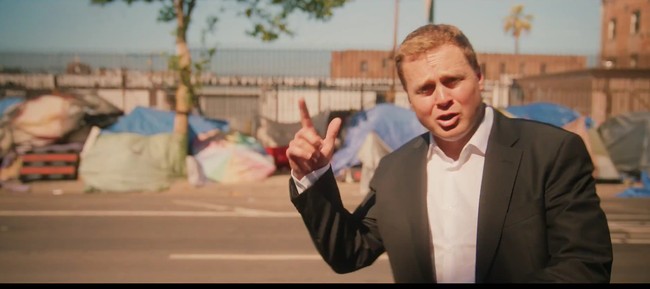
Spencer Pratt has launched The WAR Foundation to challenge Los Angeles’ political establishment, aiming to spotlight corruption, failed leadership, and what he calls a profit-driven network of politicians and nonprofits that leave the city worse off.
Pratt is taking a direct, confrontational approach that mixes documentary-style video with media outreach to pressure local leaders and institutions. He frames the foundation as a continuation of his mayoral effort, shifting from campaigning to sustained public exposure. The message is clear: this is about accountability and changing how power is exercised in the city.
The foundation’s stated goals are blunt and partisan in tone: expose corruption, push transparency and accountability, and “restore common sense” while pushing back against socialism in important institutions. That language is meant to resonate with voters frustrated by visible decline, and it telegraphs a skeptical view of entrenched nonprofits and consultants. Pratt’s critics will scoff, but the strategy banks on tapping public anger at visible decline and structural waste.
https://x.com/spencerpratt/status/2074573485637046646
Together, we will:
Win the war against political corruption with innovative new media.
Advocate for transparency, accountability, and integrity in government and culture.
Restore common sense and roll back the long march of socialism through our vital institutions.
The video Pratt released with the launch is raw, unsparing, and meant to look and feel like on-the-ground reporting rather than polished campaign ads. It opens with rapid clips, claims about viral reach, and then moves into a litany of urban decay that viewers recognize from day-to-day life. Pratt narrates in a voice that contrasts sharply with official assurances, aiming to make the city’s problems feel immediate and personal.
“Now that the campaign portion of my mission to save Los Angeles is coming to a close, and I’m moving on to the next, more interesting phase. You have no idea how bad things are about to get for this city. More of your favorite restaurants will be shuttering, that means less tax revenue, that means the city has to cut services, more potholes, less firefighters, less police patrols, more criminals, more drug addicts terrorizing your communities.”
The argument is straightforward: shuttered businesses reduce tax revenue, which forces cuts to essentials and creates a spiral of decline that officials fail to stop. Pratt points fingers at the people who have enjoyed contracts, titles, and influence while offering plans that don’t fix the visible problems. He argues those same actors reap benefits from the crisis economy around public funding and nonprofit contracts.
“Look at this place already: weeds growing from every crack and crevice, graffiti over every square inch of public space, garbage, drugs, feces, burned-up dogs, burned-down towns, abandoned storefronts. The city is a mess, all while corrupt politicians and fraudulent NGOs profit off the misery and fleece us for the tax dollars.”
Pratt promises a steady stream of investigative, cinematic pieces that aim to pull back the curtain on what he calls a corrupt municipal machine. The format borrows from grassroots media playbooks: short, punchy narratives that are easy to share and hard for the establishment to ignore. Whether that approach leads to concrete reforms or simply fuels outrage depends on how deeply his reporting connects with residents and local accountability mechanisms.
“I didn’t get in this for political power, I got in this to expose this corrupt machine, and nothing has changed. Every week I’m going into the belly of the beast, bringing you hard-hitting cinematic documentaries exposing the fraud and corruption in California.”
Residents Pratt interviews describe firsthand scenes of decline: closed dining rooms, boarded storefronts, needles and discarded trash in public spaces, and harrowing accounts about bodies found on blocks. The video includes testimony that explicitly accuses actors inside City Hall of profiting from illicit activities tied to public programs. Those claims are incendiary and will draw demands for evidence and official responses.
Taking on a city’s political class is a tall order, and Pratt’s style guarantees he’ll be dismissed by many as a provocateur. Yet his critique lands where many taxpayers live: visible decline, indifferent official explanations, and the steady flow of contracts to intermediaries that produce little measurable improvement. The WAR Foundation positions itself as the kind of watchdog that treats appearance and outcomes as proof points that voters can see for themselves.
Whether Pratt’s campaign-like media push translates into lasting institutional change remains to be seen, but his launch has already forced the conversation out of city hall and into neighborhoods. The coming weeks will show if cinematic exposes and public pressure can prod audits, investigations, or policy shifts, or if the dynamics of local governance will simply absorb another round of outrage. For now, Pratt has made it clear he intends to keep pressing with visibility and volume.



Add comment