
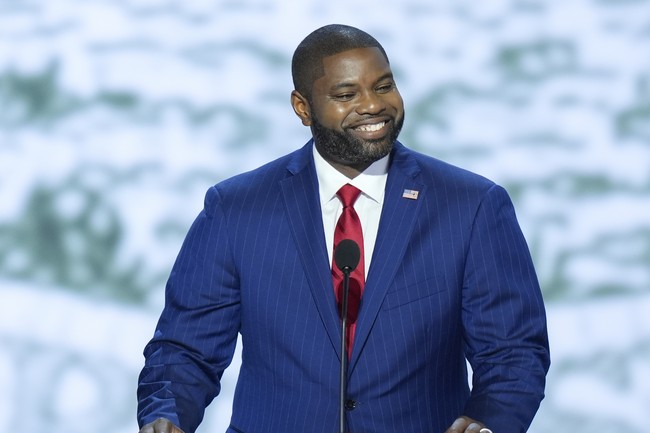
Florida Republicans have chosen Rep. Byron Donalds as their nominee to replace term-limited Gov. Ron DeSantis, setting up a November contest against Democrat David Jolly and handing the GOP a clear path to keep the governor’s office in conservative hands.
The Republican primary ended with Byron Donalds emerging as the dominant candidate out of a crowded field, finishing with roughly 49 percent of the vote. His nearest rival, Lt. Gov. Jay Collins, trailed by a wide margin, and other contenders split the remainder, leaving Donalds with a solid plurality that closed the nomination quickly and decisively.
Donalds’ victory reflects a party that coalesced around a candidate with national name recognition and an established connection to the base. That consolidation followed an early endorsement from former President Trump, a signal that helped frame the race and likely accelerated voters’ alignment behind Donalds.
https://x.com/DecisionDeskHQ/status/2089865493775573376
On the Democratic side, former Republican congressman David Jolly secured his party’s nomination, creating a general election match-up that pits a Republican standard-bearer against a high-profile party switcher. Jolly’s move from the GOP to the Democratic Party during the last several years provides a clear contrast between the two nominees and gives Republicans a narrative advantage on party loyalty and conservative governance.
Florida’s political trajectory has favored Republicans for years, and the state’s recent history bears that out in statewide results. The governorship has been in GOP hands through multiple cycles, and Donalds now inherits a statewide electorate that has grown increasingly comfortable with conservative leadership and policy priorities.
Beyond raw numbers, Donalds brings a campaign message that emphasizes continuity with the policies enacted under the previous administration while promising to push a conservative agenda tailored to Florida’s unique priorities. That approach resonates in a state where fiscal restraint, public safety, and a pro-growth regulatory stance remain top voter concerns.
The Democratic nominee faces long odds in a state that has not elected a Democrat governor since the 1990s, and national trends give Republicans advantages in down-ballot and statewide races. Still, general elections can surprise, and both campaigns are likely to drill into turnout strategies as November approaches.
Republicans see the result as a validation of their organizing strength and an opportunity to present a unified front in the general election. Donalds’ emergence from a crowded primary as the clear nominee simplifies fundraising and message discipline for the rest of the cycle, allowing the party to pivot resources toward outreach and voter mobilization.
Donald’s path to the nomination also revealed the value of endorsements and early positioning in a competitive primary. The campaign’s ability to translate endorsements into voter enthusiasm made a practical difference, converting name recognition into votes and enabling a quick path to the nomination without a costly runoff scenario.
Once seen as a swing state, Florida hasn’t elected a Democrat statewide since 2018 when Nikki Fried, the Florida Democratic Party chair, won agriculture commissioner. The last time a Democrat won the Sunshine State at the presidential level was in 2012 under former President Obama.
But it’s been even longer — more than three decades — since Florida’s elected a Democrat as its top executive, when Democrat Lawton Chiles narrowly won a second term against Republican Jeb Bush.
That historical context underlines why Republicans are optimistic about November. The GOP’s recent dominance in Florida gives the party confidence that a standard-bearer aligned with the state’s conservative shift can hold the governorship and continue shaping policy at the state level.
Strategically, Republicans will focus on delivering a message that ties Donalds to Florida’s successes in economic growth, job creation, and public safety, while casting the opponent as out of step with mainstream Florida voters. The campaign playbook will likely lean heavily on contrasts that highlight track records and policy differences.
For Democrats, the challenge will be convincing a broad swath of Florida voters to pivot away from the GOP’s recent winning themes and toward a different vision for the state. David Jolly’s profile as a former Republican turned Democrat gives him a unique pitch, but converting that into statewide support requires overcoming entrenched partisan dynamics.
As the calendar moves toward November, both campaigns will refine messaging, target swing counties, and marshal resources to maximize turnout. Republicans, buoyed by the primary outcome, appear well positioned to defend the governor’s office, while Democrats must make strategic choices to broaden their appeal in a state that has steadily moved rightward over the past decade.

Add comment