
The WNBA’s recent Fever-Dream game stirred controversy beyond the final score, with a security incident over shirts, a viral National Anthem moment by Sophie Cunningham, and visible political gestures from one team; this piece examines those events, the league’s inconsistent approach, and what they reveal about priorities and respect in professional sports.
Sunday’s Indiana Fever-Atlanta Dream matchup produced more than basketball highlights; it produced cultural flashpoints. A mother and daughter were told to cover up shirts that read “XX-XY” and “XX” with “For the Girls” on the back, a situation that drew immediate attention and pushback. That security intervention felt heavy-handed to many fans who simply saw a family expressing identity and support for women.
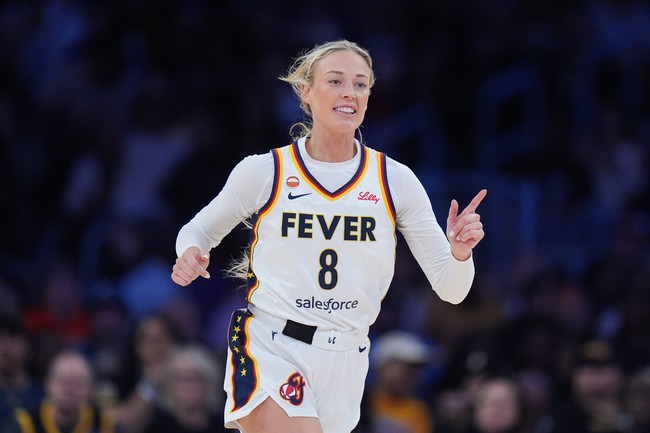
At the same time, Caitlin Clark’s on-court moment trolling Angel Reese became an instant meme, but it was Sophie Cunningham’s gesture during the National Anthem that struck a chord with a different crowd. Cunningham placed her hand over her heart while the anthem played, a plain and respectful act that many viewers praised. Those images spread fast and framed a contrast between simple patriotism and the league’s more complicated signals.
Not every team came onto the floor for the anthem, and the Atlanta Dream have made that choice before. The Fever stood on the court and showed respect; the Dream reportedly were not on the court at the time, choosing a different routine. That inconsistency puts fans in a tough spot: they buy tickets expecting a shared ritual, not a patchwork of personal or political statements.
The WNBA permits teams to pick their own pre-game routines, which gives individual clubs latitude but also creates a lack of uniform standards for moments that matter to many Americans. When a league allows such disparate approaches, it sends the message that performance and politics can outrank common courtesies. For viewers who see standing for the anthem as a minimum of respect, the behavior of some teams looks like a refusal to acknowledge a broad swath of the audience.
At the same time the Dream skipped parts of the anthem routine, they took time to recognize Stacey Abrams, a known political figure. That public acknowledgment read as an explicit political choice and reinforced the notion that the league and certain teams are comfortable mixing sports with partisan messaging. Fans who want sports to be a neutral public square may find that unsettling, especially when players or teams decide which civic rituals deserve attention and which do not.
The scene around the shirts and the anthem highlighted a broader problem: the WNBA often seems to prioritize performative gestures over consistent respect for traditions that unite most fans. Security policing a mother and daughter while political shout-outs get center stage suggests mixed priorities. That disconnect fuels criticism that the league is out of touch with supporters who value clear, straightforward respect for the flag and for families cheering from the stands.
Sophie Cunningham’s quiet, simple act—hand over heart as the anthem played—resonated because it was ordinary and sincere. In a season where grand gestures and loud statements are common, an unvarnished display of respect can feel refreshing and honest. Fans noticed and applauded that contrast, which only magnified questions about why the league tolerates varying approaches to the same moment.
https://x.com/BrickCenter_/status/2089566024383479943
There is also a consistency issue beyond optics: policy matters. If teams can opt out of standing together, then the league needs a clearer message about how it handles pre-game rituals and fan interactions. Security decisions, like ordering a child to cover a shirt, should be narrowly applied and explained; otherwise, they look arbitrary. Without transparent rules, the WNBA leaves itself open to accusations that it enforces some standards and ignores others based on politics or optics.
The Fever’s choice to stand and the reaction to the Dream’s actions show a split between players and fans over what professional sports should signal. Many viewers want to see athletes focus on the game and basic civic customs rather than become platforms for political theater. When a team uses a game to spotlight a politician, they cross into a territory that not all ticket holders signed up for.
In the end, episodes like this matter because they shape how the WNBA is perceived off the court. Simple acts of respect, predictable pre-game routines, and fair treatment of fans should be the baseline for any professional league. When those basics are uneven, controversies arise and the sport itself gets overshadowed by debates about priorities.
Fans and commentators will keep watching how the league responds, if it responds, and whether it chooses consistency over selective spectacle. The Fever’s posture and Cunningham’s visible respect are a reminder that small, unforced moments often speak louder than staged statements. Until the WNBA sets clearer expectations, these conflicts will keep bubbling up, drawing attention away from the play on the court.
Whatever the intentions behind the Dream’s choices, the interaction with fans over shirts and the selective public recognition of political figures make one thing clear: sports leagues are judgment-free spaces only when they decide to be. If the WNBA wants to widen its audience, it will need to align its actions with the simple norms most fans expect.

Add comment