
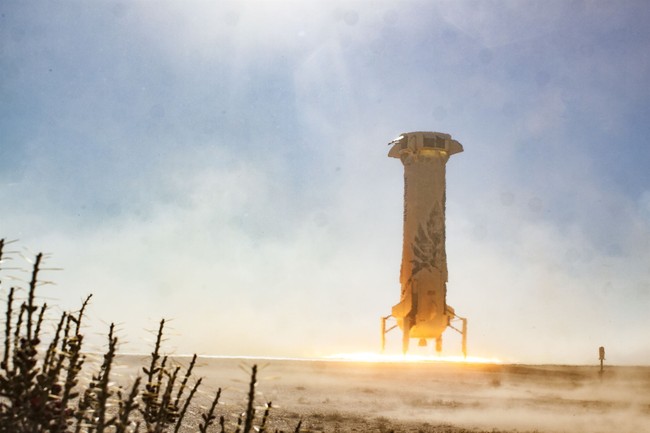
Jeff Bezos’ privately built New Glenn rocket experienced a dramatic failure during a ground test, producing a massive fireball but causing no injuries. The event sent viral video across social platforms, drew a terse note from Elon Musk — “Rockets are hard.” — and prompted calm, technical responses from industry figures stressing the inherent risks of heavy‑lift development. This article walks through the sequence of events, public reactions, and what the mishap underscores about modern launch programs.
Blue Origin’s New Glenn, a very large launch vehicle intended for heavy payloads and broadband satellite deployments, exploded during testing ahead of a planned mission. The vehicle had been undergoing prelaunch checks when a catastrophic structural or propulsion failure produced a towering plume of flame and debris. By any measure the blast was enormous, and the footage circulating online shows why people described it as almost nuclear in appearance.
Video of the event circulated widely almost immediately, and observers compared the blast to historic mishaps while noting the fortunate absence of injuries. The raw images make clear that even routine ground trials for large rockets are high stakes, since so much propellant and structural energy is involved. Investigators will have to reconstruct the sequence from telemetry, ground cameras, and sensor logs to determine the initiating fault.
https://x.com/nicksortor/status/2060170321383059562
Amateur and professional videos of the explosion spread quickly, adding public pressure for a prompt explanation while also giving experts more visual data to analyze. Those clips will be useful to engineers studying plume shape, debris patterns, and the timing of failure modes. Visual evidence complements the instrumented data that Blue Origin and regulators will review to trace the root cause.
Industry figures reacted with a mix of sympathy and technical realism, and SpaceX founder Elon Musk summed an engineering truth up succinctly: “Rockets are hard.” The remark landed as both a wry observation and a reminder that spaceflight development routinely encounters setbacks. Other leaders in aerospace echoed the sentiment and emphasized that such events are known hazards of pushing launch capability upward in size and performance.
Bezos himself acknowledged the setback and the work ahead for his team, acknowledging disappointment but also committing to the investigative process. Public-facing comments like these serve to reassure stakeholders that leadership will prioritize safety and rigorous failure analysis. Behind the statements, teams of engineers will be methodically sifting through hardware, software, and procedural traces to isolate the failure chain.
Blue Origin issued an operational update describing the immediate situation and steps they planned to take while federal regulators and independent experts prepared to review the case. That kind of coordination between company, regulators, and third-party analysts is typical after a large anomaly and is meant to avoid repeating mistakes. The timeline for a full technical report will depend on the complexity of the failure and the volume of data to analyze.
Musk also posted a conciliatory message: “Sorry to see this, I hope you recover quickly” which underscores how industry rivals can still exchange professional courtesy following incidents. Statements like that reflect mutual recognition that setbacks ultimately advance the field as teams learn and adapt. Meanwhile, NASA representatives reminded the public that developing new heavy-lift systems carries unforgiving consequences for design or test errors.
NASA Administrator Jared Isaacman added, “spaceflight is unforgiving, and developing new heavy-lift launch capability is extraordinarily difficult.” That perspective echoes decades of hard lessons in rocketry, from early test failures through the rigorous certification processes now in place. Investigations will consider materials, avionics, ground support, fueling procedures, and human factors to craft corrective actions and refine safety margins.
The episode highlights how private ventures are taking on extremely challenging engineering goals in an environment where transparency and rapid learning matter. While public reaction ranges from ridicule to concern, the technical community will focus on data, procedures, and incremental remediation. The scale of modern launch vehicles amplifies both the potential benefits of success and the severity of failure, so expect thorough analysis and a methodical path forward as teams work to restore confidence and continue progress in space access.


Add comment