
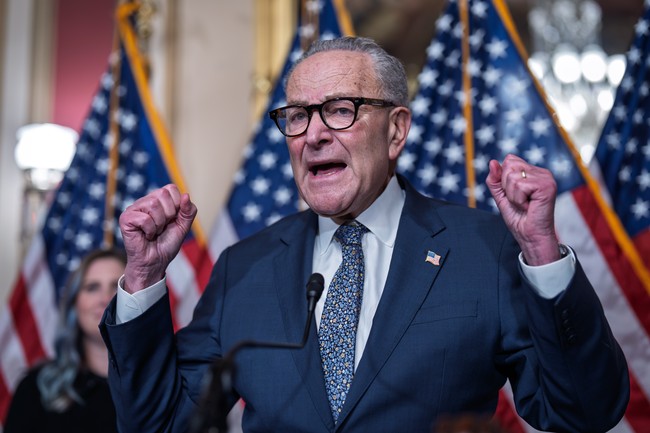
Summary: This piece examines Senate Minority Leader Chuck Schumer’s recent call for President Trump to release oil from the Strategic Petroleum Reserve, contrasts that demand with Schumer’s past opposition to filling the SPR when prices were about $29 a barrel, and questions the consistency of Democratic energy policy amid rising fuel costs tied to Operation Epic Fury.
Senator Chuck Schumer has publicly urged President Trump to tap the Strategic Petroleum Reserve as gasoline prices climb. That demand comes after years in which Schumer opposed actions to replenish the reserve when oil was much cheaper. The timing and tone of his appeal have prompted criticism from conservatives who see the move as politically convenient and inconsistent.
The core of the criticism is straightforward: Schumer once blocked filling the SPR when crude traded near $29 a barrel, yet now he wants the reserve opened as oil passes $110 per barrel. Observers note that choosing not to bolster reserves when prices were low left policymakers with fewer options now that global events have pushed energy costs higher. That sequence of choices fuels the narrative of political hypocrisy.
The top Senate Democrat wants President Donald Trump to tap the nation’s oil stockpile as fuel prices skyrocket, years after blocking his attempt to replenish the supply when prices were low.
Senate Minority Leader Chuck Schumer, D-N.Y., called on Trump to unleash reserve barrels of oil from America’s Strategic Petroleum Reserve (SPR) as oil prices spike amid the ongoing conflict in the Middle East.
Schumer argued in a statement that the reserve “exists for moments exactly like this.”
Political opponents point out that releasing oil from the SPR rarely produces long-term relief at the pump. The reserve is designed as an emergency buffer, not a permanent price-control tool. Still, the optics of Schumer pressing for a release after previously blocking a low-cost replenishment have stuck and become a focal point for criticism.
There’s also a broader policy critique: many Democrats have opposed expanded domestic oil development and have pushed green energy priorities that, critics say, reduce the nation’s long-term energy resilience. When the debate centers on strategic stockpiles, opponents argue both past refusals to fill the SPR and shorter-term resistance to fossil fuel production limit practical responses when crises hit.
“When wars and global crises disrupt energy markets, the United States has the ability to act, but President Trump and his administration are refusing to do so,” Schumer said. “Trump should release oil from the SPR now to stabilize markets, bring prices down, and stop the price shock that American families are already feeling thanks to his reckless war.”
During his first term, Trump wanted to use about $3 billion from a colossal COVID-19 stimulus package making its way through Congress to fill the reserve, but the move was promptly rejected by Schumer and congressional Democrats, who panned it as a “bailout” for the oil industry.
The price per barrel at the time was roughly $29, according to WTI Crude Oil. Now, oil has eclipsed $110 per barrel over the weekend for the first time since 2022.
Supporters of the president emphasize context: if policymakers had filled the reserve when prices were low, the nation would be better positioned to smooth price shocks today. That argument focuses less on partisan blame and more on practical preparedness. It’s an argument designed to highlight consequences of fiscal and policy choices over time.
Other voices push back on the idea that tapping the SPR will meaningfully lower pump prices, arguing market forces, refinery capacity, and distribution logistics play bigger roles. Energy markets are complex, and one policy tool rarely fixes a sudden spike in consumer costs. Still, the symbolic weight of invoking the reserve during a crisis is powerful politics.
Beyond the SPR debate, the broader tug-of-war over energy policy remains central. Voters see competing priorities: some want domestic production expanded to ensure supply and price stability, while others prioritize climate-driven transitions away from fossil fuels. That divide informs reactions to Schumer’s stance and colors how different audiences interpret his recent statements.
As the political argument plays out, the SPR episode is likely to be used as a campaign talking point by both sides. For critics it’s evidence of flip-flopping; for defenders it’s a case of pressing any available lever to help consumers now. Either way, the episode underscores how energy policy decisions made in one political season can resonate long into the next.

Get this LUNATIC out of our Government NOW!!!
I just stated the following elsewhere on this site which says it all!
>The Demoncrap party don’t give a rat’s ass about the safety and well-being of the American Citizenry or this United States of America a Constitutional Republic under God! They’ve been getting away far too long playing their political theater games and moves to seize total power control of the country for decades now and they need to be charged with such Sedition and Insurrection, so they can be properly dealt with at GITMO!
You fools that vote for any of them are being so played like stupid lemmings!<