
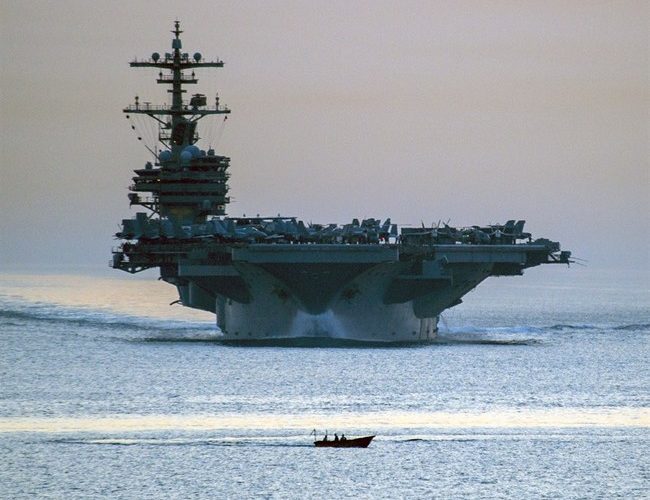
The U.S. has a significant carrier presence steaming near the Middle East as tensions with Iran and proxy groups escalate, and reports now indicate a third carrier strike group may be heading that way to reinforce an already massive naval buildup.
American naval power is concentrated across multiple maritime zones: the USS Abraham Lincoln is operating in the Arabian Sea and Gulf of Oman, while the USS Gerald R. Ford is positioned in the Red Sea. Those deployments have been central to recent strikes labeled Operation Epic Fury, actions coordinated with Israeli forces under Operation Roaring Lion and supported by long-range bombers and regional bases. The scale of force on scene already represents the largest U.S. naval deployment in the region since the Iraq War, a posture meant to deter further escalation and protect critical shipping lanes.
Media reports now suggest the USS George H.W. Bush carrier strike group is preparing to deploy, which, if it sails, would bring three nuclear-powered supercarriers into the theater at once. That concentration would give commanders multiple, overlapping strike and defense packages spread across the Red Sea, the eastern Mediterranean, and the approaches to the Strait of Hormuz. Such a presence complicates any adversary calculation and increases options for rapid response to attacks on commercial or military vessels.
Estimates indicate it would take roughly 10 to 12 days for a carrier group to transit from Norfolk, Virginia to the eastern Mediterranean if ordered to move quickly. Timelines like that matter because carriers project continuous airpower while underway and can be rerouted to cover hot spots as they develop. The logistics of steaming a full carrier strike group from CONUS include replenishment, air wing coordination, and integration with regional command structures before arriving on station.
The Ford completed the necessary operational exercises to certify its strike group for combat operations, and then transited through the Suez Canal into the Red Sea. That deployment positions Carrier Strike Group 12 to respond to threats from Houthi forces in Yemen, who have threatened to attack merchant shipping and potentially enter the wider conflict in support of Iran. A carrier in the Red Sea provides both offensive strike capability and defensive air cover for nearby sea lanes.
The Bush recently completed the Composite Training Unit Exercise (COMPTUEX), which “brings together all elements of a carrier strike group to operate as a cohesive, multi-domain fighting force,” according to the US Navy.
Like the Lincoln, the Bush is a Nimitz-class supercarrier.
Reports note that Carrier Strike Group 12 crossed the Suez Canal after a port call and then moved into the Red Sea, where it stands ready to act if Houthi forces attempt to join the fight on Iran’s side. The Ford group’s movement through the Mediterranean and into the Red Sea demonstrates how quickly naval assets can shift between theaters to meet emerging threats. That mobility is the core advantage of carrier strike groups: persistent presence that can be concentrated at a moment’s notice.
On Thursday, the Ford carrier strike group, officially known as Carrier Strike Group 12, crossed the Suez Canal after docking in Haifa and is now positioned in the Red Sea, reportedly prepared to attack or defend should the Houthis attempt to join the ongoing war with Iran.
It entered the Mediterranean after transiting the Strait of Gibraltar, a movement reported by multiple outlets tracking US naval deployments.
Analysts tracking deployments list the current lineup of carriers and task groups operating in the region, but only the Pentagon has the full picture of exact locations and movements. There is public reporting that suggests the Gerald Ford has been on an extended deployment of around 11 months, which raises questions about potential rotations or staggered relief schedules for carrier air wings and crews. If the Bush sails and the timing aligns, for a period there would be three carrier strike groups forward-deployed, each with escort destroyers, cruisers, and logistical ships supporting them.
For opponents who rely on asymmetric tactics or proxy forces, the arrival of additional carrier strike groups increases the risk and reduces safe havens at sea. Carriers bring air superiority, long-range strike options, and command-and-control capabilities that can shape a theater-wide campaign. That combination is meant to deter attacks on commerce, defend allies, and, if necessary, deliver decisive blows against hostile military infrastructure.
With multiple carrier groups in close proximity, commanders can present layered defenses while keeping options open for precision strikes if hostile forces escalate. The posture also reinforces freedom of navigation through the Strait of Hormuz and adjacent waterways that host a large share of global energy shipments. For policymakers, the visible concentration of firepower serves both military and diplomatic purposes during a volatile phase of the conflict.



Add comment