
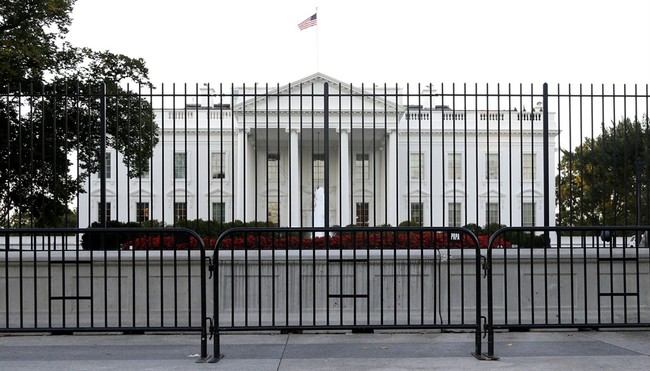
The White House saw another security breach when a man jumped a construction barrier and engaged Secret Service officers, leaving one agent with a cut and the suspect in custody; the quick response contained the threat and renewed debate about who is responsible for public safety around the presidential complex.
People who try to get past White House defenses often seem oblivious to the risks, and this incident was no different. The complex is defended by snipers, K9 teams, and armed officers, so any deliberate attempt to cross a barrier invites a rapid, forceful response. Yet breaches still happen, and each one highlights the need for constant vigilance and clear responsibility for security.
On Thursday a man leaped a construction bollard near the northeast side by the Treasury Building and was immediately confronted by uniformed Secret Service police officers. A physical struggle ensued at a pedestrian gate, and one agent received a laceration and was evaluated for non-life-threatening injuries. The suspect was taken into custody and also underwent medical evaluation.
Video from the scene shows the moment he crossed the line and got into a physical struggle with agents. One Secret Service agent was hurt during the fight.
The suspect was taken into custody right away. Officials have not yet released his name or any details about why he tried to get past the barrier. The White House is one of the most protected places in the country, but security breaches like this still happen from time to time.
This latest incident comes at a busy time for the Trump administration. Many people online are now talking about how important it is to keep the president and the White House safe. The quick action by the Secret Service stopped the situation before it could get worse.
Source: Fox News, Nick Sortor
The official statement from the Secret Service spelled out the sequence. “Shortly after 11:30 a.m., a man was quickly detained by uniformed U.S. Secret Service police officers after jumping over a construction bollard near the Treasury Building on the northeast side of the complex. Officers encountered the individual near a pedestrian gate, where he engaged in a physical altercation before being taken into custody. One officer sustained a laceration. Both the officer and the suspect underwent medical evaluation for non-life-threatening injuries.”
That quoted statement makes clear the agency acted fast and kept things from escalating, but quick responses only matter if policy and perimeter planning are up to the task. Over the years the physical defenses at the White House have been altered and strengthened repeatedly, yet individuals still get close enough to test them. When breaches occur, critics ask if political rhetoric and social tensions play any role in encouraging dangerous behavior.
There is a broader context here about public safety and the political climate. From a conservative perspective, law and order matter and so does protecting the president and staff with firm, visible security. When political discourse turns violent or celebratory of chaos, those of us who believe in stable institutions get worried about copycat incidents and the strain those incidents put on protective services.
Upgrading fences and repositioning barriers are necessary but not sufficient actions. Physical upgrades like raising fence height or adding bollards can deter casual intruders, but they do not stop someone determined to force an encounter. That is why the people responsible for security need smart procedures, clear rules of engagement, and robust coordination among agencies so incidents get handled with minimal risk to agents, bystanders, and officials.
This event also raises questions about how the narrative around such breaks is shaped. When a breach occurs, some outlets emphasize the drama and the visuals, while others focus on facts and the threat to leadership. From a Republican viewpoint, emphasizing the reality of danger and the competence of security teams reinforces the message that the nation needs firm, competent guardians to protect its centers of government.
Incidents at the White House have happened across administrations, proving that no single fix ends the problem. Security upgrades over decades—some of them dramatic—reflect an ongoing effort to adapt to new threats and changing tactics. Still, human factors like intent, mental state, and how the public talks about power and authority matter a great deal when someone decides to test those defenses.
Stopping a breach quickly is essential, but preventing the next one requires clear accountability and steady leadership committed to law and order. Protecting the president and the complex around him is a nonpartisan need in practice, even if the political blame for chaotic rhetoric often falls on one side in public debate. The episode is a reminder that safety depends on solid security measures and a culture that discourages violence and disruption.



Add comment