
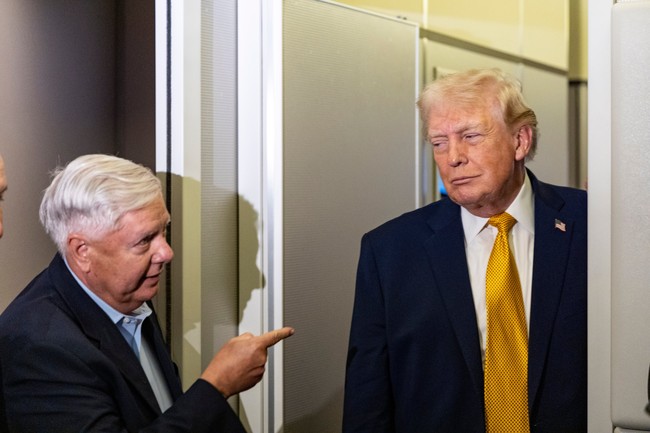
Sen. Lindsey Graham’s sudden passing shocked Washington and viewers nationwide, prompting live interviews and raw reactions from President Donald Trump about their recent call and Graham’s role in national politics.
The news of Senator Graham’s unexpected death broke early Sunday, upending planned appearances and memorial conversations across broadcast outlets. He had been scheduled to appear on a morning program following a trip to Ukraine, and his sudden loss left colleagues and constituents stunned. That schedule disruption highlighted how quickly events can turn, from a routine interview to national mourning.
When Kristen Welker could not speak with Graham as planned, she instead reached President Trump by phone to capture his reaction to the loss. Trump described a recent evening call with Graham and reflected on how close in time that conversation was to the senator’s passing. The timing of that exchange and the effort Graham was making on legislation became a focal point of the interview.
https://x.com/RapidResponse47/status/2076299228440105223
WELKER: President Trump, thank you for joining us, and my condolences to you.
TRUMP: Well, thank you. He’s a tough one to lose. He’s…he was great. He was unique in every way, actually.
WELKER: He was, Mr. President, and I know that we are all just absorbing this news. We are all in shock. Can you tell us, Mr. President, how you received this news and your immediate gut reaction when you heard it?
TRUMP: So what makes it even stranger is that I got a call last night, sometime in, you know, the early evening, maybe in the sevens. And he called, and he said, “We’re all set for the SAVE America Act. He was pushing the SAVE America Act like crazy. He got back — said he just landed from Ukraine. I said, “That’s a long trip to make.” He said — he sounded a little tired, but perfect, but…a little bit tired — had a right to be. And he was a worker — he was really a worker, but he sounded great actually, but he was…he actually said he was tired.
But he wanted to pass the SAVE America Act. And I said, “Well, we’re gonna get it done, Lindsey, we’re gonna get it done. I’ll see you, like, soon.” We thought maybe we might even meet today. And then, that was it. And that was, you know…very…around the time, it couldn’t have been much longer. It could’ve been his last call. I don’t know exactly, but I got a message about 1 o’clock in the morning from one of the people in his office that he had passed away. I said, “You gotta…I just can’t believe it.” He was like a member of the family to me. It’s very tough, actually. It’s amazing.
He was such an advocate — he was, you know, if he wanted to get something…and you know, he had a unique ability; he was able to deal with Democrats and Repub — if I had a problem, a real problem, I wouldn’t often ask, but if I had a problem with a Democrat, he could work it out. He was a great — he was a great politician, actually.
Trump’s description painted Graham as both relentless on policy and skilled at brokering deals across the aisle. He emphasized Graham’s push on legislation called the SAVE America Act and noted that Graham had just returned from Ukraine. Those details framed Graham’s final days as busy and focused on national priorities.
Observers noted the poignancy of the timing, given that Graham reportedly sounded tired yet determined on that call. Trump said he and Graham had discussed meeting soon, and minutes or hours later, word arrived that the senator had died. That proximity turned an ordinary political exchange into a moment of profound personal loss for those who knew him.
Beyond their private rapport, Graham’s public record drew attention in conversations about his legacy. Trump and others pointed to Graham’s high-profile defense of Brett Kavanaugh during confirmation proceedings as a defining moment that revealed his willingness to stand his ground. That episode will likely remain part of how many remember Graham’s career in Washington.
The White House shared a light-hearted photo of Graham and Trump from earlier in the year, underscoring a personal connection that extended beyond policy debates. Images and memories circulated as officials and citizens reflected on Graham’s character and work ethic. Such moments served to humanize a figure often cast in the heat of partisan fights.
Across party lines and among constituents, reactions mixed grief with acknowledgment of Graham’s complex role in the Senate. He was described as a tireless advocate who could pick up the phone and work issues out in the Capitol. For many conservatives, his ability to negotiate with Democrats when necessary marked him as an effective operator in a polarized environment.
Newsrooms adjusted programming to accommodate live tributes and analysis, and interviews with key figures filled the airwaves as people sought context and reflection. The abruptness of the senator’s death amplified the sense of loss and the scramble to capture firsthand reactions. That frantic coverage also showed how modern media responds instantly to sudden developments.
Locally and nationally, constituents and colleagues began to share memories of Graham’s persistence and tenacity. He built a reputation for relentless work on issues he cared about and for being willing to take politically risky stands. Those traits will shape how political historians and the public evaluate his impact in the months ahead.
As tributes continued, the dialogue shifted between personal remembrances and assessments of Graham’s policy legacy. Conversations focused on his defense of key figures, his posture on foreign policy, and his role in conservative causes. In the immediate aftermath, much of the attention remained on that final night and the call President Trump described as possibly the last one Graham made.


Add comment