
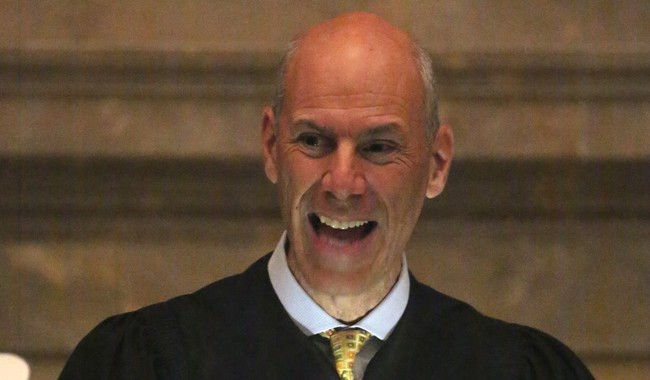
Senate Republicans Josh Hawley and Eric Schmitt pressed their case this week that D.C. District Judge James Boasberg’s courtroom conduct crossed a line, arguing in a Judiciary subcommittee hearing that his handling of subpoenas, gag orders, and non-disclosure agreements shows negligence and potential abuse of power warranting impeachment consideration.
Congress returned from the holiday break and the Senate Judiciary Subcommittee convened to examine what members call “rogue judges.” Senators on the panel focused on Boasberg’s role in issuing broad subpoenas and non-disclosure orders tied to the Arctic Frost matter and the treatment of senators’ phone records. The hearing spotlighted concerns about separation of powers and whether proper legal standards were ignored.
Senator Hawley questioned a legal expert, pressing hard on whether a judge can sign subpoenas or nondisclosure orders without checking who is targeted or whether statutory protections for senators apply. He emphasized that judges should inquire when sensitive privileges or special statutes, like those governing congressional materials, might be implicated. The line between routine judicial action and overreach, he argued, was crossed in this instance.
HAWLEY: I’ll start with you, Professor Luther, and just see if I can figure out what the baseline here is. We’ve now learned today — it’s been said over and over by our Democrat colleagues — that Judge Boasberg can’t be held to account, and he did nothing wrong because he had no idea — no idea — whose records he was issuing subpoenas for. And he didn’t inquire; he didn’t ask. He just signed it, as Senator Cruz was just saying. That is despite 2 U.S.C. § 6628(c). So, is that just how it works — that it’s just, it’s fine; the judge can just — whatever…DOJ says — he doesn’t need to inquire; separation of powers concerns he doesn’t need to ask about it. It doesn’t matter — he can just sign it?
LUTHER: That’s certainly not how it’s supposed to be, but based on the evidence that’s publicly disclosed, that seems to be the best evidence of what happened.
HAWLEY: And is that how non-disclosure orders work as well? That you can get a non-disclosure order against specific individuals — not to notify specific individuals — if there’s some suggestion that somewhere someone in the universe might disclose or tamper with evidence somehow in some way. Is that how a specific non-disclosure order works? I’ve never heard of such a thing, but maybe I just missed it.
LUTHER: No. That’s the point where Smith’s team should’ve told Judge Boasberg, “These are senators, and there are different obligations under the law for how we treat them.”
HAWLEY: I’ve never heard of a non-disclosure order — I was the attorney general of my state; we’ve sought these things in the past — I’ve never heard of one where you said, “Well actually, we don’t, we can’t offer you any evidence that any of the people targeted in the order would actually tamper, but somebody out there somewhere might, maybe — take our word for it, sign the order,” and he does it anyway.
I mean, let me just say it this way: Does this actually exonerate Judge Boasberg? I mean, does this make it better? My Democrat colleagues have offered this as, “Oh, he was just doing his job.” Does this make it better or worse?
LUTHER: No, I think what has shifted from maybe a month ago when this broke for the first time is, it’s not so much that Judge Boasberg is being intentionally — it’s not intentional; it’s more negligent. And that’s, I think, the situation.
HAWLEY: Yeah, it’s grossly negligent.
Hawley connected the dots between procedural lapses and a broader pattern of government machinery being used against ordinary citizens or political opponents. He warned that when judges adopt a hands-off approach to subpoenas and gag orders, it can enable executive overreach. The argument presented to the subcommittee was that negligence in a federal judge’s decisions carries institutional consequences.
Missouri’s senators both weighed in beyond the Hawley exchange, framing Boasberg’s conduct as part of a troubling trend. Senator Schmitt laid out a list of specific grievances alleging how Boasberg has supposedly misused his authority in multiple contexts. They called attention to the cumulative effect of a judge repeatedly inserting himself into politically charged cases.
Rogue Judge Boasberg is abusing his power to go after the Trump Administration. He must be impeached and removed.
He has abused his role as Chief Judge in 5 ways:
(1) Forcing himself onto hot button cases;
(2) Abusing his power in the Judicial Conference to fear monger to the Judiciary about the specter of a nonexistent Constitutional crisis;
(3) Rubber-stamping gag orders and subpoenas against U.S. Senators;
(4) Trying to hold DOJ lawyers in contempt for a case the Supreme Court said he had no jurisdiction over;
(5) He sits on the Circuit Judicial Council, which would be able to overturn any disciplinary action taken against him.
He has made it clear, time and time again that he, instead of wearing that black robe, wears a blue jersey.
The House must immediately begin impeachment proceedings.
The senators argued impeachment is the constitutional remedy for judges who step outside legal bounds or act negligently in ways that harm separation of powers. They pointed to specific statutes and procedural norms they say were overlooked and insisted accountability is necessary to preserve judicial impartiality. That push frames impeachment not as partisan theater but as a structural check.
Whether the House will act remains uncertain, and removal from the bench is far from guaranteed. Still, the hearing made clear that Republican senators are building a public record that could support articles of impeachment if the House chooses to pursue them. The exchange also served to put pressure on the judiciary to explain its internal oversight and decision-making.
The message from Hawley and Schmitt was forceful: judges are not above the law and must respect statutory protections for other branches of government. Their argument stressed that when judicial discretion becomes negligence or selective enforcement, elected officials have a duty to respond. The topic will likely stay in the headlines as both parties weigh institutional norms and political consequence.


ABSOLUTELY and try him before a Military Tribunal at GITMO for TREASON!!!
GET IT DONE NOW!!!