
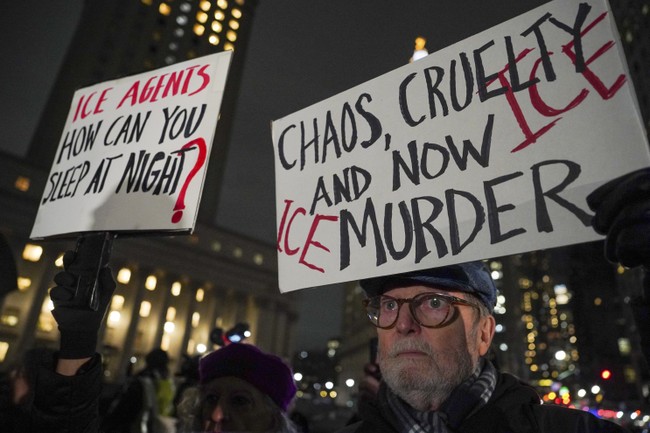
The recent confrontation in Minneapolis involving an anti-ICE assailant and a federal agent has escalated a national debate about rhetoric, responsibility, and public safety; this article recounts the incident, highlights reactions from Republican leaders, and details how inflammatory language from some Democrats has been called out for fueling violence while investigations and political arguments continue.
Republican lawmakers warned that persistent demonization of immigration enforcement could inspire violence, and those warnings turned urgent after a Minneapolis operation ended with shots fired and one woman killed. The woman has been identified as 37-year-old Renee Good, and reports indicate an ICE agent who was struck during the incident was treated and released from a hospital. That sequence of events has become a focal point for critics who say heated political talk is translating into real-world danger for officers doing their jobs.
President Trump weighed in on social media with a direct charge aimed at Democrats: “the reason these incidents are happening is because the Radical Left is threatening, assaulting, and targeting our Law Enforcement Officers and ICE Agents on a daily basis. They are just trying to do the job of MAKING AMERICA SAFE.” Those words were seized on by Republicans as evidence that public hostility toward law enforcement has consequences. Conservative voices argue that the political left’s framing of ICE and other officers as villains lowers the barrier to violent action by fringe actors.
In Minnesota, the political response split sharply along party lines, with state leaders offering differing narratives about blame and responsibility. Some Democrats criticized federal policies and the administration, while Republican members of Congress pointed to what they see as a culture of demonization that normalizes attacks. The conflict has quickly moved past policy disagreement and into a debate over whether rhetoric contributed to an escalation that cost a life and endangered officers.
Rep. Derrick Van Orden (WI-03) posted on X, calling the incident a product of what he termed Democrats’ violent rhetoric and labeling similar actions as examples of far-left domestic extremism. “This is the direct result of Democrats’ violent rhetoric. It must stop now,” he wrote, framing the attack on an ICE agent as one of several incidents tied to the same trend. Van Orden’s comments reflect a broader Republican stance that public leaders must change how they speak about law enforcement to prevent further radicalization.
Republicans argue that slogans and insults aimed at officers—phrases that equate law enforcement with tyrants or use dehumanizing language—do more than divide; they allegedly prime individuals already on the edge to act. In congressional and local forums, GOP lawmakers have urged accountability not only for violent actors but also for those they say stoke an environment of hostility. That line of reasoning links political discourse, street-level actions, and the need for a national conversation about civic responsibility.
The Minneapolis case has prompted federal agencies to step in and coordinate investigations while state and local leaders trade public condemnations. Officials are balancing the need for a thorough probe with the public demand for answers and assurances about officer safety. For Republicans, the immediate priority has been to highlight any connection between public attacks on ICE and subsequent violent incidents as evidence of a dangerous pattern.
In a separate post, Van Orden explicitly called out the left for language he says equates officers to historical tyrannical groups and uses “vile slurs” that amount to a systematic campaign of demonization. “The left’s constant demonization of our officers, calling them ‘American Gestapo’ and vile slurs, is brainwashing and fueling this type of radicalization,” the Congressman correctly in another message posted on X. That phrasing was pointed and intended to underline the GOP argument that words matter and can have lethal outcomes.
Critics of the Republican reaction say political speech alone is not the root cause and point to deeper social and policy disputes over immigration enforcement practices. This incident, however, has stripped away some of the abstraction: a violent encounter occurred, a life was lost, and both policy and rhetoric are being examined as possible contributors. Republicans are using the episode to press for a change in tone from opponents and to call for stronger protections for officers in the field.
As investigations proceed, the debate will likely continue in both political and law enforcement circles, with Republicans emphasizing the link between demonizing rhetoric and real-world danger. The core question remains whether public leaders can or should be held responsible for language that critics argue catalyzes violence, and whether changing discourse will reduce the risk faced by those carrying out federal and local law enforcement duties.

Add comment