
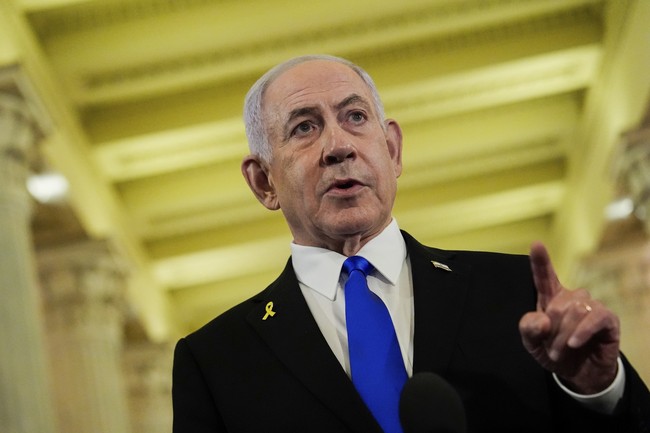
Checklist: summarize Netanyahu’s assessment of Iran’s nuclear setback; report the key facts from his interview and retain his quotes exactly; explain the threat to Israel versus the United States; describe the implications of striking Iran’s program and the likely future risk; include the supplied embed token in place.
Israel’s prime minister told a clear, blunt story: recent operations against Iran’s nuclear apparatus have set back Tehran’s ability to build a weapon, but the threat has not vanished. Benjamin Netanyahu framed the strikes as an urgent response to an imminent danger that threatened Israel’s existence and posed a broader risk to America and its allies. The description is stark and specific, naming destroyed infrastructure, centrifuges, and scientists as the tangible results of the campaign. That gives a hard-headed account of what was accomplished and why it mattered right now.
Netanyahu’s language makes the stakes plain: this was not routine diplomacy or a minor skirmish, but action taken because Iran “was on the verge of making nuclear weapons.” He emphasized timing and capability in his remarks, insisting the operation forced the immediate threat backwards. The prime minister said the effort hit the technical heart of the program, targeting the factories and facilities that turn material and technology into a bomb. Those details matter because they define what “setback” really looks like on the ground.
Netanyahu spelled out outcomes in blunt terms: “We pushed that immediate threat away. We destroyed a lot of their infrastructure, a lot of their centrifuges, a lot of the associated factories and facilities that they use for manufacturing nuclear weapons,” he said. He also counted human costs to the program’s expertise: “We knocked out 20 of their top nuclear scientists — 20 of their top nuclear scientists. So we pushed it back considerably.” Those lines quantify the hit, making it easier to judge how valuable the operation was in slowing Tehran’s trajectory toward a weapon.
Even while describing success, the prime minister refused to pretend the danger is gone forever. He compared the situation to a medical procedure, using an image meant to convey recurring risk and hard choices. His metaphor underscores the point: removing the immediate danger doesn’t erase motivation or future capability. For a nation like Israel, where a single weapon could cause catastrophic loss, prevention must remain a constant priority.
“It’s like when you excise a lump of cancer from your body, you know it may come back. But you know one thing: If you wouldn’t do it, you could die,” he said. “And Israel was obviously placed with an existential threat. And America was threatened with a very great danger.” Those sentences are not rhetorical flourishes; they’re a direct declaration of why decisive force was used rather than waiting for diplomacy to catch up.
The scale and geography of the danger shape how it’s perceived. In the United States, vast distances make a single strike less likely to end a nation, but in Israel a concentrated blast could be civilization-shattering. Israel is roughly the size of a single U.S. state and densely populated, so even a small Iranian arsenal would have devastating potential. Netanyahu repeatedly made the point that survival was the driver of action, and that reality demands an uncompromising approach to any nuclear threat aimed at Israel.
There’s also the strategic calculus: an attack that sets back Iran buys time for allies, but it invites future attempts from a determined regime. Tehran’s leadership has reasons to pursue nuclear capability—prestige, deterrence, and regional leverage—and those motives do not vanish when facilities are damaged. The prime minister’s warning was crisp: capability was reduced, desire remained, and the risk will therefore persist unless permanently removed by political or military means.
From a conservative perspective that prizes national strength and deterrence, the operation is seen as validation of a policy that ties credible force to security. Successful strikes that delay a nuclear program reinforce the logic of action before a threat becomes irreversible. At the same time, that same logic recognizes a strategic truth: delaying a program is different from eliminating intent, and the long game remains unsettled.
Netanyahu’s remarks made one thing clear—these were not cosmetic blows but concrete degradations of Iran’s program, and they were enacted because the alternative was unacceptable risk. The regional balance shifted temporarily, and the window for further escalation was narrowed. But the prime minister’s metaphor about excising cancer is a sober reminder that this kind of victory is rarely permanent and that vigilance will be required going forward.


Add comment