
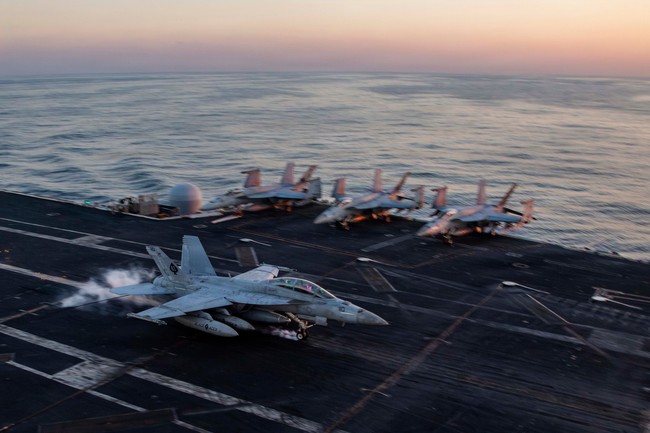
Here’s the situation in brief: CENTCOM says the United States has struck back at Iran after attacks on commercial ships in the Strait of Hormuz, calling the strikes a campaign to impose heavy costs; quotes from CENTCOM and a White House-aligned X post are preserved below; the exact targets in Iran haven’t been fully detailed, though past threats against power and oil infrastructure were noted; embedded media tokens from the original report remain in their approximate places for reference.
It’s on. The United States Central Command (CENTCOM) says it has launched a new series of strikes against Iran in response to the Islamic Republic targeting commercial vessels transiting the Strait of Hormuz, and the report notes these were crewed by innocent civilians. CENTCOM frames the operation as a measured effort to impose heavy costs for actions that violated an existing ceasefire. The strikes are described as a direct response to attacks on three commercial vessels, and the statement calls Iran’s behavior “unwarranted, dangerous, and a clear violation of the ceasefire.”
https://x.com/CENTCOM/status/2074603238175998290?ref_src=twsrc%5Etfw
CENTCOM reports:
U.S. Central Command forces have begun launching a series of powerful strikes against Iran to impose heavy costs for targeting and attacking commercial shipping crewed by innocent civilians in an international waterway. The U.S. strikes are in response to Iranian attacks on three commercial vessels that were transiting the Strait of Hormuz. Iran’s demonstrated aggression was unwarranted, dangerous, and a clear violation of the ceasefire.
Officials have not published a full target list, so the exact locations and damage assessments inside Iran remain unclear at this hour. There is historical context to consider: President Trump has previously warned that U.S. action could include strikes against electrical generation and petroleum infrastructure, signaling that strategic economic and military targets are on the table. That kind of targeting would be meant to degrade Iran’s ability to sustain hostile activity rather than to escalate indefinitely.
Earlier reporting cited incidents over two days where Iranian forces allegedly fired missiles at commercial ships, and different outlets offered varying counts of affected vessels. Some reports suggested two tankers were struck while others put the number at three, underscoring how chaotic initial battlefield reporting can be. Those ship strikes prompted rapid policy responses in Washington, signaling that the administration was prepared to follow through on threatened consequences.
One earlier account relayed: “On Monday and Tuesday, they were at it again, and reportedly fired at least two missiles at commercial vessels in the Strait — and President Donald Trump is not pleased.” That wording captures the immediacy and anger driving the U.S. decision-making process, and it helps explain why CENTCOM moved swiftly. As tensions rose, U.S. authorities opted for kinetic measures rather than delay, presenting them as necessary to protect freedom of navigation and civilian mariners.
Embedded material from the original reporting emphasized a White House reaction and a tougher posture on Iranian oil exports, and an official social post was shared to underline the policy shift. The embedded X message declared a revocation of a U.S. license that previously allowed Iranian oil sales, framing that financial squeeze as part of the consequences for striking commercial vessels. The tone of that post combined firm policy action with political messaging about accountability on the global stage.
The embedded X post reads:
JUST IN: President Trump is officially REVOKING the US license that allowed Iran to sell their oil, after the mullahs STRUCK vessels in the Strait of Hormuz — Reuters The US says Iran’s actions WILL be met with consequences. TRUMP FAFO playing out overseas! He will NOT let them get away with MoU violations again.
Those moves suggest a broad strategy: use military strikes to punish immediate aggression while applying economic pressure to limit Iran’s ability to fund or sustain further attacks. From a tactical view, hitting selected infrastructure can be calibrated to impose costs without triggering full-scale regional war, yet it still sends a clear message that attacks on civilians will meet forceful responses. The U.S. approach appears aimed at deterrence through pain rather than unchecked escalation.
Accounts also preserved embedded reactions and situational reporting from the field, underscoring that this remains an unfolding story with details likely to change. Journalistic clarity will depend on further official disclosures and on-the-ground assessments that may take time to verify. For now, CENTCOM’s public statement and the administration’s economic steps form the backbone of the U.S. response to the Strait of Hormuz incidents.
News consumers should expect more updates as verification continues and as commanders and policymakers decide on any additional measures. The strikes and sanctions together mark a clear shift from rhetorical warnings to concrete penalties, and they show the administration willing to act to protect commercial shipping and to punish violations of international norms.

When are the U.S. Officials going to face the FACT that those that run Iran are EVIL to the core Megalomaniac Fanatics that will never be trustworthy in any way shape or form and to end all of this back and forth game all of those Iranian Leaders and Mullahs need to be taken out!
Obliterate all of them with clandestine missions and wipe the IRGC off the face of the earth once and for all! They all support the false religion of Islam that is a front for totalitarian control; as they expect their Mahdi to be coming to bring on the Mother of All Wars!~