
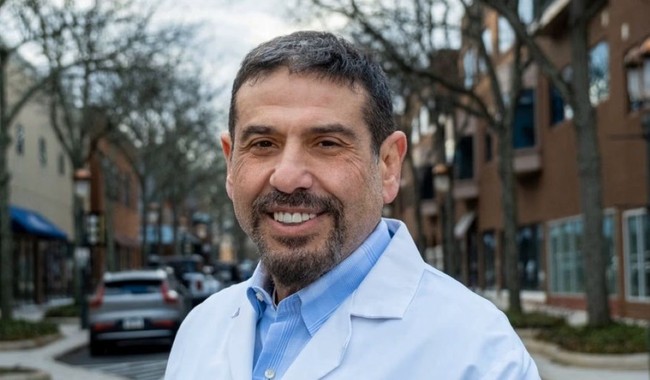
The primary takeaway here is simple: many ordinary Democratic voters are backing extremists without doing basic fact-checking, and that has real consequences for safety, national security, and our political future. This piece examines one recent New Jersey primary, the background of the nominee, how party messaging shapes voter behavior, and why everyday voters need to stop functioning as uncritical tools of partisan elites.
When a party’s base repeatedly chooses candidates with troubling affiliations, it becomes fair to ask whether those voters are acting on informed judgment or repeating talking points handed down from above. In a safe Democratic district in New Jersey, Adam Hamawy won a primary despite a public record that raises hard questions about his past associations and recent activities. Voters rewarded a candidate who, to many observers, appears aligned with violent Islamist networks and who has publicly embraced narratives that inflame divisions.
Adam Hamawy testified on behalf of the “Blind Sheikh” Omar Abdel-Rahman, mastermind of the deadly 1993 World Trade Center bombing, concerning a conference to which Hamawy traveled with Abdel-Rahman where the sheikh and other jihadis promoted pro-terror views. According to the New York Post, which viewed the trial transcripts, Hamawy initially lied under oath and said the sheikh had not discussed jihad, only admitting the truth when confronted with evidence to the contrary. Hamawy traveled to Bosnia in 1994 with the “Benevolence International Foundation,” which Bosnian authorities later shut down in an operation coordinated with U.S. authorities after they found the organization was a front for funding and supporting al-Qaida. Osama Bin Laden himself founded the offices where Hamawy worked.
That blockquoted material documents actions that most Americans would find alarming, yet primary voters still supported him by a comfortable margin. In 2024 he traveled to Gaza, described Israel as committing “genocide,” and worked in a facility later reported to have been used by Hamas as a command center. Those facts, when taken together, are not trivial. They point to poor judgment at best and dangerous sympathies at worst for someone seeking a seat in Congress.
Not only that, but it appears Hamawy is still aligning himself with terror movements. In 2024, he visited Gaza (where the overwhelming majority of residents support jihad) and falsely accused Israel of “genocide,” an accusation repeatedly debunked but dangerously effective in fueling violent antisemitism. While there, Hamawy worked as a surgeon at Gaza’s European Hospital, which was subsequently exposed as a literal Hamas command center. Israel later eliminated Hamas boss Mohammed Sinwar and other key terrorists in a tunnel right under the hospital. Israel’s military confirmed that Hamas used the hospital as a command center during the Oct. 7 atrocities, before Hamawy arrived there. There’s even evidence that Hamas was holding Israeli hostages in the tunnels there while Hamawy was working at the hospital, per the Washington Free Beacon.
It is one thing to debate foreign policy and another to elect people with suspect ties to violent movements. Yet the reaction from many Democratic primary voters seemed to boil down to tribal litmus tests: hatred of President Trump and alignment with party narratives trumped scrutiny of character and associations. That tribalism allows extremists to slip through when voters treat party cues as a substitute for investigation.
Elites and operatives on the left have long pushed framings that mobilize emotions and obscure inconvenient facts, using slogans and labels to short-circuit independent thought. That approach rewards loyalty over judgment and amplifies candidates who play to grievance. When voters stop asking basic questions and accept headlines or party talking points uncritically, the field narrows to whoever best embodies the outrage machine.
Ordinary Democrats are not all radicals, and many are decent people going about their lives. But when a sizable chunk of a party’s base behaves like a collection of reflexive followers, the results are predictable and dangerous. The soft bigotry of unquestioning allegiance can produce nominees whose records would alarm most Americans, yet they prevail because party identity becomes the shorthand for trust.
Practical skepticism starts with recognizing the cues elites use: charged words like Nazism, genocide, fascism, or blanket accusations of authoritarianism are often deployed to shut down disagreement. When those words are front and center, independent voters ought to pause and dig beyond mainstream summaries. A reasonable search is not limited to the usual media playlists; it includes reading trial transcripts, historical reporting, and contemporaneous documents when they exist.
If primary results in safe districts produce candidates with deeply troubling backgrounds, then the problem is shared between elites and rank-and-file voters who failed to vet them. Change requires ordinary voters to reclaim responsibility for what they elect, to stop being convenient instruments of partisan machines, and to demand candidates who put national security and civic stability ahead of grievance politics.
Republicans and others concerned about the Republic should call out the weaknesses where they see them and push for a political culture where voters demand evidence, accountability, and clarity. When voters on any side refuse to be tools of their elites, politics improves and dangerous candidates find fewer paths to power.


Add comment