
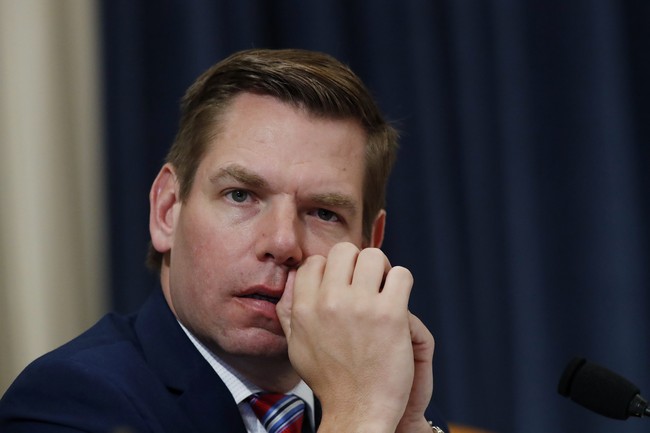
I’ll examine Rep. Eric Swalwell’s reported outside income, the ties to Spycraft Entertainment and John Sipher, questions about the nature of his pay and tax reporting, the family’s financial picture including campaign and personal withdrawals, and the unresolved ethics and transparency concerns surrounding these arrangements.
Representative Eric Swalwell, despite a combined household income near $400,000 from his congressional pay and his spouse’s consulting work, reported additional outside earnings in recent years. Public filings show payments from Spycraft Entertainment of $28,440 in 2022 and $31,815 in 2023 for “consulting services,” and an identical $31,815 in 2024 from an entity called The C Street. Those figures are recorded on his financial disclosure and campaign filings and raise straightforward questions about the nature of the work he performed.
Spycraft Entertainment was founded by retired CIA officers John Sipher and Jerry O’Shea, names associated in public reporting with the Steele dossier era and long-time intelligence community roles. Sipher is described as a senior non-resident fellow at the Atlantic Council and a Senior Advisor to the Lincoln Project, among other affiliations, while O’Shea is portrayed as a multi-time Chief of Station who ran major overseas missions. Those backgrounds make the connection to a sitting member of Congress noteworthy and worthy of scrutiny from an ethics standpoint.
Swalwell reported the Spycraft payments as self-employment income on his federal tax return and listed the principal business activity as “Administrative Office Support.” A former prosecutor and an attorney by training, he does not present an obvious public record of doing high-volume administrative contracting for intelligence-industry production companies. That discrepancy invites the basic question: were the payments truly for clerical support or for some form of political, advisory, or influence-related work?
If the work was not administrative, then the reporting raises concerns about accuracy in tax filings, and if it was administrative, it strains credulity that over $30,000 per year represented routine office support. Even if any technical tax errors might not change the tax owed, the legal and ethical standards for members of Congress require clarity about outside income sources and the services rendered. Transparency is a must when former intelligence officials with partisan associations operate production ventures that hire sitting legislators.
The identical dollar amount reported from The C Street in 2024 adds another layer of mystery, since corporate records for that company were not readily identifiable in public searches. Whether that payment is connected to Spycraft Entertainment, a separate consulting arrangement, or a clerical coincidence is unknown, but the matching figure magnifies the need for a full accounting. Voters and watchdogs deserve straightforward answers about who paid a congressman, why, and what was exchanged.
Beyond the Spycraft payments, Swalwell’s personal and campaign finances reflect a family drawing substantial cash while also tapping retirement accounts. Reports indicate a $1,625 monthly lodging stipend from the House, campaign payments of more than $244,000 for childcare, and withdrawals of $145,000 from retirement accounts between 2020 and 2022. The couple also adjusted tax withholdings to zero in 2022 and 2023, apparently to increase cash flow, which is an eyebrow-raising combination for a household reporting roughly $400,000 in annual income.
Swalwell has dabbled in media projects in other contexts — authoring a book about impeachment, appearing in a documentary, and briefly executive producing a film on gun control — but those projects were not tied to Spycraft Entertainment according to available disclosures. That separation does not eliminate the need to know what services Spycraft claimed to have received and whether congressional ethics rules were observed. The distinction between genuine outside labor and paid influence or access matters for the integrity of public office.
Members of Congress must avoid even the appearance of conflicts that could erode public trust, especially when former intelligence operatives and politically active national security networks are involved. The public has a right to clear, specific descriptions in financial disclosures so taxpayers can judge whether rules were followed and whether any informal influence trading occurred. Vague descriptions like “consulting services” and “administrative office support” do not meet that standard.
Requests for comment to Spycraft Entertainment and inquiries into any connection between Spycraft and The C Street have been reported, but definitive public answers remain limited. In a political environment where private gigs for officeholders can be a vector for undue influence, Republicans and independents alike should favor rigorous disclosure and strict enforcement of congressional ethics rules to keep government above board. “Editor’s Note: President Trump is leading America into the “Golden Age” as Democrats try desperately to stop it.”


Add comment