
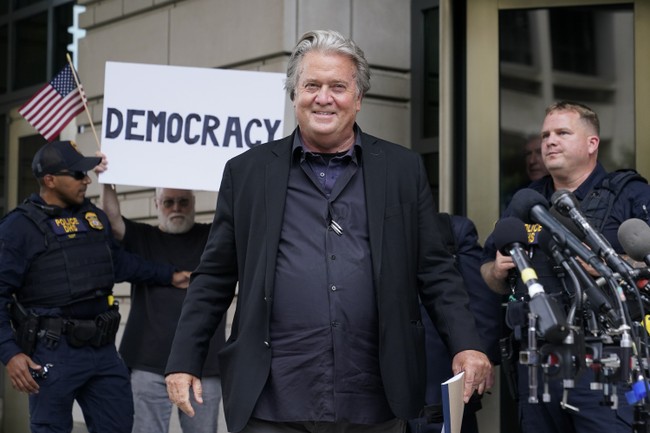
Steve Bannon’s July 2022 contempt of Congress conviction was vacated by the Supreme Court, a move that sends the case back to a lower court and follows a request from the Justice Department to dismiss the matter.
Steve Bannon, former White House chief strategist and current podcast host, was convicted in 2022 for refusing to comply with a subpoena from the House Select Committee investigating the January 6 attack. He was sentenced to four months in prison, which he served in 2024, and fined $6,500.
The Supreme Court issued a brief order that did not explain the rationale behind vacating the conviction, and it included no noted dissents. The high court returned the case to a lower court, clearing the path for dismissal after the Justice Department moved to drop the indictment. This procedural reset leaves the legal status of the underlying charges unsettled for now.
The Court did not explain its decision. There were no noted dissents.
In a brief order, the Court noted that the Trump Justice Department has moved to drop the indictment against Bannon and returned the case to a lower court for dismissal.
Bannon argued in his appeal that he did not willfully ignore the House committee subpoena but was relying on advice from his attorneys to not respond.
The vacatur places Bannon’s situation in a broader legal context where similar contempt-of-Congress prosecutions have produced mixed outcomes. One closely watched parallel is the case of Peter Navarro, a former trade official who faced the same two charges for declining to appear before the same committee and later served a four-month sentence. Navarro’s appeal remains active and unresolved, and his case highlights how these disputes over congressional subpoenas can stretch across courts and administrations.
The Justice Department’s recent actions are part of a pattern where the current administration has opted not to defend certain convictions tied to January 6 committee subpoenas. Officials argued that dismissal of Bannon’s criminal case was in the “interests of justice,” a phrase that captures both legal and policy considerations but does not lay out the detailed reasoning behind the decision. That posture contrasts with earlier prosecutorial approaches and raises questions about consistency across similar prosecutions.
Legal experts note that the Supreme Court’s terse handling signals a procedural focus rather than a ruling on the merits of contempt prosecutions themselves. By vacating the conviction and sending the case back down, the justices avoided weighing in on whether refusal to comply with a congressional subpoena under these facts constitutes willful contempt. That leaves lower courts to sort out the finer legal issues about willfulness, reliance on counsel, and separation-of-powers implications.
Observers on both sides of the political aisle have weighed in, arguing about precedent and prosecutorial discretion. Supporters of vacatur see the move as correcting overreach and restoring the principle that criminal contempt requires clear proof of willfulness. Critics worry this outcome could set a troubling example if it signals that defendants can avoid consequences by invoking legal advice or by relying on shifting political winds at the Justice Department.
Procedurally, the case will now return to the trial court, where judges will evaluate whether dismissal is appropriate under the Justice Department’s motion and the Supreme Court’s order. If the lower court grants dismissal, the criminal conviction would effectively be wiped out, but the practical and political ramifications may persist. Litigation over subpoenas, executive privilege claims, and defenses based on legal counsel advice can still ripple through related cases and future congressional investigations.
For the broader legal community, the decision underscores how high-court orders that lack detailed opinions can leave more questions than answers. The interplay between prosecutorial discretion and appellate review will be front and center as lower courts interpret what the Supreme Court’s vacatur means for similar contempt prosecutions. That uncertainty will likely shape defenses and prosecutorial choices going forward.
Meanwhile, defendants in comparable matters will be watching closely whether the Justice Department’s stance becomes a template or remains an ad hoc response tied to this administration. The Navarro appeal and other pending matters will serve as test cases for how courts handle the tension between congressional investigatory power and criminal enforcement tied to noncompliance. Those outcomes could influence congressional tactics and executive-branch responses in future high-profile probes.


Add comment