
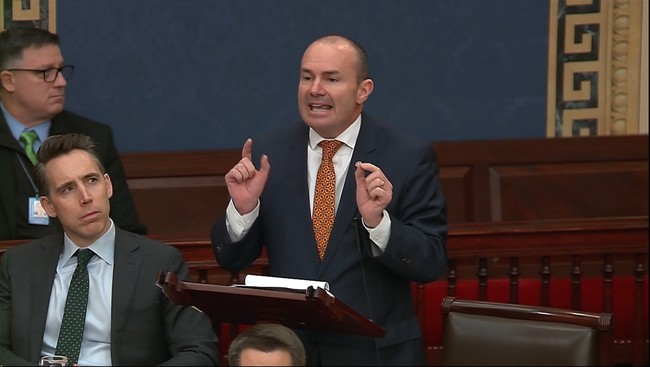
The Senate debate over the SAVE America Act put Republican concerns about election integrity and common-sense voter ID rules front and center, with Sen. Mike Lee arguing that protecting the constitutional right to vote and preventing fraud are not mutually exclusive. He challenged Democrats who claim ID requirements disenfranchise voters, arguing that safeguards ensure every lawful citizen’s ballot retains full value and that ignoring fraud effectively dilutes legitimate votes. The back-and-forth included sharp exchanges, courtroom-style logic, and pointed accusations about states’ reluctance to share voter data. Video clips and reactions highlighted the political theater and the real stakes of preserving trust in our elections.
Americans know basic truths: cheating is wrong and honesty matters. When it comes to voting, those principles translate into making sure only eligible citizens cast ballots so that each lawful vote counts equally. The debate on the Senate floor was not some abstract legal exercise; it was about whether we protect the franchise or let it be weakened by sloppy rules and refusals to verify eligibility.
Sen. Mike Lee laid out the argument plainly, pushing back against the idea that a constitutionally protected right means there are no reasonable rules around exercising it. He argued that requiring valid ID and sensible verification steps does not negate the right to vote, it protects it. Allowing fraudulent votes to slip in is the true disenfranchisement because it diminishes the weight of every honest citizen’s ballot.
[Note: At 2:08 in the video, the beginning portion of the clip repeats. There is an edit around :36, also.]
“They [the Democrats] say, ‘Well, it’s [voting] a constitutionally-protected right. Darn right it is! And it’s our job to make sure that that’s protected. But the fact that it’s a constitutionally-protected right in no way, shape, or form means that we have to make it easy to vote, and screw the rest. Let’s let them cheat.”
Lee pointed out the obvious: making voting easy does not mean eliminating responsible checks that prevent fraud. Democrats, he said, seem laser-focused on reducing barriers to the point where the integrity of an election is compromised. That obsession, in his telling, risks opening the door to ineligible voting, which in turn diminishes the power of legitimate citizens’ voices.
“Their mantra appears to be, ‘Make it easy to vote and screw the rest, we don’t care,'” Lee said on the floor, calling out what he sees as a single-minded pursuit. He pushed back on dismissive claims that voter fraud is a fantasy, noting that ignoring proven vulnerabilities has real consequences for the value of lawful ballots. The point was not to make voting harder for citizens but to prevent noncitizen or otherwise ineligible votes from canceling out the votes of Americans.
He asked a simple rhetorical question: if requiring ID for voting is labeled disenfranchisement, would the same logic apply to other routine things like getting a job? The comparison underscored the impracticality of treating civic participation uniquely untethered to any standard verification. In Lee’s framing, the real grievance should be against systems that allow fraud, not against common-sense steps that protect voters.
Lee hammered the constitutional argument hard: “That’s not a rational conclusion, unless of course your objective is to facilitate noncitizen fraudulent voting in our elections, to the disenfranchisement of actual American citizens who are there to vote. This is not a victimless crime! And shame on my colleagues for suggesting otherwise.” Those words drove home the Republican view that lax policies privilege partisan advantage over citizen rights.
The floor exchanges also exposed political theater. Lee accused some Democrats of reflexive opposition driven by partisan instincts rather than sober analysis, reducing complex policy debates to slogans and sound bites. That critique reached beyond voter ID to a broader skepticism about motives when safeguards are resisted without credible alternatives for verification.
Commentary and reaction on social platforms amplified the moment, with supporters praising Lee’s clarity and critics dismissing it as partisan bluster. The larger issue remains: will Congress adopt measures that strengthen the trustworthiness of federal elections, or will political calculation keep vulnerabilities in place? Lawmakers on both sides will keep arguing, but the practical stakes are whether citizens can trust that their ballots matter.
Senator Mike Lee just NAILED IT on the Democrat game on the SAVE America Act.
“Most so-called blue states” REFUSE to share voter data with DHS because they know it would expose illegal aliens in active voter rolls.
Their excuse boils down to “ORANGE MAN BAD.”
“Their argument that ‘TRUMP BAD’ equals no state should have to share its data, even where necessary in order to weed out FRAUD in federal elections.”
“That argument isn’t good.”
Another clip surfaced that highlighted complaints about state-level data practices and the refusal of some jurisdictions to cooperate with federal verification efforts. Supporters of stronger rules say that without accurate data sharing and routine checks, attempts to secure elections will be hamstrung at every turn. Skeptics of federal intervention respond that states control elections and must guard voting access, but the clash is over which path better preserves citizens’ rights.
The debate over the SAVE America Act is emblematic of a larger partisan divide: one side prioritizes ease and access, sometimes at the cost of verification, while the other emphasizes rules and checks to ensure lawful participation. Sen. Lee’s message was crisp and forceful: you cannot defend the right to vote by letting the system be so porous that the votes of real Americans are effectively canceled out. That argument will be central as the Senate continues to wrestle with election policy and the balance between access and integrity.

Add comment