
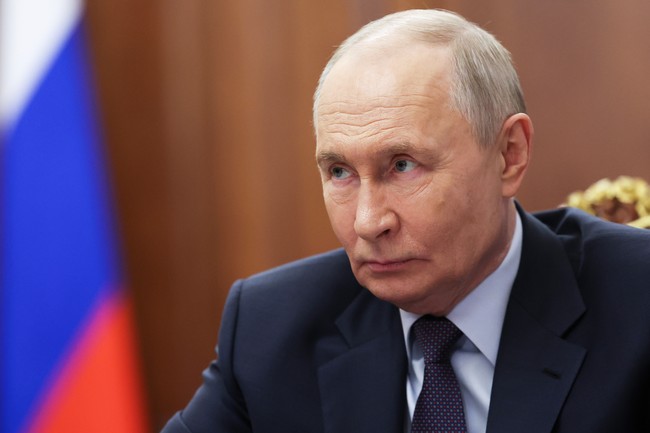
Vladimir Putin told reporters the Russia-Ukraine war is “nearing completion,” and that statement comes amid a short cease-fire and a reported prisoner exchange negotiated with U.S. involvement. This article walks through what was said, what leaders on both sides have done publicly, and the big unanswered questions about any long-term settlement and who negotiates it.
Putin’s line about the conflict “nearing completion” landed like a surprising olive branch, especially for families on both sides who have lost loved ones. He balanced that with a sober note, admitting the situation is “still a serious thing,” which keeps expectations grounded. The war, which began in February 2022, has created enormous human suffering and strategic shifts across Europe.
Russian President Vladimir Putin told reporters that he thinks the Russia-Ukraine war “is coming to an end.”
The war started in February 2022. On Friday, President Donald Trump announced a three-day cease-fire.
Roughly 1.8 million people have died in the war.
There is a short, strictly observed pause of hostilities tied to Russia’s Victory Day, and President Trump publicly announced the three-day cease-fire. That pause has opened a narrow window for diplomatic moves, including a large prisoner exchange that both sides appear to accept in principle. Those are real developments anyone who wants peace should welcome, but they are tactical and temporary unless followed by substantive agreements.
Here’s the clip of :
Ukraine’s leadership is using the moment to secure humanitarian wins, including the reported 1,000-for-1,000 prisoner swap tied to the temporary cease-fire. Volodymyr Zelensky framed the exchange as part of a negotiating process mediated by the American side and made clear that bringing prisoners home is a priority over symbolic events. He thanked the U.S. for its diplomatic role and asked that the Russians be held to their commitments.
In recent days, there have been many appeals and signals regarding the setup for tomorrow in Moscow in connection with our Ukrainian long-range sanctions. The principle of symmetry in our actions is well known and has been clearly communicated to the Russian side. An additional argument for Ukraine in determining our position has always been the resolution of one of the key humanitarian issues of this war – namely, the release of prisoners of war. Red Square is less important to us than the lives of Ukrainian prisoners who can be brought home.
That is why today, within the framework of the negotiating process mediated by the American side, we received Russia’s agreement to conduct a prisoner exchange in the format of 1,000 for 1,000. A ceasefire regime must also be established on May 9, 10, and 11. Ukraine is consistently working to bring its people home from Russian captivity. I have instructed our team to promptly prepare everything necessary for the exchange.
I thank the President of the United States and his team for their productive diplomatic involvement. We expect the United States to ensure that the Russian side fulfills these agreements. Glory to Ukraine!
Even with these positive noises, the big structural questions remain unanswered. What would a long-term cease-fire actually look like, and who enforces it? Will the borders and front lines revert, or will current territorial control be treated as permanent? Those are policy-level choices that will shape security across Europe for decades.
Crimea is the thorny example everyone keeps circling. If Kyiv expects to recover Crimea through diplomacy, that hope collides with hard reality and the strategic importance Russia assigns to the peninsula. Conversations about territory will be the hardest part of any follow-up talks, and neither side appears ready to concede significant ground without leverage.
Who mediates a lasting deal matters a lot. Europe could play the lead, or the United States may remain the central broker, depending on how the politics shake out. From a Republican standpoint, strong U.S. diplomacy that secures concrete humanitarian results and protects American interests is what matters most; ad hoc agreements without verification will be fragile.
We should be cautiously optimistic, but not naive. There have been pauses and pledges before that did not hold, and wartime bargaining rarely produces clean, permanent endings without persistent oversight. Still, a credible prisoner exchange and a cease-fire window are tangible outcomes worth noting as we watch whether a temporary lull becomes a durable peace. President Trump announced the cease-fire in .
Zelensky replied on Friday in his :
Public statements are one thing; follow-through is another. The international community will be watching whether Russia honors the exchange and the cease-fire dates, and whether Kyiv, with U.S. backing, can secure guarantees for its people. For now, families on both sides are holding their breath, hoping this Mother’s Day brings something closer to an end than another brutal chapter.



Add comment