
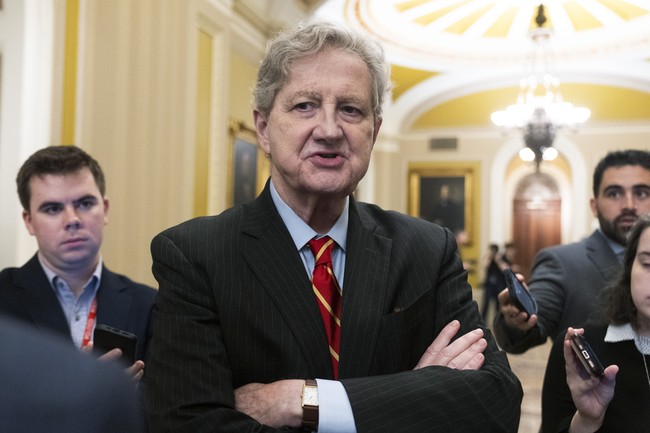
Sen. John Kennedy pressed the Senate to act on the SAVE America Act, insisting Republicans should stop politicking and force a vote, and he mocked both procedural delays and the far-left agenda being pushed by some Democrats.
Sen. John Kennedy was pointed and unapologetic in a recent TV interview, saying he would stay in Washington as long as necessary to get the bill to a vote. He criticized endless meetings and signaled a preference for decisive action over procedural theater. That stance frames a clear Republican demand: finish the job and stop the delay tactics. It’s a plainspoken call for accountability and results.
Kennedy’s frustration centered on what he described as needless meetings that produce no outcomes, a gripe many in both parties have felt. He said, “I am prepared to stay here as long as it takes. I’ve been to a squillion meetings to talk about this stuff that could’ve been an email! I’d rather have a back alley colonoscopy than go to another meeting! It’s time to vote!” Those lines cut through the usual Senate-speak with a bluntness designed to move colleagues to act.
https://x.com/EricLDaugh/status/2085394303778496676
The senator made clear the vote schedule was uncertain, but his impatience was not. He argued the right response to delay is persistence, not compromise on principle. For Republicans, that translates to using every available tool to push legislation through and to resist letting procedure become a substitute for policy.
Kennedy also called out what he sees as the Democrats’ left flank, warning that their priorities won’t play well outside some coastal and urban strongholds. He said much of what they push might be popular in very blue districts, but the nation at large is not buying policies that he portrayed as extreme. The message was aimed at convincing swing voters that Republicans will check those tendencies.
The senator laid out a straightforward strategy for handling the most vocal progressives: let them speak and let the public judge. He labeled this approach “Operation: Let Them Speak,” and used it to highlight positions he found radical. It’s a tactical move that relies on contrast — the more they explain their platform, the clearer the choice becomes for voters across America.
He summarized the left’s positions with a list of claims that he argued are out of step with mainstream views. “These folks have contempt for America when they should have gratitude. They wanna open the prisons, open the border, defund the police, defund ICE, abolish Thanksgiving, a government-run economy. The American people aren’t gonna, not going to support that kind of nonsense.” Quoting him exactly underscores how sharply he framed the argument and how he expects voters to react.
Kudlow, in the interview, agreed with Kennedy’s assessment and the broader point that some Democratic leaders have articulated an agenda that seems disconnected from practical governance. The exchange reinforced the Republican narrative that Democrats are tilting toward policies that many Americans find unpalatable. That alignment between a senator and a media commentator aims to amplify the critique and pressure lawmakers to distance themselves from extreme ideas.
Kennedy also pointed out the contrast between populist rhetoric and policy clarity, saying that some socialist leaders struggle to define basic terms even as they promise sweeping changes. That confusion, he suggested, weakens the Democrats’ appeal outside their core bases. Republicans can use that to insist on clearer policy debates and to demand concrete answers rather than platitudes.
The broader Republican point in this coverage is twofold: push for immediate votes on priorities, and force a public reckoning with Democratic proposals. By keeping the pressure on procedural fronts and on the message front, conservatives hope to shape the upcoming political battleground. Kennedy’s remarks are meant to energize that effort and to provide soundbites that resonate with voters tired of Washington dithering.
From this perspective, the remedy is simple—stop the meetings that accomplish nothing and put policies to a clear vote where voters can see the choices. Kennedy’s colorful language and his insistence on action are designed to make that point memorable. Republicans see an opening to define the debate and to present themselves as the party of governance rather than endless negotiation.
The bottom line of the exchange was a mix of impatience with process and a strategic push to expose what Republicans call the excesses of the left. Kennedy’s style is plainspoken and confrontational by design, meant to prod colleagues and highlight contrasts for voters. Whether it succeeds will depend on how Republicans translate this rhetoric into legislative tactics and how voters respond to the vivid contrasts being drawn.


Add comment