
This article reports on undercover footage from investigative teams showing paid exchanges of cash, cigarettes, and drugs for petition signatures on Los Angeles’ Skid Row, confrontations that turned hostile, and the legal and civic implications of paying people to register or sign petitions.
Mainstream outlets often downplay the scope of voter fraud, but newly surfaced videos make the problem hard to ignore. Investigators from O’Keefe Media Group and Frontlines TPUSA documented people on Skid Row being offered cash and goods in return for petition signatures. The footage shows circulators admitting they get paid per signature and that many signers do not understand what they are signing.
That kind of behavior is not a small oversight. The videos capture petition circulators admitting payments of $7–$10 per signature and claims of daily earnings exceeding $1,000. These are direct incentives that can corrupt the signature-gathering process and distort democratic participation, especially when the signers are vulnerable and unclear about the documents they are asked to endorse.
Watch:
On camera, examples are blunt and unsettling. The footage includes a petitioner named Brenda Brown caught handing over cash while distributing voter registration forms. The investigators describe petition circulators offering cash, cigarettes, and marijuana in exchange for signatures, and some signers clearly lack understanding of the petitions they sign.
“James O’Keefe and undercover journalists with O’Keefe Media Group investigated Skid Row in Los Angeles, California while posing as homeless individuals. Hidden camera footage shows petition circulators offering cash, cigarettes, and marijuana in exchange for signatures on California ballot petitions (emphasis his). ”
“On camera, petitioners admitted they are paid $7–$10 per signature, sometimes earning more than $1,000 per day. Meanwhile, many homeless individuals signing the petitions appeared to have no understanding of what they were signing. ”
“One petitioner, Brenda Brown, was recorded handing over cash while distributing voter registration forms.”
““We gon’ give you $2.”
“Because you haven’t registered, I need to register you. So I can get paid too. I’M PAYING YOU GUYS, I NEED TO GET PAID TOO.””
Federal and state laws make this conduct illegal. Paying someone to register to vote or to sign a petition violates 52 U.S.C. §10307(c) and carries severe penalties, including up to five years in prison and a $10,000 fine. California law also bars offering anything of value for petition signatures under California Elections Code §18603, making these transactions plainly unlawful.
TPUSA’s team encountered similar behavior and faced threats when they pressed the issue. A petition circulator, caught on camera, sells a narrative about protecting women from harms like assault by rideshare drivers yet clearly cannot explain the petition’s content. The mismatch between the pitch and the actual text shows a troubling lack of transparency in how some petitions are pushed onto vulnerable people.
Just like in OMG’s video, TPUSA’s team is threatened and told to “bleed yo’ feet,” which apparently means, get the hell out of here, or we attack:
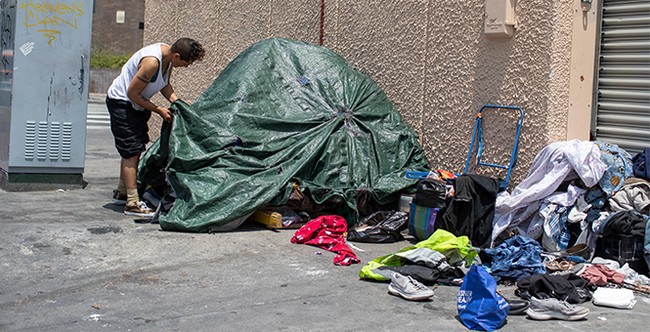
Beyond the legal questions, the videos raise plain moral concerns about exploiting homelessness for political ends. The scenes on Skid Row are dire and chaotic; interviewees and investigators describe sprawling tent encampments, public drug use, open defecation, and visible suffering across many contiguous blocks. The physical and human decay visible on the streets makes those residents easy targets for exploitative petitioning schemes.
Seeing something in person changes your perspective. The writer reports visiting Skid Row and finding conditions worse than expected, describing the area as stinking and presenting impassable sidewalks because of tents and human debris. The scale is striking: long stretches of disrepair and despair spanning dozens of city blocks, creating an environment where oversight and ethical practice easily collapse.
This is a political and civic problem as much as a criminal one, and it reflects leadership failures at multiple levels. When political actors insist fraud is insignificant while footage shows repeated payment-for-signature schemes, the public trust in our processes erodes. Elected officials and local leaders bear responsibility for addressing both the humanitarian crisis and the legal breaches that arise from it.
These videos do not just make for sensational footage; they document illegal practices that can corrupt policy initiatives and the electoral process. Law enforcement, election officials, and policymakers should take the evidence seriously and enforce the rules that protect the integrity of petitions and voter registration. At minimum, the footage demands investigation and accountability.
The situation on Skid Row is ugly and avoidable, and the documented exchanges of cash and goods for signatures are a concrete example of how the system can be gamed. If we want elections and ballot measures to reflect genuine public will, practices that pay people to sign or register must be exposed and stopped immediately.



Add comment