
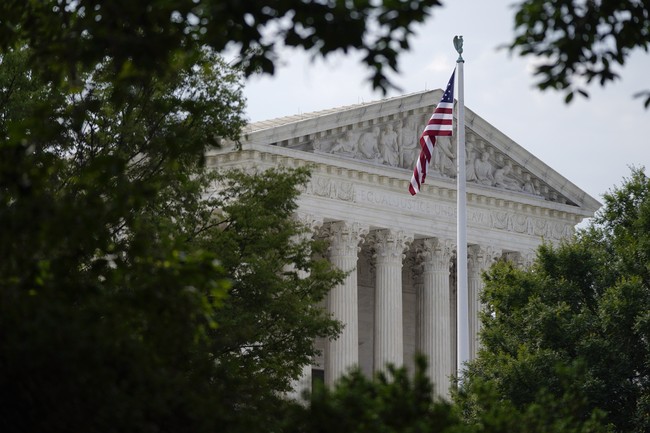
The Supreme Court has struck down Louisiana’s congressional map in a 6-3 ruling, finding the state’s creation of a second majority-Black district was not compelled by the Voting Rights Act and ran afoul of the Equal Protection Clause, with Justice Alito writing the majority opinion and Justice Kagan dissenting.
The Court’s opinion centered on whether Section 2 of the Voting Rights Act required Louisiana to draw a second majority-minority district when it enacted SB8 in 2024. In a 6-3 decision, the majority concluded the Voting Rights Act did not force that outcome and therefore race-conscious line drawing lacked a compelling interest under the Constitution. Justice Samuel Alito wrote the opinion, joined by Chief Justice Roberts and Justices Thomas, Gorsuch, Kavanaugh, and Barrett.
The contested map created a sprawling District 6 stretching roughly 250 miles from Shreveport through Alexandria and Lafayette to Baton Rouge. That arrangement followed a lower court finding in Robinson v. Ardoin that the prior map likely violated Section 2, prompting the state legislature to adopt SB8. The Supreme Court focused on whether the plaintiffs had met each step of the updated Section 2 test the Court now applies.
Alito found the plaintiffs failed at every step of that test, and he rejected the argument that the Voting Rights Act required a second majority-Black district. He warned that the illustrative maps the plaintiffs proposed would have dramatically altered the partisan balance in certain districts. The majority pointed out that some of those alternative maps would have placed Representative Julia Letlow in an area with more than twice as many registered Democrats as Republicans, which the opinion said would effectively end her congressional career.
The Court also criticized the plaintiffs’ racial polarization analysis for not controlling for partisan preference, a critical flaw in the majority’s view. Alito emphasized that the totality-of-circumstances showing leaned heavily on historical discrimination rather than contemporary evidence. He framed the Voting Rights Act as forward-looking and quoted the Court’s 2013 decision: “is not designed to punish for the past” but “works to ensure a better future.”
From a practical standpoint, the majority stressed that using race as the predominant factor in drawing districts requires a strong legal justification that simply wasn’t present here. Absent a clear statutory mandate, the Court held the state’s race-based decisions were unconstitutional under the Equal Protection Clause. The ruling makes clear the justices intend to draw lines between permissible consideration of race and impermissible racial predominance.
Justice Elena Kagan issued the dissent, joined by Justices Sonia Sotomayor and Ketanji Brown Jackson, sharply criticizing the majority for undermining Section 2 protections. Kagan argued the decision revives an intent standard that Congress expressly rejected in 1982, effectively gutting the statute’s power to remedy vote dilution. Her dissent frames the ruling as a rollback of the tools Congress provided to address racially polarized voting and its effects on representation.
The ruling creates immediate implications for states with similar districts and for future redistricting battles. Legislatures and private litigants will now have to weigh carefully whether proposed districts can be defended without making race the dominant factor. Court watchers note the decision signals a narrower avenue for courts to order race-conscious remedies absent compelling evidence under the updated Section 2 framework.
Political operatives on both sides will test the new limits in upcoming redistricting cycles and election litigation, and state legislatures may revise maps to avoid constitutional pitfalls the decision highlights. The practical fallout could reshape competition in several Southern states where race and partisan voting patterns are tightly linked. Expect new challenges as plaintiffs attempt to thread the narrower needle the majority has defined.
The decision also reopens debates about how courts should balance remedial aims with constitutional constraints during redistricting. For Republicans and conservatives, the ruling is a win for colorblind districting principles and for restraining federal intervention in state mapmaking. For critics, the decision narrows remedies available to minority voters and raises thorny questions about how to address persistent racial polarization without running afoul of the Constitution.
Going forward, litigants seeking race-based remedies will need robust, contemporaneous evidence tying vote denial or dilution to current conditions rather than historical injustices. Courts will scrutinize polarization analyses and alternative maps for partisan effects, not just racial composition. The new standard will make future Section 2 claims more exacting and will shape how both lawmakers and advocates approach the next round of redistricting fights.



Add comment