
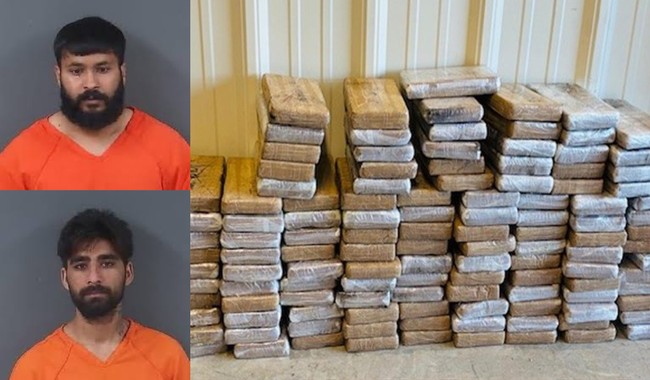
This article reports on the arrest of two truck drivers from California found with about 309 pounds of cocaine during a DOT stop in Putnam County, Indiana, the drugs’ estimated $7 million street value, the involvement of Indiana State Police interdiction units and ICE holds, and official statements underscoring public safety and immigration enforcement.
The traffic stop on I-70 uncovered a major drug shipment hidden in the sleeper berth of a semi tractor-trailer, highlighting how commercial routes can be exploited for illegal trafficking. The two men arrested are identified as Gupreet Singh of Fresno, California, and Jasveer Singh of Santa Clara, California, and both are now facing narcotics charges and ICE deportation holds. This bust underscores growing concerns among law enforcement and conservative policymakers about border security and the need to protect highways. It also raises questions about how commercial vehicle oversight and immigration enforcement intersect.
The Indiana State Police trooper who initiated the stop observed criminal indicators during a routine DOT compliance check, and a K-9 alerted, prompting a probable cause search that produced the cocaine. The agency’s official account notes that 309 pounds of cocaine were recovered from the sleeper area of the truck. Authorities estimate the street value of that seizure at $7 million, and records indicate the shipment originated in Joplin, Missouri, bound for Richmond, Indiana. Those facts are stark and hard to ignore when talking about the scale of illicit trade moving through American interstate systems.
Saturday, January 3, 2026, at approximately 1:30 p.m., an Indiana State Police Trooper stopped a blue International semi tractor-trailer on I-70 at the 41 mile-marker eastbound, for a routine DOT compliance inspection. During conversations with the driver, criminal indicators were observed and a positive alert from an Indiana State Police K-9 led to a probable cause search.
During the search, the trooper found 309 pounds of cocaine in the sleeper berth of the truck.
Indiana’s interdiction troopers are assigned specifically to detect and interdict drug smuggling along major corridors, and officials say the seizure came from a full-time interdiction trooper in the Drug Enforcement Section. ISP Superintendent Anthony Scott emphasized how these patrols operate to keep illegal drugs off the roads and away from communities. From a Republican perspective, the takeaway is straightforward: strong, targeted enforcement on interstate freight routes protects citizens and lawful commerce. The operation also illustrates the value of specialized law enforcement roles focused on commercial vehicle enforcement.
State officials made it clear that immigration enforcement was part of the outcome, with ICE deportation holds placed on the two men arrested. Indiana has coordinated operations with federal immigration authorities in the past, and state leaders frame such cooperation as a way to prevent repeat offenses and remove dangerous actors. Lawmakers who prioritize secure borders and public safety see joint state-federal partnerships as essential. Arresting and processing noncitizen offenders through ICE helps ensure the criminal justice outcome aligns with broader immigration priorities.
Gov. Mike Braun’s earlier comments about protecting interstate highways as the “Crossroads of America” reflect a priority to keep commerce moving without providing safe passage for criminals. He warned that those using the interstate system for crime are endangering communities, and he supported expanding patrol resources to commercial vehicle enforcement. That position aligns with calls from Republicans to bolster enforcement capacity and hold accountable anyone who exploits America’s transportation networks. Public safety advocates argue that arresting traffickers at the border and on highways reduces victimization and stops supply before drugs reach local markets.
“Trucks come through Indiana hauling everything from produce to hazardous materials to nearly every other type of commercial goods. Millions of pounds of freight moving on the highways every day. For the Indiana State Police, this is not about immigration status alone. It’s about public safety. An 80,000-pound truck in untrained hands is a dangerous thing.”
Officials stress that the mission is broader than immigration: protecting lawful truckers and trucking companies from the criminal behavior of a few. A safe supply chain benefits drivers, businesses, and consumers who rely on predictable freight movement. Conservatives argue that effective road enforcement supports commerce and community safety, and that resources devoted to interdiction are investments in both. Removing large quantities of narcotics from circulation also prevents downstream violence and addiction-related harms in local communities.
The case in Putnam County stands as an example of the kind of interdiction Republicans say needs to be sustained and expanded nationwide. When state troopers, interdiction teams, and federal partners act decisively, large shipments can be seized and dangerous individuals can be removed from the road. That approach, proponents say, keeps Americans safer and businesses freer from criminal disruption. The arrest of the two drivers and seizure of 309 pounds of cocaine shows how coordinated enforcement can yield tangible results.



Add comment