
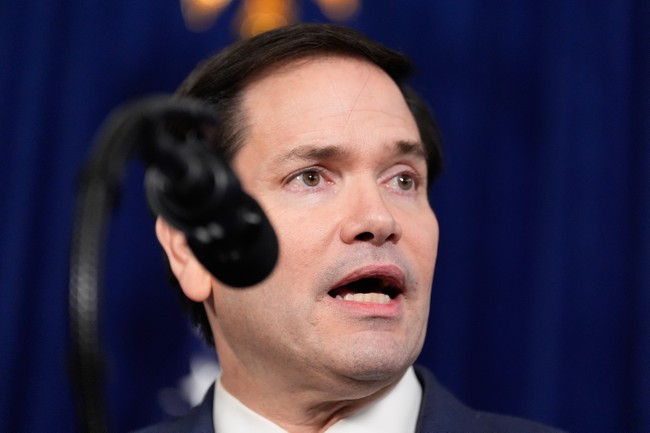
Secretary of State Marco Rubio spoke with ABC News’ This Week about Venezuela’s future, sanctions, and American leverage over oil shipments after Nicolás Maduro’s ouster, offering blunt explanations about strategy, legal constraints, and operational realities on the ground.
Rubio faced direct questions about sanctions and how they are being applied to Venezuela’s oil industry, and he made clear that the United States has operational leverage. He explained that sanctioned vessels can be seized and that court orders exist to support those actions, pointing to a squeezable logistics picture as storage runs low. This leverage is central to the effort to force governance changes in Venezuela’s oil sector.
Rubio answered whether the United States is effectively running Venezuela by saying U.S. actions are aimed at shaping the post-Maduro trajectory rather than administering the country. He described how the current posture — including naval assets positioned offshore — creates real options to interdict sanctioned shipments. He emphasized that selective enforcement backed by court orders gives the U.S. the ability to pick which vessels to target.
…and we can pick and choose which ones we go after. We have court orders for each one.
The senator emphasized that Venezuela’s oil resource is massive in quantity even if quality and production capacity are degraded, and that sanctions remain a primary instrument to weaken Maduro’s hold. He noted the industry is operating in a broken, predatory fashion that benefits a narrow circle of cronies rather than the Venezuelan people. Pressure on oil exports is intended to reduce the regime’s financial lifelines.
When asked about U.S. companies or other foreign firms working in Venezuela, Rubio stressed this is not a rush to secure fields for outsiders but a plan to prevent sanctioned oil from moving until governance is fixed. He framed the situation as one where fields are effectively run by thieves and cronies, with production at a fraction of historic levels. Rubio suggested that non-Russian, non-Chinese companies would be preferred partners if and when the sector is rebuilt, signaling an intent to limit Moscow and Beijing’s gains.
Well, ultimately, this isn’t about securing (Venezuela’s) oil fields. This is about ensuring that no sanctioned oil can come in and out until they make changes to the governance of that entire industry. Because, right now, that industry is non-existent in the traditional way. These oil fields, basically, are pirate operations. People literally steal the oil from the ground; they have, that’s how they hold this regime together. A handful of cronies benefit from this oil.
Rubio described production as under 20 percent of capacity, with aging equipment and mismanagement draining any revenue the fields produce. He argued that this rot justifies keeping sanctions in place and tightly controlling who can rebuild the industry. The policy aims to ensure reforms reach state institutions rather than enriching corrupt intermediaries.
The conversation also covered legitimacy and succession inside Venezuela, with Rubio making clear the existing Maduro apparatus lacks legal legitimacy in the view of multiple countries. He pointed out that even when outside actors do not recognize Maduro, they must deal with officials who control critical infrastructure like airports and ports. That reality forces pragmatic engagement with de facto authorities while rejecting their political claims.
Well, this is not about a legitimate president. We don’t believe that this regime in place is legitimate via an election. And that’s not just us. It’s 60-some countries around the world that have taken that view as well, including the European Union. But we understand that there are people in Venezuela that, today, who are the ones that can actually make changes. For example, when we want to send in the migrant flights, even though we never recognized the Maduro regime as legitimate, we had to deal with the authorities that controlled the airports.
Rubio was also asked why Congress was not notified in advance of certain rapid moves, and he invoked operational urgency and the risk of leaks. He argued that notifying a broad audience in Congress would likely result in swift public disclosure that could compromise missions and allow the regime to move assets or personnel. He framed secrecy as sometimes necessary to protect outcomes in high-stakes international operations.
The administration’s claim of exigent circumstances — a legal standard for acting without prior notice in urgent situations — was mentioned in the interview as the basis for not informing Congress ahead of time. That standard covers scenarios where immediate action is necessary to prevent harm, evidence destruction, or escape, and Rubio used it to justify the timeline of decisions. The legal and political debate over that choice is likely to continue, but Rubio’s point was that speed and surprise mattered.
Throughout the discussion Rubio presented a policy focused on squeezing illicit revenue streams, preventing geopolitical rivals from stepping into the vacuum, and insisting on governance reforms before reopening the sector to foreign investors. His tone was pragmatic and unsparing about how the oil industry has been misused to prop up authoritarian rule. The work ahead, Rubio indicated, will be long and detailed, aimed at restoring legitimate institutions and curbing corrupt extraction of national wealth.

Add comment