
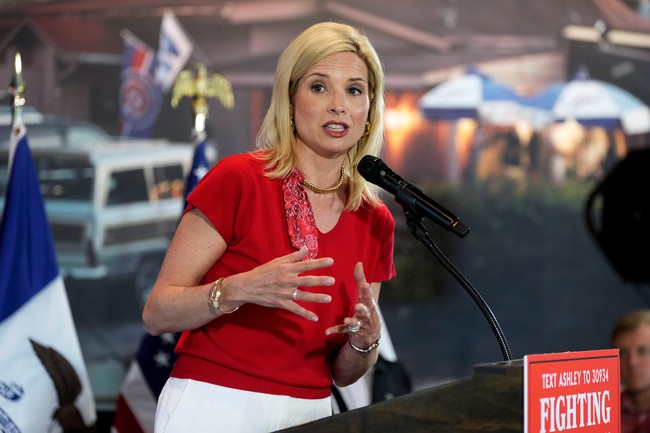
The Iowa Republican primary to fill Sen. Joni Ernst’s open seat concluded without drama: Rep. Ashley Hinson won the GOP nomination by a wide margin, consolidating establishment and Trump-aligned support and setting up a likely Republican hold in the fall. This piece lays out what happened in the contest, who backed each candidate, the main themes of the campaigns, and where the race appears headed as the general election approaches.
The contest opened when two-term Sen. Joni Ernst decided not to run again, creating an open-seat fight in a state that GOP voters have favored for years. With early returns in, Decision Desk HQ reported a decisive result: Republican Rep. Ashley Hinson beat former state senator Jim Carlin roughly 76 percent to 24 percent with about 15 percent of precincts reported. The margin underlines how quickly the party coalesced around a single nominee once Ernst stepped aside.
https://x.com/DecisionDeskHQ/status/2061979831194054676
Hinson’s path to the nomination leaned on endorsements and a clear promise to work with the Republican congressional majority and the Republican president. She had the backing of Sen. Joni Ernst, Gov. Kim Reynolds, and former President Donald Trump, signaling unified party support at both the state and national level. That alignment helped Hinson position herself as a candidate who will protect conservative policy wins and be a reliable vote on the Senate floor.
When Hinson announced her campaign in September 2025 she framed herself as a direct partner to the former president and a defender of the priorities that matter to GOP voters. She pledged to be President Trump’s “top ally in the United States Senate,” and she emphasized her role in supporting major conservative legislation while in the House. Her public remarks stressed fiscal responsibility and returning taxpayer dollars to families, themes that resonated with many Iowa voters.
“What I have tried to do as a member of Congress, and hopefully will continue to do in the United States Senate, is focus on policies that are going to make life more affordable in the long run for Iowans, returning as many taxpayer dollars as we can,” she said.
Jim Carlin ran from the right on several cultural and veterans issues, promoting his record as a state senator and his efforts on accountability in state institutions. He highlighted work on a senior property tax freeze and efforts to protect veterans and children, presenting himself as a fighter for people outside Washington. Carlin also emphasized his early sponsorship of socially conservative measures, hoping to rally grassroots voters who value culture-war stances.
“The work I’ve done, including work on a senior property tax freeze, was about you,” he said. “It’s about seniors, it’s about veterans, it’s about children and protecting them. And right now, I don’t think the government is serving us. I think it’s actually working against the economic interests of the middle class.”
The primary result shows Republicans in Iowa coalescing around electability as much as ideology this cycle, favoring a candidate with House experience, statewide endorsements, and a clear message about economic relief. Hinson’s campaign repeatedly pointed to her role in legislative bargaining and presented the Senate bid as a natural next step to expand those efforts. That pragmatic pitch, mixed with strong endorsements, made her the clear favorite.
Looking ahead to November, Hinson is poised to face the likely Democratic nominee, State Rep. Josh Turek, in a state that still leans Republican. Analysts and handicappers rate the open-seat contest as Likely Republican, reflecting Iowa’s recent voting patterns and the strength of the GOP bench here. The general election will test whether national trends or local familiarity carry more weight with voters this fall.
For Republicans, retaining this seat matters for defending a Senate majority and preserving momentum on policy priorities that were advanced by the House and the prior administration. The result in Iowa contributes to a larger map argument about which party controls the Senate and who will set the agenda in Washington. Winning here keeps conservative momentum intact and reduces the number of pickups Democrats need to flip control.
Both campaigns will shift now to the general election playbook: Hinson will expand her message statewide and stress continuity with successful conservative policy moves, while Democrats will try to nationalize the race and capitalize on open-seat dynamics. With high-profile endorsements behind Hinson and a clear primary victory under her belt, Republicans in Iowa enter the summer with a practical path to holding the seat.


Add comment