
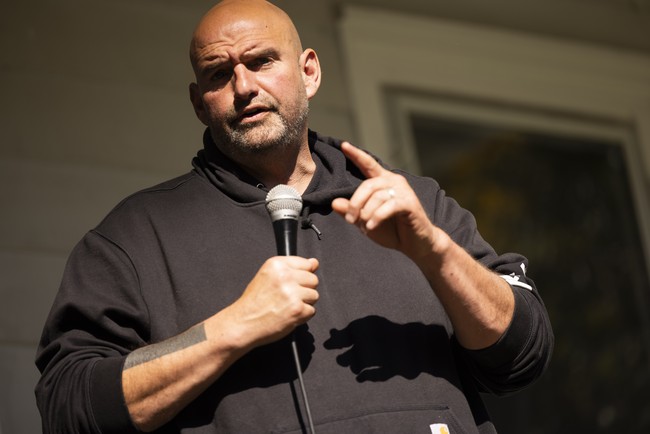
Republican readers should care because John Fetterman’s profile as a dissenter inside the Democratic Party forces a clear choice for voters and leaders alike: keep applauding a party that tolerates chaotic behavior, or reward a senator who breaks from the party line on issues like voter ID, spending, and support for Israel. This piece looks at why his independence matters, how the party has reacted, and what switching parties or becoming an independent would realistically mean for Pennsylvania and national politics.
Tuesday night’s high-profile events in Washington highlighted a growing divide between mainstream voters and the Democratic establishment, drawing attention to how some members of that party behave on the floor and in public. Outbursts and chaotic moments shifted focus away from policy to personality, and those moments feed a larger narrative about whether the party still represents moderate, working-class Americans. That debate has placed John Fetterman in an awkward spotlight as someone who publicly bucks his own side.
Fetterman’s history of breaking with fellow Democrats is well known in Pennsylvania circles, not as theater but as a track record of votes and public remarks that put him at odds with party orthodoxy. He’s criticized resistance to voter ID, opposed certain spending positions that precipitated shutdown fights, and taken consistent pro-Israel stances at times when parts of his caucus have been less forceful. Those actions have made him a useful foil for Republicans who argue the Democratic Party is drifting from mainstream concerns.
Press and pundits have labeled senators who defy their party as “mavericks” when convenient, but Fetterman hasn’t received the same warm treatment the left extended to dissenters from other parties in the past. Instead of praise, he’s faced internal plotting and potential primary challenges from activists who see his independence as a liability. That kind of intra-party pushback shows a party willing to intimidate its own members for deviating from a rigid script.
Interviewers repeatedly ask a predictable question: will he switch parties? Fetterman has said he will not, framing his role as an independent voice inside the Democratic fold. His repeated refusal to join the Republican Party doesn’t mean he won’t be useful to Republicans politically. If he maintains his pattern of voting and rhetoric, he can peel off votes and create openings for Republicans in swing states where moderate voters matter most.
The math of party control matters here. A formal party switch by Fetterman would be headline news and could change Senate arithmetic, but it’s not the only relevant option. Becoming an independent who still caucuses with Democrats would be more likely and would keep current committee dynamics intact. For Republicans, that outcome offers less immediate gain than a formal flip, but it still signals weakness within the Democratic ranks and could embolden senators in swing states to follow a similar path.
Voters in Pennsylvania care about representation that reflects mixed values across urban and rural areas, and Fetterman has repeatedly invoked that responsibility as his reason for resisting full party conformity. He has emphasized voting patterns and practical governance over ideological purity, arguing that a senator from a politically diverse state must bridge divides. That position appeals to moderates and independents who are tired of extreme rhetoric from both sides.
Democratic activists, however, appear impatient with any deviation from the current party line, which has provoked discussions about mounting a primary challenge despite Fetterman not being up for reelection until 2028. Those internal moves reveal a party more interested in loyalty tests than in expanding appeal. For Republicans, the spectacle of a party policing its own offers political ammunition and a simple message: the Democrats are choosing purity over electability.
Fetterman’s critics on the left have, at times, deployed harsh labels and rhetoric against opponents of the party line; he has pushed back against the use of terms like “Nazis” or “fascists” to describe political opponents. His public rebuke of such language speaks to a different tone in political discourse—one that many voters say they prefer. That alone makes him an interesting figure to watch in the run-up to 2026 contests and beyond.
Republicans naturally would welcome a seat flip, but the realistic scenarios are narrower: continued independent-minded voting or a formal party switch, which remains unlikely. Either way, Fetterman’s stance exposes tensions within the Democratic coalition and gives voters a clearer choice about whether they want rigid party discipline or a representative who occasionally breaks ranks. Watch for how party leaders react; their response will tell you whether they want unity through persuasion or unity through enforcement.
“It’s like, the numbers bear it out. I vote in the 90 percents. I mean, you can look it up; it’s a fact. I’m not changing the party, and I might clap for some things that I agree, but when you represent Pennsylvania, that’s there, I mean, we’d all love, like a blue state, then you know, then you really just have to talk to one side, but for me, it’s a special responsibility if you represent Pennsylvania, that, you know, we have to find a way forward.”
How national journalists frame Fetterman’s choices will shape whether his independence is treated as admirable or punished. The same actions earn different media responses depending on which party the dissenter belongs to, and the inconsistency frustrates voters who want honest, even-handed coverage. Conservatives can use that narrative to highlight media bias and to argue for clearer distinctions between party rhetoric and actual policy outcomes.
The bottom line for Republican strategists is straightforward: whether he remains a Democratic senator who votes independently or shifts toward independence formally, Fetterman’s posture weakens the image of a monolithic left. That reality opens opportunities in swing states and underscores the importance of appealing to independent and moderate voters. Expect both parties to watch Pennsylvania closely as a test case for whether a centrist streak can survive inside today’s polarized parties.

Add comment