
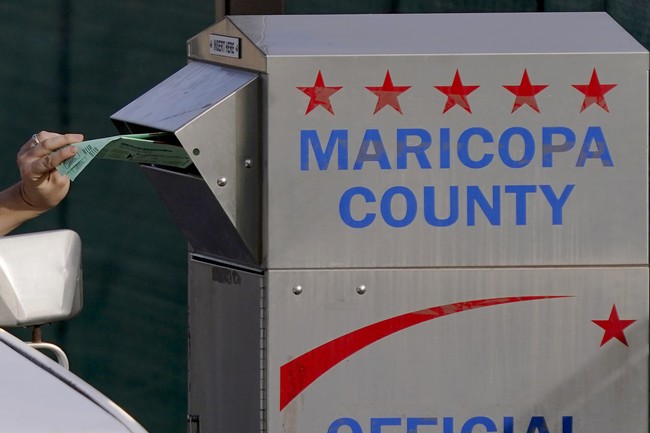
Federal agents have quietly collected large volumes of electronic voting records from Maricopa County after a grand jury subpoena, stoking renewed debate about election integrity in Arizona and across the country. This piece walks through what the seizure involved, who has reacted, the context from prior probes, and how local officials are responding while preserving the exact statements quoted in source material. Embedded media from the original reporting remain in place for reference. The focus here is on the facts and reactions around the subpoena and the ongoing investigation.
Maricopa County has been a flashpoint for election disputes since 2020, and the recent development is a significant escalation. According to multiple people familiar with the probe, the FBI is receiving gigabytes of electronic election data from Arizona’s largest county. The transfer followed a grand jury subpoena, a legal step that signals the investigation has reached a more formal, evidence-driven phase.
The FBI is expanding its criminal probe into suspected election irregularities, secretly obtaining a large tranche of voting records from Arizona’s largest county with a recent grand jury subpoena, multiple people familiar with the probe told Just the News.
The sources, who spoke only on condition of anonymity because of the secrecy of the grand jury probe, said FBI agents are receiving gigabytes of electronic election data from Maricopa County, about a month after the bureau first disclosed an investigation into election irregularities by raiding a warehouse near Atlanta and seizing ballots from the 2020 election conducted in Fulton County, Georgia’s largest metropolis.
Republican voices in Arizona and beyond have framed the move as overdue accountability for long-standing concerns about voting practices. Kari Lake, who ran high-profile campaigns in 2022 and 2024 and now works in a federal advisory role, welcomed the news emphatically. “The news of this subpoena gives me great hope that something will finally be done.” Her statement captured the sentiment among supporters who have pushed for deeper scrutiny of the county’s procedures.
Investigators reportedly acted after observers flagged potential problems at a local warehouse during the 2024 cycle where blank and filled-out absentee ballots were seen in proximity. Those concerns were raised by mixed-party teams of observers who felt they had witnessed irregular handling of ballots. The subpoena arrives against a backdrop of state-level inquiries and years of partisan disputes over election administration in Arizona.
The subpoena comes five years after the GOP-led Arizona state Senate conducted a lengthy investigation into the 2020 election and concluded there were significant irregularities.
More recently, the bureau was alerted to a report filed by Republican and Democrat election observers who believed they observed irregularities in November 2024 at a warehouse in Arizona where blank and filled-out absentee ballots were observed in the same location, according to the sources.
President Donald Trump, who has long criticized the conduct of past elections, reacted with a single-word endorsement in public comments. “Great!” His reaction was brief but aligned with the broader Republican narrative that federal scrutiny is warranted. Supporters see the subpoena as confirmation that federal authorities are taking steps they demanded for years.
Not everyone expects cooperation to be smooth, and some analysts say pushback is likely from local officials who view the subpoena as politically charged. Data and political analyst Garrett Archer warned that election administrators in Arizona could resist federal investigators and prioritize state-level processes. He highlighted the potential for jurisdictional tension and public messaging battles as the inquiry unfolds.
The debate now centers on what the seized gigabytes of data will reveal and how quickly prosecutors and investigators can parse electronic records. For residents and observers, the practical questions include whether the data will show procedural failures, deliberate misconduct, or explainable administrative errors. The stakes are high because findings could influence public trust and future policy choices.
Longstanding partisan fault lines underline reactions: Republicans emphasize the need for clarity and consequence, while Democrats often warn against politicizing law enforcement. That tension will shape reporting and official statements as the probe progresses. The coming weeks and months will determine whether this inquiry produces prosecutions, policy changes, or simply more contested headlines about election administration.

Add comment