

Two striking Alaska moments landed this week: a sudden, bright fireball that surprised Fairbanks residents and a rookie Iditarod musher who faced a charging bison and relied on a family story and quick thinking to get her team out of trouble unharmed. The following article walks through the fireball reports, expert context on meteors, the Iditarod encounter, and some plainspoken reflections on wildlife, firearms, and cultural survival in Alaska.
Alaska Man Monday: The Great Fairbanks Fireball, and Iditarod Bison Encounters
Spring’s extra daylight shifts the show upstairs from auroras to other sky drama, and Fairbanks got a reminder that the universe still has a surprise or two. People reported a bright, explosive meteor that lit hillsides and lingered as trails of light, prompting those slow, helpless head-turns you get when something huge and unexpected happens.
Just the other day, folks up Fairbanks way were enjoying just a regular Tuesday morning. Then, this happened: BOOM!
A bright and fiery fireball streaked across the Fairbanks sky Tuesday morning, drawing reports from residents who witnessed the event from their cars and homes.
The fireball — which streaked across the sky at around 7:32 a.m. — was also caught on camera.
Brian Collyard was driving to work when the flash of light caught his attention on the left side of his vehicle.
He initially thought it was an oncoming car with its high beams on.
“There was literally — what I would say — hundreds to 1,000 different light trails that came off this thing,” Collyard described. “It was absolutely phenomenal.
“It was the biggest explosive meteor I’ve ever seen in my life, and I’ll never forget it.”
Collyard said the flash illuminated the hillside north of Fairbanks, lighting up trees and an open snow-covered field. He described the aftermath as a descending display of individual light trails that lasted for an extended period.
Eyewitness accounts like Collyard’s tend to stick with you, and this one is vivid: flash, trails, hillside lit up like daytime for a beat. Those scenes get passed around quickly on social media and among neighbors because natural spectacles do what good stories do—everyone wants to know what they just saw.
Aaron Slonecker, director of the Planetarium and Discovery Center at the Anchorage Museum, said the event qualifies as a fireball.
“[A] meteor is a piece of rock that’s moving through the Earth’s atmosphere,” Slonecker said. “And we call it a fireball when it gets really bright and kind of fiery like that.”
Slonecker said rocks traveling through the atmosphere at speeds ranging from 25,000 to 160,000 mph generate friction with the air that causes them to heat up, disintegrate, and produce bright light.
That expert voice helps sober up the wonder with a bit of physics: meteors are fast, they burn up in the atmosphere, and occasionally one is bright enough to earn the fireball label. Most of the time you just get a streak and a sense of awe; sometimes you get that lingering, fracturing trail that sets people talking for days.
Out on the trail, the Iditarod produced its own high-drama moment unrelated to the sky. Rookie musher Jody Potts-Joseph ran into an aggressive bison, and what followed was a tense few minutes that highlighted preparation, quick thinking, and a surprising turn toward family wisdom when her firearm failed to fire.
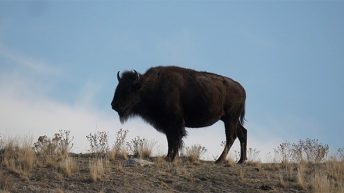
When the pistol in 48-year-old Fairbanks rookie Jody Potts-Joseph’s hands refused to fire at the wild bison her dog team encountered on the Iditarod trail, she remembered the story her grandmother told her years ago.
It was those words that helped drive away the large animal from the spot on the trail where the dog team ran up on it.
Potts-Joseph, who is from Fairbanks but runs her kennel out of Eagle Village near the Canadian border, left the Rohn checkpoint at 3:35 p.m. Tuesday running near the back of the field.
Facing a charging bison with a sidearm that won’t go bang is a scenario you don’t want to rehearse in your head. Potts-Joseph’s account is raw and human: a firearm that fails, a frozen second, and the choice to try something else. That something else was a phrase her grandmother had used in an encounter long ago with a bear.
“I got into a standoff and all I had is — my Glock wouldn’t fire,” she recounted in a cell phone video she took minutes after the encounter. “It was charging me … and it kept charging but it wouldn’t actually touch my dogs, but it was head down, pawing, and it would charge and then would stop. It did that three or four times.
With her pistol clicking but not firing, Potts-Joseph said she had to make a quick choice.
She remembered her grandmother speaking in the Hän Gwich’in tongue to calm a bear, so she did the same to the buffalo and, amazingly, the animal turned and left. The scene leaves room for skepticism and respect at once: skeptical about animals understanding languages, respectful toward practices that have kept people safe for generations.
It was then that she remembered a story her grandmother told years ago when they encountered a bear in the Alaska wilderness. Her grandmother began speaking her Native tongue, talking to the bear in the words from the Hän Gwich’in people.
“[It] means, ‘Go away, have mercy on us, leave us alone,’” Potts-Joseph explained. “And that bear just calmed down and turned around and walked off.”
Tuesday afternoon on the trail, Potts-Joseph repeated those same words.
“That was my last resort,” she said. “I said that, and the buffalo turned around and ran up that hill.
“That’s what they say, that animals can understand our Native language, and we didn’t get hurt.”
Practical takeaway: keep your firearms in working order before heading into bush country, but don’t mock the tools people inherit from their elders. Alaska’s mix of high-stakes solitude and cultural survival produces strange, necessary wisdom you likely won’t learn in a classroom.
Alaska Man score: 5 exploding meteors for the Fairbanks sky event, and 5 moose nuggets for the Iditarod bison encounter, since nobody and nothing was hurt.
Editor’s Note: Do you enjoy conservative reporting that challenges the radical left and woke media? Support the work that brings those perspectives forward.


Add comment