
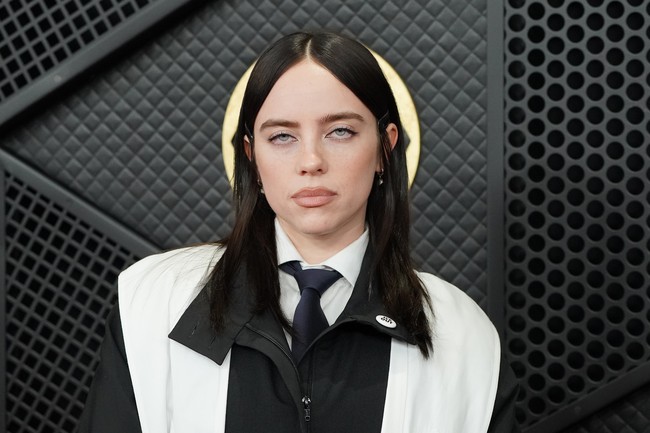
This piece examines Billie Eilish’s “No one is illegal on stolen land” Grammys comment, the public reactions that followed, and how a recent confrontation and an Australian activist’s experience highlight tensions between celebrity absolutes and real-world sovereignty and enforcement.
Billie Eilish’s Grammys line, “No one is illegal on stolen land,” landed as a bold moral claim that rejects borders and federal immigration enforcement. Onstage slogans can energize crowds, but they can also be tested in the real world where law and property meet speech. That collision is what we saw after an Australian activist said he was detained at LAX and a reporter went to Eilish’s gated Los Angeles home to make a point. These incidents expose the gap between sweeping rhetoric and the everyday mechanics of security, property rights, and national sovereignty.
When Eilish added “F**k ICE” during her acceptance speech, it was more than theater; it was a blanket condemnation of a core federal agency. Such language frames immigration enforcement as morally illegitimate and suggests that borders themselves lack standing. That is a political stance with real policy implications, not just a catchy line for a stage.
An Australian activist identified as Drew Pavlou claims he tried to live out the slogan through provocation and ran into immigration enforcement. He says he spent 30 hours at Los Angeles International Airport and was denied entry to the United States after publicly joking about moving into Eilish’s mansion. He framed it as a stunt and a critique, but he also said the encounter showed that laws and status still matter at the border.
He wrote on X:
“Billie Eilish got me deported from the US – I think her legal team contacted DHS.
I spent 30 hours at LAX immigration trying to explain that my shit posts were just a joke and that I didn’t actually plan to personally move into her mansion.
Honestly most of the agents were nice and laughed at the idea but there was nothing I could do, maybe evil leftists are still in charge of sections of the bureaucracy.
I guess some people are in fact actually illegal on stolen land.
And I guess I am just a BAD GUY.
Honestly I am legitimately one of the most misunderstood theorists/artists of the 21st century.”
Pavlou later posted what appears to be and said agents questioned him about his activist history. His claim that Eilish’s legal team contacted DHS remains unverified, and the Department of Homeland Security has not publicly confirmed any such contact. Still, the episode itself draws attention to a simple fact: legal status and immigration protocols apply regardless of theatrical intent.
Meanwhile, GB News reporter Ben Leo went to Eilish’s $3 million Los Angeles home to test the slogan in a more literal way. He stood outside a gated property ringed with cameras and called for entry on the grounds that the land was stolen. The test was meant to dramatize the mismatch between abolitionist-sounding rhetoric and the realities of private property and security.
“Billie, let us in please, Billie. We are here because this is stolen land. And we think we should be given access to your quite lovely $3 million dollar mansion.”
He noted that “according to the driveway, Billie does believe in borders,” pointing to gates and surveillance as evidence that exclusion applies at the scale of a home. That observation hits at the heart of the dispute: the same principles people invoke to criticize immigration enforcement are the very principles that protect private property and personal safety. Gates and cameras are on-the-ground versions of border control.
There is nothing controversial about a homeowner using gates or hiring security; property rights are legitimate and long-standing. The Republican view emphasizes that those same principles — recognition of boundaries, rules for entry, and the enforcement of law — are essential at the national level too. If someone argues that borders are illegitimate in principle, they should acknowledge the downstream effects when exclusion protects them personally.
Celebrity activism often trades in absolutes because absolutes are powerful onstage. They create clear soundbites and viral moments, and they reward the speaker with applause and attention. But slogans do not change statutes or administrative rules, and they rarely survive contact with institutions built to regulate entry and ownership.
When activists or satirists push an idea to its logical extreme, institutions tend to do what institutions do: enforce rules. Pavlou’s detention, whether embellished or not, illustrates how immigration procedures can override performative declarations. And a gated mansion demonstrates that the person making the declaration still values exclusion when it protects their own space.
Slogans are simple and satisfying, but sovereignty is complex and messy. The contrast between Eilish’s stage rhetoric and the locked gates around her home shines a light on that contradiction. It’s one thing to shout a moral line in a crowded room and another to live in a system that uses exclusion as a tool to protect people and places.
At the end of the day, rhetoric meets reality at points like airports, front gates, and courts. Lawmakers and citizens who care about order will point out that advocating for open borders while embracing exclusion for private safety is inconsistent. That inconsistency is worth examining, especially when public figures make sweeping claims about rights and ownership.
Celebrity lines may rile up fans and headlines, but they do not erase visas, courthouses, or property deeds. The debate over what counts as “stolen land” and who is “illegal” will continue, but for now, the gates around mansions and the checks at airports remain very real enforcement mechanisms.


Add comment