
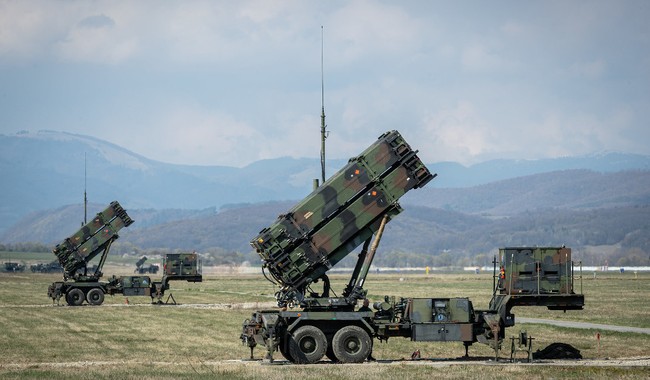
I’ll explain President Trump’s announcement at the NATO summit that Ukraine will be licensed to produce Patriot anti-ballistic interceptors, include the exact transcript from the summit, outline the missile shortage and recent Russian strikes, describe the strategic and economic implications of the licensing decision, note existing industrial ties and training options, and examine the political tone shift between leaders.
President Trump used the NATO summit in Ankara to announce that the United States will permit Ukraine to manufacture the Patriot anti-missile system under license. The comment came amid intense missile strikes on Ukrainian cities and growing concern about the global shortage of Patriot interceptors. The decision aims to ease supply bottlenecks and strengthen Ukraine’s ability to defend its population centers. It also signals a shift in U.S. policy toward enabling partner production of advanced air-defense systems.
TRUMP: But one of the things I think we’re going to be talking about today, I just a little birdie told me this uh about the fact that we’ll give them the right to make Patriots. We’ll show them how to do it. It’s very complex, actually. But it’s, uh, you’ll figure out the complexity quickly.
And we’re talking about that, and we’ll the company that makes them, which is building now four plants, you know, all of our companies will be able to do this in 2 to 3 months. If you order a Patriot now you have to wait a long time for them. Same thing with Tomahawks. We have a lot of certain equipment. But with the they call it the elite equipment. And you don’t need elite equipment necessarily for a war, but uh so one of the things we’re going to be talking about is you’ll uh we’re going to give a license to you to make Patriots. This is really cool, right?
ZELENSKY: Right.
TRUMP: This way you can’t complain that we’re not giving them enough. I said, “Make them yourself.”
Uh we haven’t informed the company of that yet, but that’ll that’ll work out all right, you know. So, they’ll be thrilled. But, you know, they’ll be able to do it. You’ll be able to figure that out. Most most countries couldn’t do that. If I said that to most countries, they wouldn’t know what I’m talking about.
But, this is a very ingenious group. And what I like about that is a defensive it’s a defensive situation as opposed to an offensive. But, I think one of the things you might want to be talking about is that.
That’s what I heard. Little birdie told me that.
Russia has recently intensified strikes on Ukrainian population centers using ballistic missiles, with more than 60 fired since July 1 and 29 on the night of July 6 alone. Ukrainian defenses, usually praised for their effectiveness, struggled because of a shortfall in Patriot interceptors. This shortage has been blamed on a global dearth of interceptors and production limits compounded by other conflicts that pulled resources in different directions. The scarcity directly affected Kyiv’s ability to stop a wave of ballistic strikes in the early hours of a recent week.
Ukraine was unable to intercept any of the 23 Russian ballistic missiles that crashed into the Kyiv area in the early hours of Monday. Russia’s nearly unimpeded strikes are the consequence of a global dearth of interceptors for the U.S.-made Patriot antimissile system, a shortage compounded by this year’s U.S.-led war with Iran.
Ukrainian President Volodymyr Zelensky is expected to ask Western countries to send more of their own scarce supply of interceptors when he attends the North Atlantic Treaty Organization summit in Ankara this week.
Zelensky called on the U.S. to give higher priority to Ukraine’s urgent missile-defense needs. “Missiles for Patriots are a priority, and, of course, we understand that the political will of the United States would certainly be enough to make up for the Patriot shortage, but so far, there is not enough of that support,” he said on Sunday evening, hours before Russia’s latest barrage.
Background context matters: the U.S. began shipping Patriot systems to Ukraine in 2023, and Kyiv has been requesting permission to manufacture interceptors domestically since mid-2026. Years of underinvestment in the defense industrial base have left production rates lower than needed for sustained high-intensity conflict. At roughly 60 interceptors produced per month nationally, the cadence is far below what wartime attrition and allied demand require.
Ukrainian President Volodymyr Zelenskyy made the case for the license in an interview with Face the Nation, stating that the US lacks sufficient anti-ballistic missile production capacity, while Russia has been ramping up domestic ballistic missile production.
“I sent a letter to the White House and to the U.S. Congress. I hope they will understand and respond,” the President stated, adding that the slow production could lead to a crisis in different parts of the world.
“60–65 anti-ballistic missiles per month, compared to current challenges, is nothing. It is no secret, and Russia knows this. We need to expand the production. I asked the previous U.S. administration, and I am asking today’s administration to give Ukraine licenses to produce Patriot missiles,” Zelenskyy said rather emphatically. “We can increase the production of Patriot missiles. This will help us. This will help the Middle East and any other country that the United States decides to help. Until we produce a European anti-ballistic system, we will need support from the United States,” he added.
Strategically, licensed production would make Ukraine more self-sufficient and deepen its defense integration with Europe, where only Germany currently builds Patriots from the ground up. Economically, a properly structured license can convert aid into commercial activity through fees, component sales, and training partnerships. Politically, the arrangement offers the U.S. a way to support Ukraine’s defense needs without draining American inventories or halting readiness in other theaters.
There are technical and timeline hurdles: turning paperwork into interceptors takes coordination, tooling, and skilled labor. Ukraine already fields a capable missile industry that manufactures missile bodies and guidance components, and partner firms in Europe have existing joint ventures and maintenance facilities. This industrial foundation makes a faster ramp plausible if training and collaboration are prioritized.
The public tone between the U.S. president and the Ukrainian leader during the announcement was notably relaxed and cooperative, a marked contrast to earlier, more strained interactions. That change in chemistry may ease diplomatic friction and accelerate practical steps such as training, shared factory use, and phased production. For now, the announcement signals a clear intent to shift policy from supplying systems to enabling allied production capability.



Add comment