
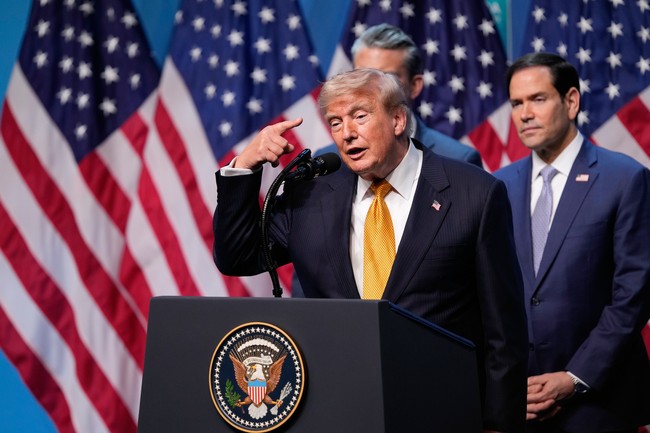
I’ll lay out what happened: Trump spoke after NATO, he warned Iran, described strikes already carried out, and hinted more were coming; multiple direct quotes show his stance and intentions, and the likely consequences for Iran’s infrastructure and leadership are clear.
President Trump closed out the NATO summit with a blend of cordiality and a hard edge toward Iran, signaling that diplomacy has limits when actions cross certain lines. He made it plain he has little appetite for further deals with Tehran after watching their recent behavior, framing the situation as one that requires decisive action. His tone suggests a willingness to finish what he sees as an unfinished security mission.
When pressed by the press about changing views on Iranian leaders, Trump said, “I got to know them,” and explained why he is reluctant to negotiate further. The exchange captured his shift from cautious engagement to blunt skepticism about Iran’s intentions and behavior. That moment makes clear this administration prefers results over endless talks.
NYT’s Tyler Pager: Mr. President, Tyler Pager with the New York Times. Last month you said that Iranian leaders were very rational people, nice people to deal with, strong people, smart people. Today you said they were scum, sick people, being led by sick people. What changed, and do you think…
https://x.com/townhallcom/status/2074896844044341465
President Trump: I got to know them. So, I’ve said that about a lot. Now, when you say, rational, I think they’re much more rational than level 1, level 2. Level 1 is gone, level 2 is gone. This is level 3. I think they are more rational, but based on their actions over the last week or two, they’re not doing a service to the people. And, I think more than anything else, is I got to know them, and I’m not sure I want to make a deal with them. We can play games, but I’m not sure I want to make a deal. Let’s just finish the job.
Later, speaking alongside Ukrainian President Zelensky, the president confirmed strikes had already occurred and hinted at more to come, suggesting additional operations might happen soon. He said the U.S. “knocked out 28 posts” and described them as mostly small targets, a detail that underscores a campaign of targeted degradation. The message was clear: the U.S. has the capacity to strike and will act when necessary to protect interests and partners.
President Trump: We hit a lot of them (Iranian targets) last night. Mostly little ones. We knocked out 28 posts last night. Little ones. That’s all they have, is little ones.
Question: Are you going to try to take out more tonight?
Trump: Will we go tonight? You know, normally, I wouldn’t tell you, I wouldn’t tell you, but you know what? There’s not a thing they can do about it. So the answer is “probably.”
The president tied recent strikes directly to Iranian attacks on commercial vessels, asserting the U.S. response was proportionate and aimed at deterrence. He described drones and missiles being launched at ships in the Strait of Hormuz, which prompted retaliatory strikes. That framing presents the U.S. actions as defensive and aimed at securing vital shipping lanes and global energy flows.
President Trump: We hit them hard last night, after they launched, they launched a couple of, you’ve got to know about this, you’ve got, you don’t mind (seemingly to President Zelensky) but they launched a couple of drones, one rocket, one missile, at ships, as they were in the Strait, which they have every right to be. And so we hit them very hard last night. Very, very hard. Probably hit them hard again tonight. I’ll give them a little warning; we’re going to hit them hard tonight. But we’ll see how it all works out. No, I’m not happy with them. For instance, we’ll have a meeting, and we’ll talk about the denuclearization of Iran, because that’s what the war is: It’s a war for the denuclearization of Iran. And we’ll have a meeting, and we’ll talk about just that, because my whole thing is not about regime change, it’s not about… Although, I think regime change is when you knock out the first group, the second group, now you’re on to… I think that’s maybe the ultimate regime change.
Reading between the lines, the administration appears prepared to target Iranian infrastructure and command nodes to reduce Tehran’s ability to project force. Trump even referenced strategic targets like Kharg Island in prior comments, a reminder that crippling Iran’s oil transit points would have major economic and strategic effects. Those possibilities underline the seriousness of the president’s warnings.
The president also addressed threats to his personal safety, noting he is reportedly high on an Iranian “kill list” and treating that fact with a mix of gravity and defiance. He used the moment to stress the dangerous nature of the job while signaling that personal risk won’t deter his policy choices. That line of argument reinforces the administration’s posture of resolve in the face of external threats.
Question: President Trump, Steven Nelson, from the New York Post, I’d like you to address speculation that you’re leaving Ankara, not in the new Air Force One, because of security concerns involving Iran. You’ve spoken twice today about them about them possibly assassinating you and possibly being successful. Did that concern have something to do with…
President Trump: Well, I speak about it a lot, because, you know, the life of a president is very dangerous. It’s 5.2 percent. You know what a race-car driver is? One tenth of one percent. A bull rider, that looks pretty dangerous to me, it’s one tenth of one percent. No, it’s 5.2 percent is, you don’t make it. You should have told me… You’re an excellent reporter, you should have told me that years ago. Maybe I wouldn’t have run. It’s a very dangerous profession. No, I’m number one on the kill list for Iran. They’re lovely people. I’m number one. So, I don’t know, I can’t tell you that, but I don’t really care. Because, I’m doing my job, and I’m doing it, I hope, better than anybody’s ever done it. Because we have a country that’s hot, and really, really successful. But, I mention it only because it’s on the list, and it came out, there was another list that came out yesterday and I’m number one. I like being number one on TikTok better. But I’m number one on the list for killing.
From a Republican perspective, these comments are a straightforward expression of leadership: set clear red lines, respond to aggression, and protect American interests and allies. The rhetoric serves a strategic purpose, signaling to Tehran and to partners that the U.S. will use force when necessary and prefers decisive outcomes over drawn-out bargaining. That posture aims to restore deterrence and shape Iran’s calculus going forward.
All told, the administration’s public remarks create an unmistakable expectation of further action aimed at degrading Iran’s military and operational capabilities. Officials have emphasized targeted strikes rather than open-ended occupation, but limits and objectives remain deliberately flexible depending on Iranian responses. For now, the message from Washington is blunt: Iran will face consequences for attacks on international shipping and threats to U.S. interests.

Add comment