
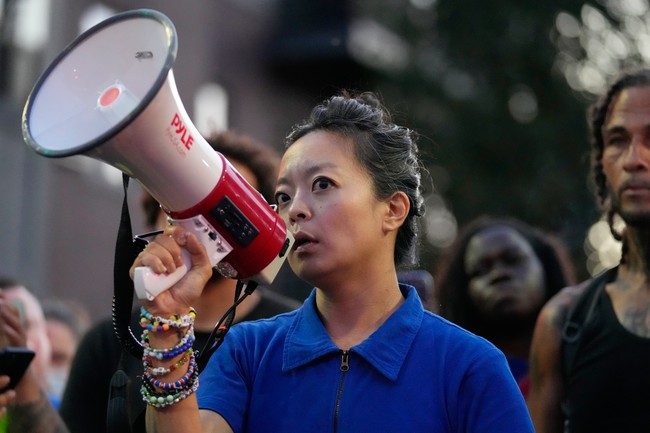
The piece examines Francesca Hong’s tense CNN appearance, the questions she dodged on radical policy goals, and how her answers — or lack of them — play into the governor’s race dynamics in Wisconsin as the primary approaches.
Democratic Socialist state Rep. Francesca Hong had a clear opportunity on national television to reassure voters worried about her policy outlook, but the interview raised more questions than it answered. Host Kaitlan Collins pressed Hong on big-ticket items that animate the left flank of the Democratic coalition, and Hong’s language often steered back to aspiration and nuance rather than firm commitments. The exchange made headlines partly because it framed ideological extremes as possible future goals rather than present plans.
Hong is leading in polls ahead of Wisconsin’s Aug. 11 primary and has attracted attention from both supporters and nervous party strategists. Other contenders have shuffled in and out of the race, and endorsements have clustered in ways that signal a tense closing stretch. That backdrop matters because every statement on crime, courts, and national institutions becomes fodder for opponents and energizes skeptical voters.
Collins opened the exchange by replaying a clip about prisons and a comment Bill Maher made in response to Hong’s earlier remark that a perfect world would have no prisons because nobody would be disposable. Maher’s line was blunt: “Murder victims are.” The clip forced Hong to pivot, and her reply leaned on distinctions between goals and immediate policy options.
“I think talking about what may be aspirational and then understanding the role of the governor, what they can and cannot do, and what is implementable right now. These are different conversations.”
That answer sent the interview into a policy tour: school funding, mental health and addiction treatment, housing, healthcare, repair cafes and even bowling alleys were discussed in succession. The broad sweep allowed Hong to outline priorities that fit a local governor’s agenda while keeping more radical national items at arm’s length. Still, viewers were left to parse which items were practical plans and which were long-term hopes.
https://x.com/greg_price11/status/2084458915115466772
When Collins circled back to the central prompt — whether Hong still believed that a perfect world would have no prisons — Hong called the idea “aspirational” and separated it from what a governor could enact immediately. She criticized Wisconsin’s incarceration rates and urged a focus on solutions over labels or slogans. That put a prison-free future in the category of a distant aspiration rather than a first-term program.
Collins then asked Hong about her stance relative to the Democratic Socialists of America platform, which includes calls to fundamentally reshape institutions like the police and prisons, and even proposals to abolish or replace national structures. Hong declined to endorse wholesale abolition in the short term and described the debate over institutional change as tactical and dependent on political realities. Still, she allowed that some elements of the DSA agenda influence her broader worldview.
On the Senate, the Supreme Court and prisons, Hong’s short answer was that she supports their existence “right now.” She added that she favors expanding the Supreme Court, a position that signals interest in altering judicial architecture without dismantling basic institutions on day one. That phrasing left open the possibility of structural change over time, which is the core concern critics highlight.
Collins also confronted Hong with a resurfaced, deleted November 2020 social post that read: “Cancel Thanksgiving. Should have done this in 1621. If it takes a worldwide pandemic for us to realize we should stop celebrating colonialism and the original superspreader event that killed Indigenous folx and women so be it.” The tweet’s blunt rhetoric pushed the conversation into cultural territory where media narratives and political optics matter as much as policy prescriptions.
“Cancel Thanksgiving. Should have done this in 1621. If it takes a worldwide pandemic for us to realize we should stop celebrating colonialism and the original superspreader event that killed Indigenous folx and women so be it.”
On air, Collins asked whether Hong still believed Thanksgiving should be canceled, and Hong responded by recounting her culinary background. She emphasized that she is a chef, that she cooked for her community at 16, and that she once owned a restaurant, , which shaped her view of bringing people together around a table. The explicit line “Thanksgiving should not be canceled” never appeared, and Hong instead described the holiday as “incredibly painful” for many people while acknowledging multiple perspectives and the capacity for views to evolve.
Other deleted posts reportedly touched on the Fourth of July and Valentine’s Day, suggesting a pattern of cultural critique that complicates traditional holiday politics. Hong framed those critiques as part of a broader conversation about history, trauma, and public celebration, but critics have cast them as dismissive of mainstream traditions. That tension is likely to be amplified by opponents in the run-up to the primary.
Across the interview Hong repeatedly moved between policy specifics and broader ideological statements, leaving plenty of room for interpretation. For Republican strategists and conservative voters watching, the show offered material to portray Hong’s vision as out of step with mainstream priorities. For her supporters, the emphasis on aspirational goals plus practical initiatives may read as principled yet pragmatic.
With primary day approaching, the CNN segment already looks like a defining moment in how voters will weigh Hong’s rhetoric against her policy proposals and governing pitch. The stakes are high in a tight race where every on-camera answer gets amplified and repurposed by opponents.


Add comment