
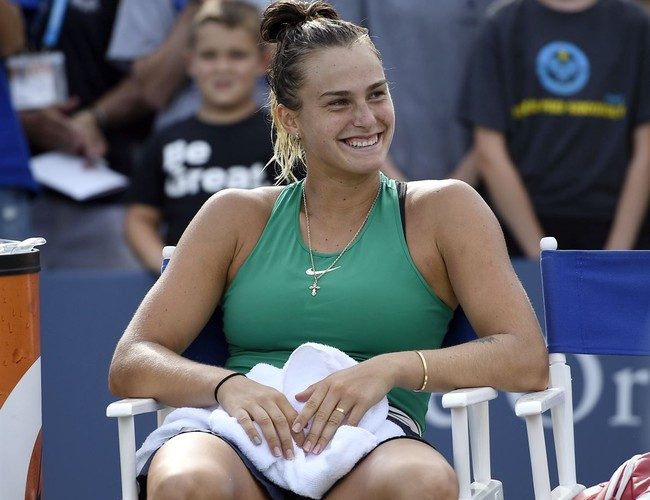
Aryna Sabalenka, the world No. 1 in women’s tennis, publicly supports the WTA’s new genetic testing policy to keep biological males out of women’s competition, arguing the move protects fairness and integrity in the sport. Her remarks at the Canadian Open echoed growing calls from athletes and observers who say sports divisions should reflect biological differences, and her stance follows high-profile exhibition matches and media commentary that highlighted those disparities.
Sabalenka made her position clear while speaking to reporters in Toronto, stressing the need to preserve a level playing field on the women’s tour. She framed the debate in straightforward terms about physical differences and fairness, pushing back against any pressure to blur the lines that separate men’s and women’s competition. The message was direct and unapologetic, reflecting concerns many athletes share about competitive equity.
“Biologically, men are way stronger than women, so I feel like it would not really be fair for women to compete against biological men,” she told reporters. Sabalenka also volunteered to comply with whatever testing protocols are put in place, signaling she sees the policy as a reasonable measure to protect women’s sport. “If they want to test us all, I’m happy to do that. It’s pretty fair, and let’s keep it that way.”
Her remarks have political and cultural resonance beyond tennis, because they touch on questions of safety, fairness, and the integrity of sex-specific competition. The debate has become a flashpoint across multiple sports, with voices on both sides arguing passionately. From a conservative perspective, the response is simple: ensure women compete against women so opportunities and records remain meaningful.
Sabalenka’s stance gained added weight because of a high-profile exhibition she played in Dubai, a match set up specifically as a Battle of the Sexes against Nick Kyrgios in December 2025. The rules for that event deliberately adjusted conditions to reduce Kyrgios’s natural advantages, from limiting his serve to shrinking Sabalenka’s side of the court by 9 percent. Those tweaks were an admission that, left unaltered, the physical gap would be obvious.
The exhibition made the differences plain for viewers and commentators, and it undercut any argument that such advantages are trivial. Observers described the optics as stark: the male player’s edge was visible in serve, power, and movement, even under contrived handicaps. For athletes and fans who want clear divisions, that demonstration strengthened the case for formal testing and separation.
https://x.com/JenniferSey/status/2084459429051904274
Public figures in sports media also weighed in, sometimes provocatively. ESPN analyst Patrick McEnroe claimed he could “easily” beat Sabalenka if they were truly competing, and even suggested a top junior boy might defeat her decisively. His comments, framed as admiration for women’s tennis, nonetheless underscored the same point Sabalenka made: physiological differences matter in competition.
Those reactions fueled renewed calls to codify rules that prevent biological males from entering women’s divisions, especially at elite levels where stakes, prize money, and records are significant. Advocates argue rules based on biology protect women and girls in locker rooms, scholarships, and podiums. The line they draw is intended to preserve the meaning of women’s achievement rather than undermine it.
On a parallel track, WNBA guard Sophie Cunningham has become a lightning rod by speaking out in defense of women’s spaces and competition. Her comments, blunt and unapologetic, reflect wider concern among female athletes who feel forced into debates about identity at the expense of fairness. “I want to protect young girls in a locker room, or young girls in sport who shouldn’t have to go against biological men,” she said, summing up a view shared by teammates and rivals alike.
Sabalenka and Cunningham, coming from different sports, now occupy the same side of this argument: sports should recognize biological realities to protect fairness and safety. That’s a position skeptics dismiss as reactionary, but supporters say it’s practical and rooted in respect for women’s accomplishments. Changing the playing field in name only, they argue, undercuts decades of effort to create legitimate women’s competition.
Policy shifts this summer show governing bodies are finally grappling with these realities instead of avoiding them. For many conservatives and many athletes, that’s progress: sports should reward skill and dedication, but they should not erase biological categories that determine competitive equity. Testing protocols, while imperfect, are seen by supporters as a necessary and enforceable way to maintain those boundaries.
The larger fight will continue in locker rooms, boardrooms, and courtrooms, but Sabalenka’s public backing of testing makes clear where elite athletes stand when asked to choose between slippery ideology and fair competition. Her willingness to lead by example reinforces the argument that women’s sport needs clear protections to remain meaningful, competitive, and safe for female athletes at every level.
Commentary and policy debates will keep evolving as more cases and events highlight the practical consequences of current rules. For now, the conversation centers on a principle many hold dear: women should compete on a level field against other women. That principle is simple, direct, and in the view of many Republicans, nonnegotiable.



Add comment