
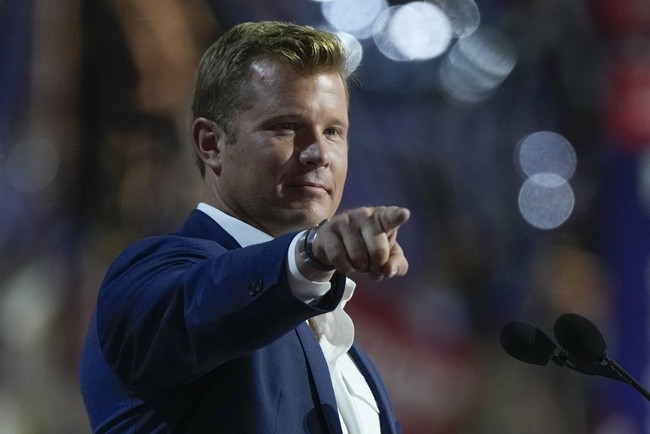
Sen. Tim Sheehy, a former Navy SEAL and Montana Republican, stepped off the dais during a Senate Armed Services subcommittee hearing to physically assist Capitol Police in removing a disruptive protester who refused to let go of a door jamb; the incident ended without serious injury and sparked a heated scene in the hearing room.
Sen. Tim Sheehy traded his senator hat for his military instincts when a protester disrupted a Wednesday subcommittee hearing on Operation Epic Fury. The protester, identified as Brian McGinnis, had mounted a loud demonstration and then refused to be removed, clinging to a door jamb while shouting, “No one wants to fight for Israel!” The refusal to yield created a tense standoff in the hearing room that Capitol Police could not resolve on their own.
McGinnis, who is running as a Green Party candidate for U.S. Senate in North Carolina and wore a Marine uniform during his protest, reportedly served one tour from 2000 to 2004 and was honorably discharged. When officers tried to pull him free, he held on so tightly they could not pry his fingers loose. That’s when Sheehy, with the calm confidence of someone trained to handle physical conflict, left the dais and approached the scene.
Sheehy walked directly to McGinnis and the officers and attempted to deescalate with conversation, asking the man to relax and release his grip. When words didn’t work, Sheehy used a controlled maneuver to force the protester to let go of the door jamb, enabling police to stand McGinnis up and escort him out. The movement was decisive, contained, and done without theatrics, which is exactly what you want when tempers flare in a crowded hearing room.
As Sheehy worked the maneuver, other protesters erupted into cries accusing the senator of hurting the man: “Let go of his hand!” “The Senator broke his hand!” and “A U.S. Senator just broke the hand of a Marine!” Those shouts only added to the chaos, though the claims were false; McGinnis’s hand was not broken. After the incident, Sheehy calmly returned to his seat and resumed the hearing, the kind of composure a veteran brings to high-pressure situations.
Capitol Police had been doing their job, but the protester’s refusal to cooperate forced a rare intervention by an elected official with special training. Sheehy’s history explains why he was uniquely suited to step in: a Naval Academy graduate who pursued SEAL training, served with Naval Special Warfare, and completed demanding special operations exchanges and schools. That background shows up in how he handled the confrontation—measured and effective rather than performative.
The hearing itself was focused on the military operation, and this disruption momentarily pulled attention away from policy to drama. Still, the response matters. A senator intervening physically is not a headline anyone should want as common, but when someone is preventing law enforcement from doing its job, action can be necessary. In this case, it resolved the immediate threat to the committee’s ability to proceed.
Video from the hearing captures the exchange and the intensity of the scene. The footage shows Sheehy stepping off the dais, engaging with the protester, and applying a maneuver that allowed officers to regain control. Observers on both sides of the aisle watched as a former tactical operator used his training to facilitate law enforcement rather than escalate the situation.
Afterward, critics on the left rushed to dramatize the episode, spinning accusations without evidence. Meanwhile, Sheehy’s own social post about the event made his intent clear: to deescalate and to prevent further violence. The senator’s message emphasized that the protester came looking for a confrontation and that those who do so sometimes need help rather than heroics.
Capitol Police were attempting to remove an unhinged protestor from the Armed Services hearing. He was fighting back. I decided to help out and deescalate the situation.
This gentleman came to the Capitol looking for a confrontation, and he got one. I hope he gets the help he needs without causing further violence.
The episode also underscored the broader point about maintaining order in places where policy is debated and votes are taken. Hearings should be forums for sober discussion, not stages for theatrical disruption. When disorder threatens that space, public servants who understand both security and civil discourse may be called on to act, and Sheehy’s actions demonstrated a focused, no-nonsense approach.
Political reactions predictably flowed in, but the immediate result was practical: the hearing continued and no one was seriously hurt. What mattered in the room that day was stopping the disruption swiftly so the committee could return to its work. In tense moments like that, having leadership with real-world operational experience can make the difference between a spectacle and a contained resolution.
Add comment