
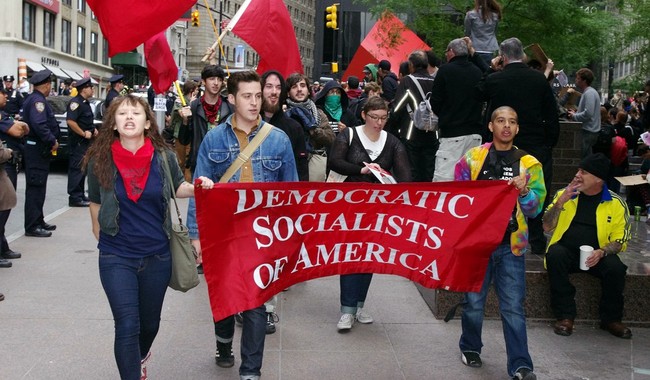
The Democratic Party’s internal tug-of-war is getting louder in New York, with Queens Borough President Donovan Richards publicly accusing the Democratic Socialists of America of sidelining minority voices, and the fallout is highlighting tension over diversity, policy priorities, and who actually leads the left wing of the party.
The DSA’s rise has reshaped local politics and powered insurgent candidates, but questions about its demographic makeup and priorities are now front and center. Donovan Richards, a longtime Queens official, raised the issue bluntly, saying the group’s outreach and focus leave many Black and Latino residents feeling ignored.
https://x.com/TwitchyTeam/status/2079643824230719552
Richards said the DSA often talks big about inclusion while their membership and culture reflect something else, suggesting a mismatch between rhetoric and reality. He pointed to examples where local priorities, such as protecting minority homeowners, have been treated as collateral damage by some on the hard left. X, “White supremacy comes in all forms.”
The immediate spark was a media report about how Black and Latino leaders feel overlooked inside the DSA and its orbit, and the reaction moved quickly from complaint to countercharge. A prominent DSA assembly member publicly complained about being left out of that coverage, only to be corrected when it turned out she had not read the full piece. Tensions escalated on social platforms where nuance rarely survives.
One striking irony is that the organization touts electoral wins while struggling to reflect the diversity of the neighborhoods it claims to represent. High-profile victories by DSA-endorsed politicians have boosted the group’s influence inside the broader Democratic coalition. Yet critics note a persistent demographic gap that undercuts the DSA’s claim to be a broad movement for working people of all backgrounds.
Polling and membership data shared in recent years have shown the DSA skews whiter and more educated than the national population, challenging the image many associate with grassroots populism. Observers say that when an organization attracts professionals and college-educated activists, it risks appearing disconnected from long-standing minority communities. Those gaps create political vulnerabilities that opponents are eager to exploit.
Richards’ political biography helps explain why his critique landed: he’s represented parts of Queens for more than a decade, including neighborhoods with substantial Black homeownership. He has positioned himself as a defender of policies that sustain generational wealth in those communities, and he sees attacks on property ownership as direct threats to that goal. The debate turned especially sharp when a prominent mayoral advisor framed homeownership as an instrument of systemic racism.
That clash over homeownership is where the philosophical dispute becomes practical and personal for voters. For many families of color, owning a home is a straightforward path to stability and wealth accumulation, not an abstract policy to be dissected by ideologues. When public officials propose tax hikes or policies perceived as threatening those gains, local leaders push back hard, and the DSA’s doctrinaire language can feel tone deaf at best and hostile at worst.
Onlookers from across the political spectrum are enjoying the spectacle but also watching for real consequences: can the national Democratic coalition absorb a growing socialist wing that does not reflect its broader electorate? Party unity depends on translating progressive energy into broad-based appeal, and that requires better outreach and policy finesse. Otherwise, intra-party fights will keep undermining electoral chances in swing areas.
Voices inside the party argue over strategy and style: some welcome the DSA’s fire and discipline, while others warn that uncompromising rhetoric alienates swing voters and minority communities. The result is a messy, public contest about who sets the party’s agenda and how loudly left-wing ideas should be pushed. For conservatives watching, the spectacle reinforces the idea that the modern left is divided and self-sabotaging.
The unfolding drama in New York serves as a cautionary tale for national Democrats trying to balance activist energy with electoral realism. If the left refuses to reckon with the demographic and material concerns of minority communities, it risks creating durable fractures. In competitive politics, tone and translation matter as much as passion and purity.


Add comment