
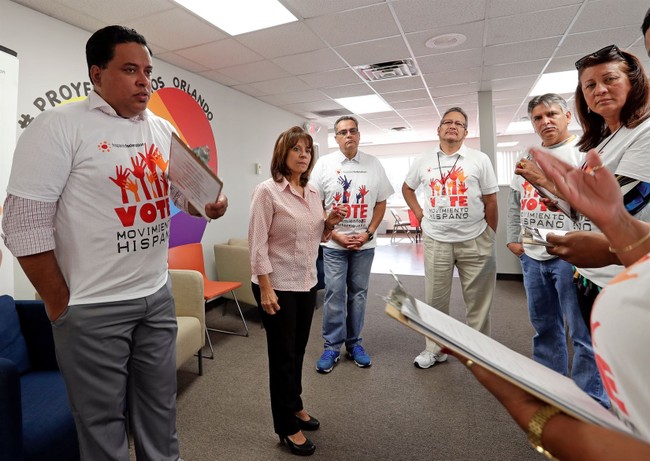
The Latino electorate is not shifting uniformly toward one party; instead it is fragmenting across generations, regions, and economic lines, creating real uncertainty for 2026. This piece explains the split nature of Latino voting behavior, highlights survey findings about party approval and economic concerns, and points to regional variation that makes forecasting risky for both parties. It argues that Republicans have made targeted gains while Democrats retain a House edge, and it stresses that economic and civil liberties worries are driving mixed results. Finally, it shows why this fragmentation, not a single directional realignment, will be the wildcard in tight midterm contests.
For years Democrats counted on Latino voters as a steady margin in key states, and Republicans claimed gains among working-class Hispanic men. That picture is now shakier, and Republicans should see opportunity in the chaos rather than concede it as permanent Democratic turf. Unpredictability in the Latino bloc forces campaigns to pay attention to local dynamics instead of relying on national blueprints. The coming cycle will reward targeted, ground-level efforts more than broad assumptions.
One recent poll summarized the moment bluntly: “The Latino electorate is splintering across generational, economic and ideological lines, creating a wildcard dynamic for the 2026 midterms.” That sentence captures the practical challenge pundits and pollsters face: many subgroups are moving in different directions at once. Polling models built on stable demographic behavior struggle when large voter groups fracture along education, age, and regional lines. Republicans can exploit that instability with tailored messages about jobs, inflation, and public safety.
A UnidosUS survey of 3,000 registered Latino voters highlights why this matters: the Latino voting-age population is now the nation’s second-largest, so internal divisions can flip close races. The survey finds clear unease with Republican congressional leadership among many respondents, but also strong concern about economic conditions. That mix means voters might punish incumbents or swing toward candidates promising concrete economic relief, regardless of party labels. Republicans who focus on pocketbook issues could convert dissatisfaction into votes in competitive districts.
“Nearly two-thirds (62%) disapprove of how the Republican Party is leading Congress, and 81% are concerned Congress is ceding too much of its constitutional authority.”
Despite those negatives for the GOP, overall House ballot preference still shows Democrats ahead in the survey. “If the 2026 midterm elections were held today, 52% of Latino voters would vote for the Democratic House candidate, compared to 28% for the Republican.” That gap is meaningful but not immutable, especially when turnout and regional patterns shift. Republicans should target subgroups where they already show traction, rather than try to reclaim a monolithic Latino vote that never really existed.
“If the 2026 midterm elections were held today, 52% of Latino voters would vote for the Democratic House candidate, compared to 28% for the Republican.”
Economic anxiety is a clear driver of this fragmentation, with many Latino families reporting worsening financial circumstances. The survey notes that “Compared to last year, 39% feel their economic situation is worse now; only 14% say they are doing better.” Cost of living, housing, and health care top the list of concerns, and those are issues that cut across party lines. Republicans who stick to a message of economic relief, lower costs, and job growth can appeal to voters anxious about day-to-day budgets.
“Compared to last year, 39% feel their economic situation is worse now; only 14% say they are doing better.”
Civil liberties and immigration enforcement add a second layer of complexity that does not map neatly to party platforms. The survey finds worry about civil rights and opposition to certain enforcement practices, which complicates simplistic appeals on either side. “59% believe civil rights and liberties have become less secure, and 72% oppose the recent ruling allowing ICE to use appearance, language, or type of work as grounds for arrest.” That kind of concern forces Republicans to balance enforcement priorities with respect for civil liberties if they want broader appeal.
“59% believe civil rights and liberties have become less secure, and 72% oppose the recent ruling allowing ICE to use appearance, language, or type of work as grounds for arrest.”
Regional differences are perhaps the most actionable takeaway for campaign strategists. Patterns vary substantially from state to state, and local context matters more than national narratives. “Patterns vary significantly by region, with shifts among working-class Hispanic men and non-college voters diverging from trends in other Latino communities.” Arizona, Texas, Nevada, and Florida each respond to different pressures, and suburban districts often behave very differently from border communities.
“Patterns vary significantly by region, with shifts among working-class Hispanic men and non-college voters diverging from trends in other Latino communities.”
Texas recent races show how uneven turnout and localized mobilization can flip expectations even in places long seen as safe for one party. Suburban Latino voters helped flip a state Senate seat when organizers focused on local concerns, proving that turnout and message matter more than broad demographic assumptions. For Republicans, that means sharpening local outreach, emphasizing economic competence, and addressing safety and liberty concerns without alienating key swing groups.
Put together, the evidence points away from a tidy realignment and toward fragmentation, where Democrats keep a general advantage but Republicans pick up ground in targeted areas. That fragmentation makes modeling outcomes less reliable and elevates the importance of on-the-ground work. In a cycle where one- or two-point margins decide control, modest shifts inside a fragmented Latino electorate could determine big results for both parties.



Add comment