
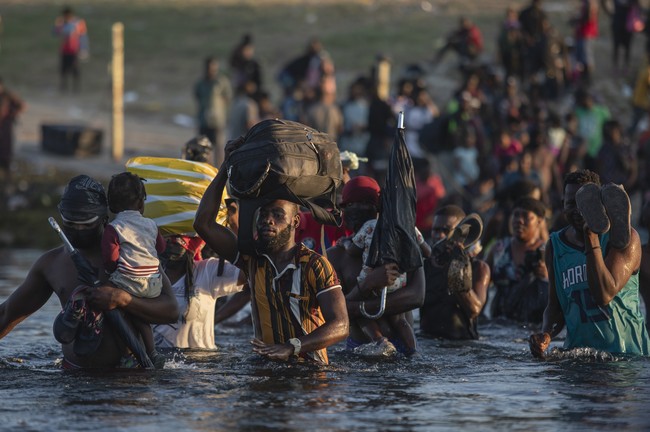
This article examines a recent fatal stabbing at a Michigan meat plant, the alleged suspect’s immigration status, official statements from DHS, legal developments in the case, and broader Republican concerns about border policy and Temporary Protected Status for Haitians.
The incident took place on June 29 in Coldwater, Michigan, at a pork processing plant where a 20-year-old employee was killed after an on-the-job argument. Local law enforcement says witnesses identified the suspect and that the victim suffered a single stab wound to the lower back and was pronounced dead at the scene. Authorities detained the accused, who is alleged to be an undocumented Haitian immigrant and who officials claim was previously encountered and released at the southern border. This case has become a flashpoint in debates over national border policy and public safety.
BREAKING: DHS confirms that a suspect arrested for murder after he allegedly stabbed his coworker to death at a Michigan meat plant is a Haitian illegal alien who was caught and released at the Texas border by the Biden administration in 2024. ICE has placed a detainer on Valmir Djempsly and he is now charged with murder.
https://x.com/BillMelugin_/status/2074919175441567782
DHS statement:
“This illegal alien barbarically stabbed his coworker to death,” said DHS Acting Assistant Secretary Lauren Bis. “This murderer was released into American communities by the Biden Administration. If it weren’t for the reckless open border policies of the Biden Administration, this criminal never would have been in our country in the first place and his victim would still be alive. We have lodged a detainer asking Michigan to not release this dangerous criminal from jail without notifying ICE.”
According to court documents, Coldwater police responded shortly after 7:41 p.m. to a reported stabbing at the plant. Investigators say witnesses saw the suspect confront the victim about a knife, chase him, and then lunge toward his back in a production area. The victim, identified in filings as Brandon Eduardo Vasquez-Chavez, did not survive despite attempts to save him. Police say they recovered the knife and secured statements from multiple witnesses who placed the suspect at the scene.
According to a complaint filed in Branch County’s 3-A District Court, Coldwater police responded to a reported stabbing at The Clemons Meat Processing Plant, 572 Newton Road shortly after 7:41 p.m.
The victim [Brandon Eduardo Vasquez-Chavez] was found unresponsive with a single stab wound to his lower back. Despite lifesaving efforts, Vasquez-Chavez was pronounced dead at the scene at 8:19 p.m.
Djempsley was detained by Branch County Sheriff’s Sgt. Paulino Hernandez after witnesses identified him as the suspect.
Multiple witnesses told investigators that Djempsley and Vasquez-Chavez had been involved in a verbal argument moments before the stabbing. Witnesses reported seeing Djempsley confront the victim about a knife, then chase him and lunge toward his back with the weapon in a production area of the plant.
After being read his rights, the suspect reportedly acknowledged arguing with the victim and said he used the weapon after being head-butted, a claim not supported by witness statements. Authorities are reviewing any available surveillance footage from the plant to corroborate eyewitness accounts. Prosecutors have filed murder charges, and police say a detainer from ICE has been placed because of the suspect’s alleged immigration status.
In court the defendant entered a not guilty plea and bond was denied, with the judge citing both public safety and flight risk. He is scheduled for a preliminary hearing in early July and faces an open murder charge that can carry a life sentence under Michigan law. The accused remains in custody at the county jail as legal procedures move forward and as federal immigration authorities coordinate with local officials.
While I have never disputed the ability of the President to end Temporary Protected Status (TPS), I strongly disagree with ending Haitian TPS at this time.
First, the situation on the ground in Haiti is a humanitarian and political disaster and continues to warrant an extension. The State Department has a level 4 travel advisory telling all Americans to evacuate and not travel there precisely because the gangs are in charge of the country, engaged in gun and drug trafficking, and kidnapping innocent Haitians. We want to root it out and allow for a stable government to be establish with a free a fair election, creating the conditions for a safe return for Haitians.
Second, of the 350,000+ lawful Haitian TPS holders, roughly 1/3rd work in our healthcare system. Immediately shutting off TPS will create a crisis in our hospitals, nursing homes, and in the I/DD community.
I’m asking the administration to allow for an orderly process by which Haitian TPS holders can maintain their work authorization while their immigration cases are adjudicated over the next six months, if the revocation of TPS moves forward.
Furthermore, I believe the Senate should take up my legislation with Congresswoman Gillen to temporarily extend Haitian TPS to address these issues.
Republican leaders have used this and similar incidents to argue that current border and immigration policies put communities at risk and that enforcement must be strengthened nationwide. They point to cases involving alleged violent offenders who entered or remained in the country under various immigration statuses as evidence that policy changes are needed. These voices stress accountability, stronger coordination with ICE, and clearer protocols for handling migrants who pose public safety concerns.
Families of victims in these situations are left to cope with loss, unanswered questions, and a legal process that can feel slow and impersonal. The wider community also wrestles with the tension between labor needs in industries like food processing and concerns about safety and enforcement. As this case proceeds through the courts, it will likely continue to fuel debates over immigration policy, local enforcement decisions, and the balance between humanitarian considerations and public safety.
Add comment