
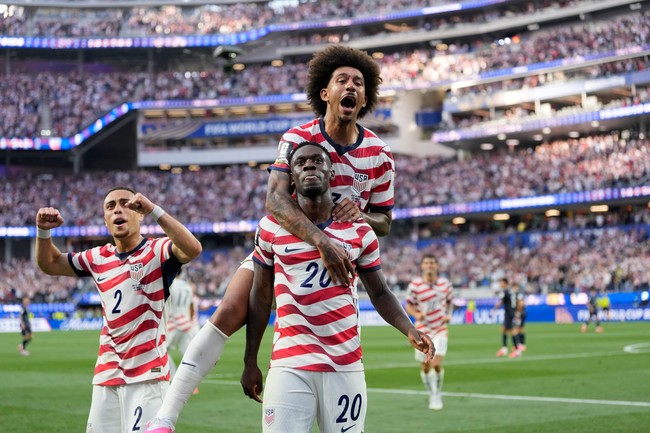
The U.S. men’s national soccer team exited the 2026 World Cup in the round of 16 yet still earned $16 million in FIFA prize money, only to learn most of their share will be pooled and split with the women’s team under a 2022 collective bargaining agreement designed to equalize pay regardless of revenue generation.
The headline is simple: the men’s side received $16 million, 20 percent goes to U.S. Soccer, and the remaining 80 percent—about $12.8 million—won’t stay exclusively with the players who earned it on the field. Under the CBA negotiated in 2022, that payout is combined with whatever the U.S. women earn in the 2027 tournament and split between the two squads after the federation takes its cut.
This arrangement traces back to the legal pressure brought by the women’s team in 2019 and the settlement that followed. The women sued for gender discrimination, which led to new collective bargaining agreements for both teams in 2022 intended to address payoff differences between men’s and women’s prize money. The result was an explicit decision to pool World Cup prize money across genders rather than let earnings remain tied to the team that generated them.
That choice matters because the revenue profiles of the two programs are different. Historically, the men’s team has generated more ticket, broadcast, and merchandise income, especially in World Cup cycles, while the women’s side often brings immense prestige and trophies but smaller FIFA payouts. Performance on the field and revenue produced aren’t the same thing, and this CBA forces a financial matching despite that gap.
To put numbers on it, the pay gap in recent years was stark: the U.S. men earned $13 million for reaching the round of 16 at the 2022 World Cup, while the U.S. women collected $1.87 million for reaching the round of 16 at the 2023 Women’s World Cup. Spain, the 2023 champions, received about $4.29 million in FIFA prize money. Those sums underline why pooling payouts changes incentives and redistributes money away from the team that brought in the larger share.
https://x.com/PolymarketSport/status/2074956411780612459
From a Republican viewpoint, this policy looks like an artificial transfer from the higher-earning team to the lower-earning team driven by a social goal rather than market realities. The men’s players earned that money through wins and commercial draw, and now much of it will be shared with a team that, while more decorated on the global stage, often produces less revenue. Critics argue this penalizes success and blurs accountability for results on the field.
The CBA supporters framed the change as correcting an injustice and making compensation fairer across genders. But fairness is not only a moral argument; it has economic consequences. If revenue-generating teams must routinely subsidize others, the feedback on ticket sales, sponsorship deals, and investment changes. Teams, leagues, and sponsors respond to where revenue flows and which squads drive public attention.
That’s the crux of the debate: should pay reflect revenue and market contribution, or should it be equalized for its own sake? The CBA chose the latter for World Cup payouts, creating a permanent mechanism to share men’s FIFA earnings with the women’s side in future tournaments. As one commentator bluntly noted after the women’s loss to Sweden in 2023, “FIFA pays out more for the men’s performance,” which “means splitting equally means the men lose money, even though they’re the ones who are making more of it.”
Fans and players will feel the consequences in different ways. Male players who chase lucrative club and national-team revenue now see a portion of their international prize money earmarked for redistribution. The women’s team benefits financially from a structure that lifts their payouts closer to parity, but the underlying revenue gap remains. Meanwhile, the broader American sports market watches to see whether this reshapes sponsorship deals and broadcast interest.
Many in the sports culture praised the idea as equal, but others see it as performative policy that ignores incentives. As Inigo Montoya might say: “You keep using that word. I do not think it means what you think it means.” The debate over whether such forced pooling improves the game or simply politicizes pay will continue to divide fans, players, and administrators.
With World Cup cycles coming and collective bargaining agreements locked in, the practical outcome is clear: men’s FIFA prize money will be part of a combined pot with the women’s earnings, and both teams will split those funds under the federation’s rules. That reality reshapes how revenue and success translate to compensation in U.S. soccer.



Add comment