
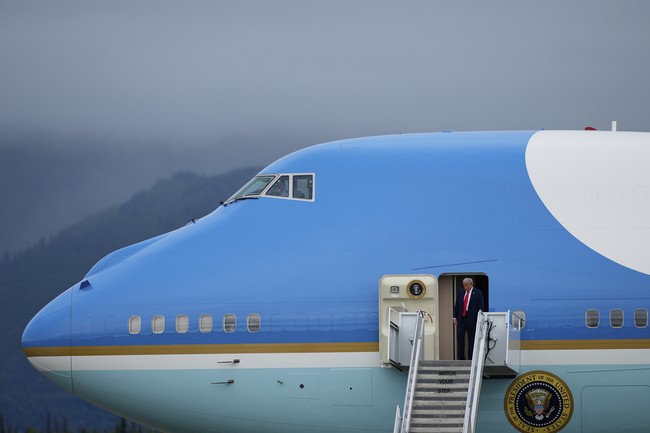
President Trump boarded the brand-new, Qatari-donated $400 million Air Force One for a North Dakota trip but left Turkey on the older, battle-tested VC-25A after security concerns tied to renewed hostilities with Iran; officials and former intelligence and military officers suggested the swap reflected worries about comms, force protection, and missile defenses around the Ankara airport.
The new presidential Boeing 747-8 made headlines with its costly exterior and a high-profile first flight to the Theodore Roosevelt Presidential Library on July 1. Yet when President Trump departed the NATO summit in Turkey, he flew on the older 747-200B (VC-25A), a plane with roots in the George H.W. Bush era. The move immediately raised questions about motive, timing, and the practical realities of presidential security in a tense international environment.
At the summit, the president explained that he had sent the new jet ahead to RAF Mildenhall so American servicemembers could be among the first to see it, reflecting a leader-minded moment of gratitude toward the troops. He also noted that routing the aircraft to Mildenhall involved virtually no significant deviation of the route home. That public explanation sits alongside more classified concerns that likely shaped the final decision.
“We just landed and met up with our new Air Force One, which was sent earlier to RAF Mildenhall, so we could show the wonderful Servicemembers, as per the entire Base’s request. They were very excited, picture enclosed. It was on our way back to the States from Turkey, with virtually no deviation of flightpath.” – President DONALD J. TRUMP
https://x.com/WhiteHouse/status/2074983539464880330
Multiple reports indicate that security drove the aircraft swap as well, with the Secret Service and military advising caution after renewed clashes involving Iran. Officials briefed on the plans said the older VC-25A was chosen because it has long been outfitted with robust defensive and communications systems, and because operational crews know its capabilities inside and out. In uncertain circumstances, reliability and known performance matter more than prestige or optics.
President Trump flew out of Turkey on Wednesday night on the old Air Force One instead of his new Qatari-donated Boeing 747-8 as a security precaution related to the resumption of hostilities with Iran, according to people briefed on the plans, who said the change came at the urging of the Secret Service.
The president has repeatedly said he is a target of Iran, a claim he summarized at NATO: “I’m number one on the kill list for Iran,” he told reporters. That history dates back to the 2020 strike that eliminated Qassem Soleimani, an act Trump defended as decisive and necessary. Given that background, planners and protectors had to weigh the risk of flying a newly painted, less-proven jet into an international airport under heightened threat levels.
Observers pointed out that the VC-25A benefits from mature, layered defenses that are not publicly detailed, including systems designed to counter missile threats and to safeguard sensitive communications. Those protections have been refined over decades of presidential air travel, and they are integrated into the aircraft and its support procedures. By contrast, a new aircraft, no matter how luxurious, will require time in operational service and for all classified capabilities to be validated in overseas environments.
The older model of Air Force One is believed to have anti-missile defenses — prompting authorities to strictly prohibit up-close photos of its rear.
It’s unclear if the new presidential jet also has anti-missile technology…
Retired Army Gen. Robert Abrams that security around the Ankara airport “was probably a concern” and that “it had to be significant enough, I think, in this case for President Trump to agree not to fly out on it.”
Marc Polymeropoulos, a retired CIA official, that he believed the plane was “not equipped with [an] appropriate comms/force pro[tection]/security package” for international duty and that “Secret Service and US [Air Force] pleas must have won out.”
When pressed about the decision, the president mixed seriousness with a bit of trademark levity, reiterating the known threat and then lightening the tone. Whether the administration emphasizes showmanship or prudence, the switch underscored that presidential travel is governed by classified risk assessments and by professionals charged with preserving executive continuity. Those judgments often remain behind closed doors for good reason.
After landing at Mildenhall, the president boarded the new jet for the transatlantic leg to the United States, closing out the immediate chapter without incident. The public will likely never see the full security analysis that shaped the choice, and that discretion is part of how national security is maintained. For now, the swap stands as a reminder that practicality and protection can trump photo ops when stakes are high.


Add comment