
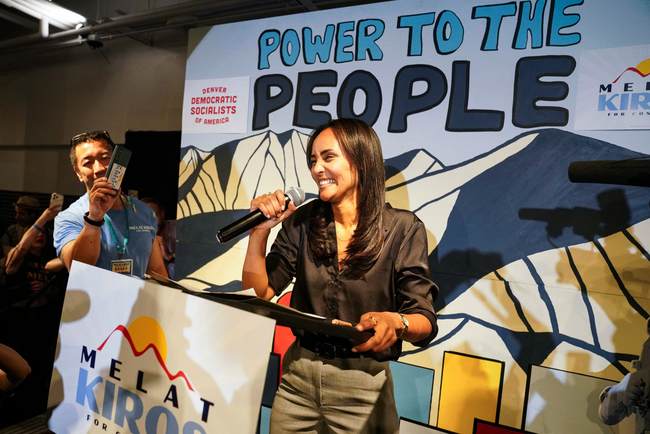
Melat Kiros, the Democratic nominee in Colorado’s 1st District and a self-identified member of the Democratic Socialists of America, faced direct questions about communism in a PBS interview and gave answers that are drawing criticism from Republicans who see her responses as dismissive and dangerous. Her insistence that being in a group with communists is “just noise” and her praise of socialism as delivering on core American ideals have prompted sharp pushback over the implications for individual rights and public policy.
What Colorado Socialist House Nominee Says About Communism Is Raising Some Eyebrows
Melat Kiros openly acknowledges membership in the Democratic Socialists of America, which makes the question about where she stands on communism more than academic. When asked bluntly, “Are you a communist?” she denied it, but the exchange on PBS left plenty of Republicans unsatisfied and worried. That simple denial didn’t answer the deeper issue: how comfortable is she sharing a platform with people who explicitly claim communist ideology?
Margaret Hoover pressed the point, asking Kiros about critics who say half of DSA leadership are communists and whether that association troubles her. Kiros’s response — shrugging and saying “Well, some members of the Democratic Party are proudly proclaiming themselves capitalists,” followed by “It’s a big tent” — felt evasive to many observers. Saying the presence of communists is “just noise from the Republican Party” minimizes an ideology with a bloody track record and ignores genuine voter concerns.
“Until a self-proclaimed communist wins an election,” she contended, “It’s just noise from the Republican Party.” That line attempts to trivialize a serious ideological clash by reframing it as partisan scare tactics. From a conservative standpoint, it’s not about rhetorical noise; it’s about principles that either defend individual liberty or demand collectivist control. The stakes are high when a candidate minimizes the historical consequences of totalitarian systems.
Coloradans deserve clarity on whether a nominee supports individual rights or systems that prioritize the state over the person. Kiros’s comfort in remaining in an organization that includes communists raises a question: does she share their ends even if she denies the label? Republicans argue that tolerance of those ends, even via ambiguous distancing, is not reassuring when policy decisions could shift away from free-market solutions.
She also introduced an odd contrast by pointing at capitalists within the Democratic Party as if that neutralizes concerns about communists. Comparing capitalism and communism as merely different party factions misses the moral and material chasm between them. Capitalism is credited with lifting billions from poverty through personal initiative and voluntary exchange, while communist regimes have been responsible for mass oppression and millions of deaths.
Worse, Kiros claimed that “evidence” shows socialism best delivers on “life, liberty, and the pursuit of happiness.” In the interview she offered no concrete evidence to back that sweeping claim, and critics say the historical record contradicts it. Socialism in practice has often substituted collective goals for individual rights, something that runs directly counter to the founding principles cited in the Declaration of Independence.
https://x.com/WesternLensman/status/2083607524838666278
Republicans point to the American system’s focus on individual rights as a fundamental difference — not a bargaining point — between our republic and collectivist alternatives. The idea that socialism aligns with those rights is, at best, an aspirational argument that ignores how centralized power tends to erode personal freedoms. Voters should demand specifics, not slogans that misapply founding language to justify radical policy shifts.
Meanwhile, the demeanor of some socialist politicians can be part of their political strategy: a calm, pleasant smile while advancing policies that critics warn are harmful. That contrast between tone and consequence worries conservatives, who argue that friendly presentation should not be allowed to mask dangerous policy goals. A smile does not alter the substance of an ideology or its potential impact on liberty and prosperity.
For GOP voters and independent conservatives watching this race, the core concern is simple: will a representative protect individual rights and economic opportunity, or will they move policy toward collectivist experiments with uncertain and often destructive outcomes? Kiros’s remarks did not resolve that question, and Republicans will press that point as the campaign continues.
Public debate about ideology matters because labels are not just academic; they signal policy priorities and political alliances. If a candidate is willing to brush off the presence of avowed communists in their organization, voters have to decide whether that indicates acceptable pluralism or a troubling tolerance for anti-liberty currents. Clear answers matter at the ballot box.
When ideological labels carry real-world consequences, it’s fair to demand specifics about how a candidate would translate beliefs into policy. Kiros’s claim about socialism’s success in delivering core American promises needs more than assertion; it needs evidence and a plan that preserves the rights that make those promises meaningful. Until then, Republicans will continue to challenge both the rhetoric and the record.



Melat has “an ass that is sucking wind” as the old adage goes and is outright “lying through her teeth!” DSA is nothing but a movement to introduce and indoctrinate Americans with Socialism/Communism and it is nothing but that!!!
I tell you as God is my witness these people pushing that DSA are nothing but “evil enemies within” and are going to ruin as well as destroy America if they are not stopped! Being enemies within the “US Constitution” spells out clearly what the remedy is to stop them or any enemies of America and its Citizens!
All of this Merry-go-round Malarkey in American politics and society at large MUST END NOW!!!
I pray most “American Citizens Wake-Up” fast!
In Jesus’ name I pray.
Amen.
Tell that Imbecile to shut up and try to prove I’m wrong about what Communism did in Cambodia; as in the “Killing Fields!” She like a AOC are brain dead zombie imbeciles completely indoctrinated/controlled; that have no clue about reality!
Pol Pot promised the People a Better life and only took their lives by the millions!
“Ideology played an important role in the genocide. Pol Pot was influenced by Marxism–Leninism and he wanted to transform Cambodia into an entirely self-sufficient agrarian socialist society that would be free from foreign influences. Stalin’s works have been described as a “crucial formative influence” on his thought. Mao’s works were also heavily influential, particularly influential was Mao’s booklet which was titled On New Democracy. Jean-Jacques Rousseau was one of Pol Pot’s favorite authors, according to historian David Chandler. In the mid-1960s, Pol Pot reformulated his ideas about Marxism–Leninism to suit the Cambodian situation by advocating goals such as bringing Cambodia back to an alleged and mythical past of the powerful Khmer Empire, eradicating influences which he viewed as “corrupting”, such as foreign aid and Western culture, as well as restoring Cambodia’s agrarian society.”
“Pol Pot’s strong belief that Cambodia needed to be transformed into an agrarian utopia stemmed from his experience in Cambodia’s rural northeast—where he developed an affinity for the agrarian self-sufficiency of the area’s isolated tribes—while the Khmer Rouge gained power.
The Cambodian genocide[a] was the systematic persecution and killing of Cambodian citizens[b] by the Khmer Rouge under the general secretaryship of Pol Pot. It resulted in the deaths of approximately 2 million people from 1975 to 1979, around 25% of Cambodia’s population in 1975 (c. 7.8 million).[3][4][5]
Pol Pot and the Khmer Rouge were supported for many years by the Chinese Communist Party (CCP), led by Mao Zedong;[c] it is estimated that at least 90% of the foreign aid which the Khmer Rouge received came from China, including at least US $1 billion in interest-free economic and military aid in 1975 alone.[11][12][13] After it seized power in April 1975, the Khmer Rouge wanted to turn the country into an agrarian socialist republic, founded on the policies of ultra-Maoism and influenced by the Cultural Revolution.[d] Pol Pot and other Khmer Rouge officials met with Mao in Beijing in June 1975, receiving approval and advice, while high-ranking CCP officials such as Politburo Standing Committee member Zhang Chunqiao later visited Cambodia to offer help.[e] To fulfill its goals, the Khmer Rouge emptied the cities and marched Cambodians to labor camps in the countryside, where mass executions, forced labor, physical abuse, torture, malnutrition, and disease were rampant.[18][19] In 1976, the Khmer Rouge renamed the country Democratic Kampuchea.” Wikipedia
://en.wikipedia.org/wiki/Cambodian_genocide