
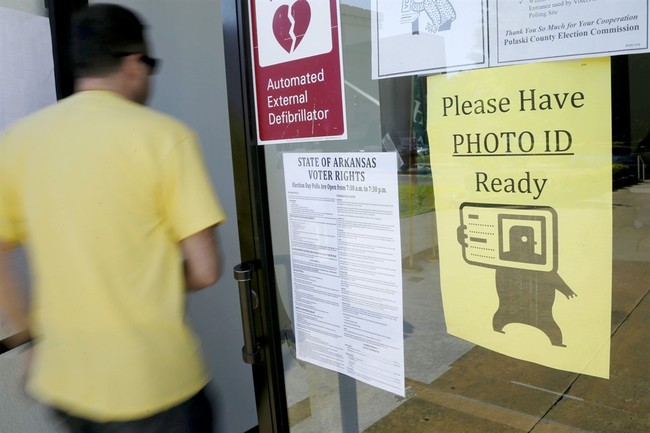
The debate over voter ID has become a parade of contradictions, with Democrats insisting photo identification is an obstacle to voting while expecting it for everyday activities; this piece lays out the absurdity of that stance, highlights a recent exchange involving Sen. Dave McCormick and Rep. Kelly Morrison, and points out how the public sees commonsense ID requirements as reasonable safeguards for election integrity.
The argument against voter ID often leans on emotional claims rather than logic, but most Americans see the practical contradiction at work. People are routinely asked for ID to buy alcohol, give blood, get married, or access government services, yet voting is sometimes treated as too sacred for the same basic verification. That inconsistency is what fuels public skepticism about opposing voter ID laws.
Sen. Dave McCormick summed up the commonsense view neatly during a recent Fox News interview when he listed everyday situations that require ID and tied that to voting. His exact words were: “I mean, you have to have an ID to get a six-pack, you have to have it to give blood, you have to have it to have a child, and you have to have it to get married. This is a commonsense thing.” That plainspoken comparison landed with people who are tired of partisan double standards.
Watch:
Predictably, a Democrat congresswoman pushed back in a way that missed the point and drew ridicule from those who pay attention to common sense. Rep. Kelly Morrison’s response tried to frame McCormick’s remarks as somehow discriminatory or overreaching, but it came off as evasive. When public reactions piled up, the disconnect between political theater and everyday reality became clearer to many voters.
The backlash wasn’t limited to pundits; ordinary citizens and commentators quickly dissected the response, pointing out the obvious parallels between ID requirements for simple tasks and the idea of safeguarding the ballot box. Those reactions flowed in fast and hard on social media and news feeds, underscoring a broader frustration with talking points that ignore practical concerns. The conversation exposed how easily political rhetoric can fall apart when measured against real-world norms.
Beyond the immediate exchange, the larger issue is about trust and responsibility in elections. Voter ID is framed by supporters as a minimal, reasonable step to protect the integrity of voting, not as a barrier to participation. Opponents often deploy race-based scare tactics or claim disenfranchisement without offering workable alternatives that maintain both access and security.
It is important to keep separating rhetoric from reality: demanding multiple forms of ID for volunteer work or city services while opposing IDs at the ballot box stretches credibility. When ordinary citizens see that you need proof of identity for routine activities, it strengthens the case for requiring the same for the critical act of voting. This alignment of expectations is why polling consistently shows wide support for voter ID across demographics.
Political theater aside, the practical policy question remains simple: how do we protect the right to vote while preventing fraud? Common-sense ID requirements are one of the straightforward tools available, and they are neither onerous nor unusual when compared to other everyday requirements. Lawmakers who refuse to acknowledge that leave voters skeptical of their motives.
“What do I do?” Don’t be like Rep. Morrison, that’s what. Do yourself a favor, and bring those forms of ID they tell you to bring when your unborn baby tees up for liftoff and announces, “It’s time, y’all!”
Editor’s Note: The Democrats are doing everything in their power to undermine the integrity of our elections.


Add comment