
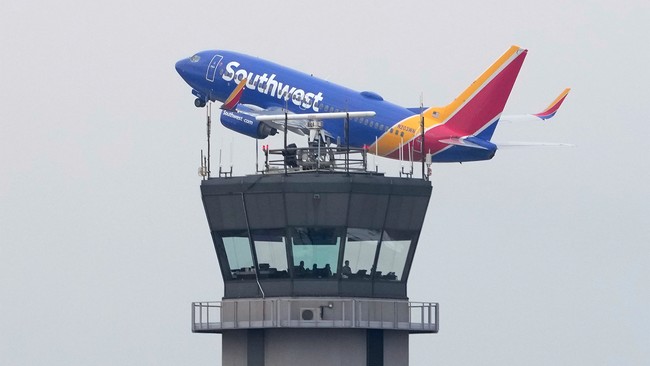
Captain Jim Curtis marked his 65th birthday and mandatory FAA retirement by flying his final Southwest Airlines leg on Father’s Day, accompanied in the cockpit by his daughter, First Officer Julia Curtis, in a scene that celebrated family, service, and the passing of an aviation legacy.
This story centers on legacy and the moments that make a career memorable. Capt. Curtis has been in the cockpit for 43 years, including 21 years serving in the United States Air Force, and spent 22 years flying commercially with Southwest Airlines. Those decades add up to more than 18,000 hours of flight time, a milestone many pilots dream about but few reach. The timing of his retirement—on his 65th birthday—was set by FAA rules that require airline pilots to stop flying at that age.
The final flight itself was quiet and full of feeling rather than spectacle. Capt. Curtis piloted the route from Las Vegas to Oakland, California, with his daughter seated beside him as first officer. On the intercom she chose to honor him not with a long speech but with words that captured what those years meant to their family. Her remarks underlined the mix of practical teaching and character-building that defined their relationship both on the ground and in the sky.
“I’m really honored to be his first officer today because Captain Curtis has been a mentor for me my entire life. He inspired me to be a pilot,” she added. “He also helped teach me how to walk, how to talk, how to ride a bike, how to throw a baseball, how to drive a car and probably most importantly, he taught me how to carry myself with humility, kindness and integrity both in and out of work.”
“Getting to fly with him is a dream come true and something that we’re going to remember for the rest of our lives,” she concluded.
The scene resonated because it was simple and sincere. Rather than an elaborate farewell, the moment was about mentorship and example—how one pilot’s conduct shaped another’s career and values. There’s a kind of full-circle feel when a child sits next to a parent in the same profession, especially one as exacting as aviation. In this case the “torch” passed in the most literal sense: the controls, the checklist, the shared responsibility for passenger safety and comfort.
Capt. Curtis’s record is a reminder that careers in service and defense often seed long-term commitments and a sense of duty. His Air Force background followed by more than two decades at a major carrier paints a portrait of consistency and devotion to craft. Accumulating over 18,000 flight hours means nights, weekends, and holidays away from home, and it also reflects trust placed in him by employers and passengers alike. Those numbers are more than statistics; they represent lives carried safely and a professional reputation earned over time.
The public reaction highlighted how much people value the personal side of aviation stories. Social posts and short videos shared snippets of the flight deck farewell, and they struck a chord because they were both relatable and aspirational. Viewers saw not just a career ending but a legacy continuing through Julia, who now wears the same colors and shoulders the same responsibilities her father did. It’s one thing to read pilot hours or job titles; it’s another to watch a father and daughter smile through a milestone that matters to them.
For crew members and travelers alike, the Curtises’ moment illustrated the quieter rewards of aviation—pride, mentorship, and the passing on of professional ethics. Piloting is technical work, but it’s also a human vocation shaped by habits, standards, and relationships. Capt. Curtis taught more than instrument approaches and emergency procedures; he modeled humility and integrity, traits that Julia explicitly credited as part of her upbringing and her professional formation.
Scenes like this play out rarely in public yet they happen all the time in workplaces where families intersect with vocation. The Curtises’ farewell was a reminder that a career can be both demanding and deeply personal, that milestones matter because of the people next to you. Their handshake across the yoke, the brief words on the intercom, and the composed smiles all conveyed a lifetime of mentoring condensed into a single flight.
What remains are memories, certificates, logbook entries, and a daughter carrying forward what she learned. The aviation community recognizes milestones like these not for ceremony but for continuity—the knowledge that experience is handed down, standards are preserved, and the next generation takes up the responsibilities with gratitude and skill. That continuity is the quiet backbone of safe skies and reliable travel, and in this case it happened on a Father’s Day that will mean more to one family than any public tribute could.
Even government officials noticed the moment and offered acknowledgment. A short public mention underscored how stories of service and family resonate beyond the cabin, connecting civic recognition with private celebration. The mention reinforced the idea that training, mentorship, and character matter in professions that keep people moving and communities connected.
In the end, the Curtises showed how a career can culminate not in solitude but in shared pride. The flight log will list a final leg from Las Vegas to Oakland, but for them the record will always include the informal lessons learned and the example set across a lifetime in uniform and in commercial cockpits. That kind of legacy keeps the aviation world steady and gives the next generation something tangible to aim for.
https://x.com/SecDuffy/status/2069443220837224575



Add comment