
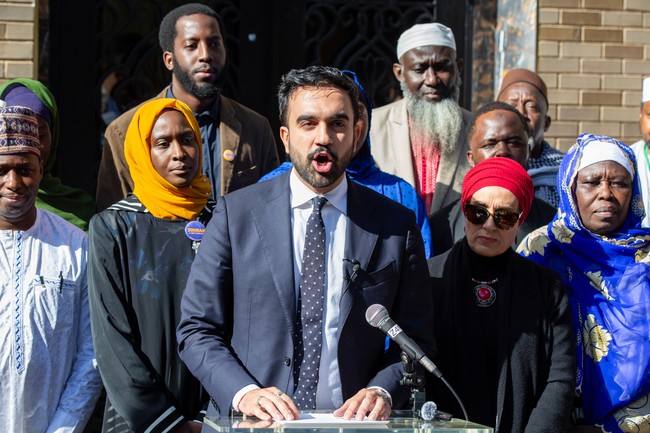
Checklist: explain Mamdani’s public threat, cite legal reality from the U.S. ambassador, quote the mayor’s own words, note political implications, and include original embeds. This piece looks at New York City Mayor Zohran Mamdani’s vow to pursue an arrest of Israeli Prime Minister Benjamin Netanyahu during UN General Assembly week, lays out why that can’t happen under U.S. law and diplomatic practice, and highlights the political theater around the comments.
New York just hired a mayor who talks like a protest sign. Zohran Mamdani declared he wants Benjamin Netanyahu arrested when the Israeli leader visits for the U.N. General Assembly, and he told a high-profile interviewer that he believes Netanyahu “belongs in the Hague.” Those are dramatic words for a city executive whose actual powers are municipal and limited.
“I believe that Prime Minister Netanyahu belongs in the Hague,” Mr. Mamdani told Lulu Garcia-Navarro this week on “The Interview,” a New York Times show, referring to the home of the United Nations’ International Court of Justice.
“He’s a war criminal who has been charged by the International Criminal Court,” Mr. Mamdani added. “And what you will find is that is an opinion that is held by many, purely because of what his actions have wrought over these last many years.”
He even admitted uncertainty about the legal basis, saying he is still checking with his law department to see “whether he has the legal authority” to act. That line reveals the core problem: a mayor can filibuster and make declarations, but he cannot rewrite international law or federal jurisdiction from City Hall. The admission undercuts the bravado and points to a political calculation rather than a credible plan.
Netanyahu responded by suggesting the mayor’s remarks show whose side he’s on. That reaction is predictable — international visits of heads of state are protected by several layers of law and custom. Congressional Republicans and many legal experts have long warned that theater like this risks diplomatic headaches and misleads constituents about what local government can actually accomplish.
U.S. Ambassador to the United Nations Mike Waltz cut through the noise with a concise legal reality check and labeled Mamdani’s plan “pure political theater.” The ambassador boiled the situation down to the fundamentals of U.S. treaty choices, diplomatic protections, and constitutional authority, showing why a city mayor cannot unilaterally arrest a visiting head of government. That short, direct rebuttal is exactly what this moment needed.
https://x.com/jacobkornbluh/status/2077183816217530696
Mayor Mamdani: here’s why your threat to arrest PM Netanyahu’s in NYC during UNGA is not going to happen:
1. The U.S. is not party to the Rome Statute that underlies the ICC,
2. The UN Headquarters Agreement grants diplomatic protections to visiting heads of gov’t,
3. head-of-state immunity applies, &
4. federal authority trumps any local mayor’s wishes.
This is pure political theater.
The facts are straightforward. The United States never joined the Rome Statute that created the International Criminal Court, meaning the ICC’s reach in U.S. territory is limited at best. The Headquarters Agreement for the United Nations and long-standing diplomatic norms afford visiting leaders specific immunities, and federal law supersedes any local action on matters of foreign relations and national security.
Beyond the legalities, this episode is political theater with consequences. A mayor who courts headlines by threatening to detain a foreign leader hands opponents a simple message: he’s more focused on activism than governance. Voters should expect mayors to run city services, not foreign policy dramas that could draw New York into unnecessary controversy.
One other striking detail is the pattern. Recent reporting shows Mamdani’s office reaching out to foreign diplomats in ways that stretch traditional mayoral duties, and that pattern matches the approach here. Whether the topic is public transit or international arrests, the conduct raises questions about priorities and judgment for someone running the country’s largest city.
Let Mamdani keep talking if he wants; the First Amendment covers bluster. But the law and protocol are on clear display thanks to the ambassador’s reply, and the practical reality is unchanged: a mayor does not have the authority to arrest a visiting head of government, and any attempt to claim otherwise is a political stunt that distracts from real city responsibilities.
The USA needs to think about what we elect a politician for. Until they are running for a federal office they need to learn to stay in their own lane.
We have local governments suing the Federal government for revoking federal FUNDING which is insane on its face. There is no right to federal funding and when a local government does not want to abide the laws and terms of the funding they can just forget receiving it.