
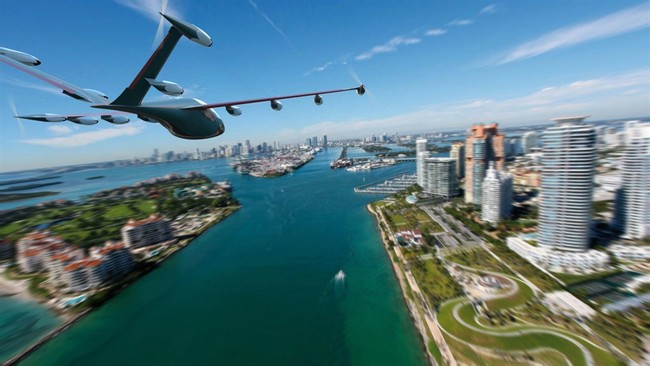
Gov. Ron DeSantis announced Florida will begin testing electric vertical takeoff and landing aircraft, or eVTOLs, by the end of the year, tying the effort to a broader push for advanced mobility at the SunTrax testing site that includes autonomous ground vehicles and vertiport infrastructure.
For decades people have joked about flying cars, and the Jetsons became shorthand for a future that never quite arrived. Florida is now moving to turn that cultural promise into a real program by inviting live tests of compact electric aircraft that take off and land vertically.
DeSantis stood at the SunTrax facility and framed the plan as bold state-level action to accelerate new transportation technology. He highlighted vertiports already built and aircraft that won’t need runways, pitching the initiative as practical progress rather than mere spectacle.
“I can’t promise we’ll ever be able to take you to the future, to the past,” DeSantis told reporters, a nod to the “Back to the Future” movie franchise. “But I think we’re going to be able to get you up in the air at some point in the not too distant future.”
The term eVTOL stands for electric Vertical Take-Off and Landing, and these aircraft are designed to handle short-to-medium trips without the footprint of conventional airports. They lift like helicopters, then transition to quieter, faster forward flight, aiming to operate as air taxis in urban or congested corridors.
DeSantis said the state will begin “actively testing” these aircraft by year’s end, positioning Florida as one of the fastest-moving states on this front. He showcased the testing environment as more than publicity — SunTrax offers high-speed lanes and integrated infrastructure that companies need for meaningful trials.
The governor also used the event to point out other advances under way at the site, including autonomous ground vehicles from firms like Waymo and Tesla. He emphasized that several test vehicles are being developed without traditional controls like steering wheels or pedals, underscoring how transportation is changing on multiple fronts.
https://x.com/FLVoiceNews/status/2086872765357781141
“We’re the only high-speed autonomous vehicle test track in the United States,” he bragged, highlighting a capability few other states have matched. That claim was meant to underscore Florida’s unique assets for private firms and startups working on next-generation mobility systems.
Florida Department of Transportation Secretary Jared Perdue added context on why the state is committing resources to these new aircraft. “When is the last time we, as civilization, got to usher in a new way to move people?” he asked. “We’ve improved the automobile with autonomy, and now we’re entering the age of flying cars.”
These vehicles are marketed as quiet, electric air taxis that ferry a handful of passengers over relatively short routes, which could make them a complement to existing transit or a niche for congested corridors. Proponents see potential to relieve pressure on highways and reduce commute times, especially in dense metro areas.
Critics will raise questions about cost, airspace management, noise, and safety certification, and those debates are already part of the regulatory landscape. Supporters argue that early testing in real-world conditions is essential to resolve those obstacles and to attract private capital and operational expertise.
Florida’s push includes not just aircraft trials but also infrastructure preparation, from vertiports to integrated air traffic systems tailored for low-altitude operations. The state is marketing its combination of test tracks, weather conditions, and local investment climate as attractive to manufacturers and service providers.
Observers will watch how these tests proceed and whether public adoption follows, but the plan signals a clear state priority: accelerate commercialization of emerging transport tech. Whether the result is fewer cars on I-4 or a new layer of urban mobility remains to be seen, but Florida’s timeline is no longer science fiction.
Plenty of futuristic conveniences from old cartoons never arrived exactly as imagined, and some remain distant dreams, like the fanciful dress-o-matic gag. Still, the sight of vertical electric aircraft preparing to lift off at a state-backed facility is a recognizable step toward a long-promised future.


Home-based job that pays more than 12,000 Dollar per month by doing simple tasks on a laptop or mobile device part-time. Last month, I earned 24,863 Dollar from this job by working 4 hours per day online. Very simple jobs to do, and the earnings are insane. Everyone can now make more money online by joining the website listed below…..
𝒋𝒖𝒔𝒕 𝒖𝒔𝒊𝒏𝒈 𝒕𝒉𝒊𝒔 𝒔𝒊𝒕𝒆.. Www.PayAtHome1.Com