
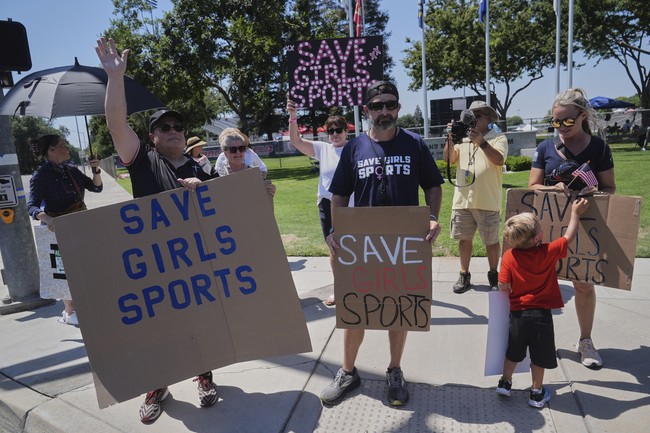
This article examines a New Hampshire case where transgender-identifying students and their families pulled lawsuits after recent Supreme Court rulings affirmed that states may reserve girls’ and women’s sports for biological females, and it highlights how female athletes pushed back, the community tensions that followed, and the broader political context around Title IX and the 2026 midterms.
The Supreme Court rulings in Little v. Hecox and West Virginia v. B.P.J. clarified that states can legally limit girls’ and women’s athletic teams to biological females without violating Title IX or the Constitution. That decision immediately reshaped legal strategies nationwide and changed the practical reality for schools and athletes. In New Hampshire, some parents of transgender teens dropped lawsuits seeking to let their sons play on girls’ teams after the rulings removed their legal pathway.
One teenage boy quit his attempt to play on a girls’ soccer team, reportedly because the situation ceased to feel enjoyable. The withdrawal followed a stretch of intense scrutiny and protests around the team and the school, leaving players and families exhausted. The episode illustrates how legal outcomes translate into personal choices and shifting team dynamics at the local level.
Online commentary captured a range of reactions, including a blunt line that summed up one perspective: “That’s as good as self-deporting.” That quote has been widely circulated and is illustrative of the no-nonsense tone many commentators took when the legal landscape changed. For supporters of women’s sports protections, it represented relief and a sense that boundaries were being reasserted.
Parker’s father described the atmosphere as “palpable tension.”
Even playing on her own turf, “there would typically be a couple of police officers at the home games where there weren’t previously,” Zach Tirrell said.
In the past, Parker also played soccer in a recreation league and could still do so.
“But I think it all kind of still sort of weighs on her,” her mother said. “It’s the same group of kids that she plays with who, honestly, have been very supportive and love to have her on the team and have expressed that to her many times over. But I think she still has that worry in her brain around, ‘What are other people going to say and do if I show up at a game?’”
Parker’s parents hope she’ll return to playing soccer some day. In the meantime, “she plans to be around and use her voice to continue standing up to discrimination,” her mother said. “In some ways she’s had to grow up a lot faster than some of her peers.”
The tension described by Parker’s family reflects how volatile high school sports can become when national issues land in small communities. Police presence at otherwise routine games signals the high stakes and the fear of confrontations. Parents and players on both sides felt under pressure, and that strain influenced decisions about participation and public statements.
Those who supported the court rulings argue that protecting single-sex sports is about preserving fair competition and safeguarding opportunities for biological girls. They point to physical differences and decades of women’s sports activism as the rationale for state-level restrictions. For many families and athletes, the idea is simple: create a level playing field where female athletes can compete and succeed without being overshadowed.
Critics of these restrictions framed their own arguments around inclusion and the mental health of transgender youth, saying the rulings closed doors for vulnerable kids. Parents who filed suits in places like New Hampshire claimed they were fighting for their children’s right to participate. When those suits were abandoned, some families cited legal realities and the emotional toll of public fights as reasons to step back.
Local school officials now face the messy task of implementing policies that reflect state law, court precedent, and community expectations. Athletic directors must reconcile regulatory compliance with the need to keep teams functioning and students engaged. Coaches are left navigating locker room dynamics and eligibility questions while trying to maintain team cohesion and fairness.
Beyond sports, this debate has become part of the wider political conversation heading into the 2026 midterm elections. The Editor’s Note reads: “The 2026 Midterms will determine the fate of President Trump’s America First agenda. Republicans must maintain control of both chambers of Congress.” That framing places a local school issue into a national partisan context and underscores how education and youth athletics have become political flashpoints.
At the community level, both sides insist they want the same basic thing: safe and healthy opportunities for kids. What differs is how to balance inclusion with competitive fairness and whose needs get priority. The New Hampshire case is one example of how courts, communities, and families are sorting through those conflicting goals in real time.
As schools and states adapt to the Supreme Court decisions, expect more contested moments in gymnasiums and on soccer fields across the country. Those disputes will test legal boundaries and force practical choices about participation, safety, and who gets to define fairness in youth and scholastic athletics.



Add comment