
This piece critiques Senate Minority Leader Chuck Schumer’s handling of the DHS funding fight, outlines the consequences for airport security and TSA staffing, notes the administration’s move to deploy ICE to ease airport chaos, and highlights Schumer’s on-floor slip where he said, “We must fund ICE…” while arguing about funding the TSA.
Senate Minority Leader Chuck Schumer is under pressure from the party’s left flank, and it shows. With calls for fresh leadership and whispers of primary challenges down the line, his political standing looks shaky among progressives who view him as ineffective. That internal revolt helps explain some of the erratic posture we’re seeing from him on funding fights that affect public safety.
The current standoff over Department of Homeland Security funding has real-world consequences beyond Capitol Hill rhetoric. Hundreds of TSA agents have reportedly quit amid the uncertainty, producing long lines and delays at major airports just as global tensions with Iran are high and threats remain. When political calculations interfere with homeland security, travelers and frontline workers pay the price.
Instead of addressing those operational gaps, the Democratic leadership has often prioritized political signaling over pragmatic fixes. That means essential agencies get used as bargaining chips, and the American people end up dealing with the fallout. Republicans are pointing out that after years of politicizing immigration and border policy, Democrats are the ones blocking a full funding solution for DHS.
President Trump moved to deploy ICE officers to assist at airports to alleviate pressure on TSA lines, and Border Czar Tom Homan confirmed support was on the way. The decision reflects a simple conservative principle: use federal resources where they are needed to keep people safe. If Democrats truly cared about security, a clean funding path for DHS would be the obvious step, and partisan brinkmanship wouldn’t be allowed to create chaos at our airports.
Schumer tried to split funding measures to shield political priorities, proposing to separate TSA funding from the broader DHS package. That tactic may score short-term headlines, but it leaves critical agencies vulnerable and invites more disruption. Meanwhile, offers from private individuals to help with TSA payrolls complicated the theater, because it undercuts the leverage Democrats hoped to wield by making agents the political hostage.
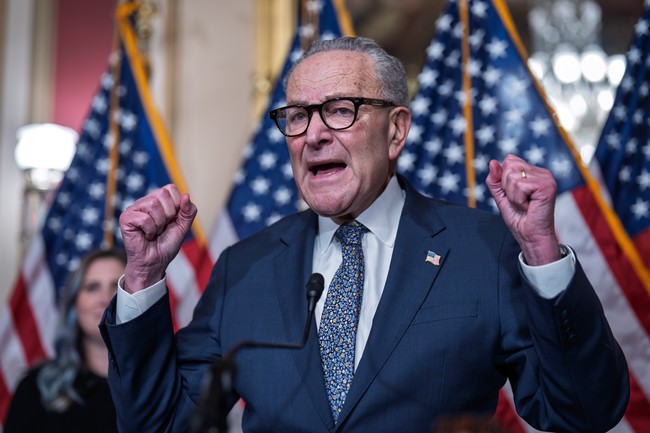
On the Senate floor, the pressure got to Schumer in a very public and embarrassing way when he tripped over his own words during an argument. He said, “We must fund ICE…” before correcting himself to insist, “We must fund TSA right now!” The slip is telling — it exposed the truth he’d rather avoid and handed conservatives a rare, blunt moment where the policy reality peeked through the performance.
That gaffe isn’t just comic relief; it highlights how the left’s priorities have warped the debate. Democrats frequently downplay ICE and other enforcement tools while insisting on policies that limit enforcement, and now their refusal to fully fund DHS has created vacancies and vulnerabilities at a time when homeland security should be nonpartisan. Conservatives argue that when national safety is at stake, political games should stop.
With ICE stepping in, the administration is seeking practical fixes — not press-friendly posturing. This move emphasizes a conservative focus on solutions that work rather than on preserving narratives. If Republicans are able to keep the focus on effective operations and public safety, they can force a choice: fund the agencies that protect citizens or accept the consequences of failure at the checkpoints.
Schumer is squeezed between a demanding left and a public that expects safety, and the mistake on the floor made that squeeze visible. He can try to thread a needle by splitting bills or bargaining over individual agencies, but the bottom line remains that DHS funding needs resolution. If Schumer wants to avoid further humiliation and real harm to travelers, simply supporting a comprehensive funding solution would be the right, practical act.
The political calculus from a Republican perspective is clear: expose the disconnect between Democratic rhetoric and the consequences of their choices, emphasize pragmatic deployments like ICE to keep airports functioning, and push for full funding of homeland security so policy doesn’t keep Americans waiting in line. The voters will notice who acted to keep them safe and who used security as a bargaining chip.



Add comment