
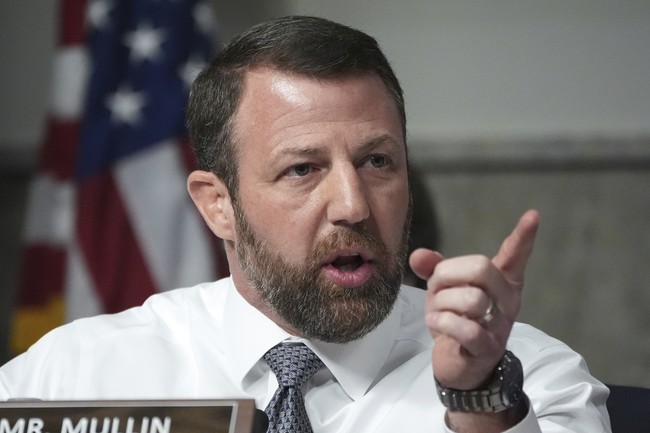
This article covers a heated Senate exchange where DHS Secretary Markwayne Mullin pushed back hard against Senator Chris Murphy’s accusations about the Department of Homeland Security, defending officers, law enforcement practices, and the role of Congress in setting the laws being enforced.
DHS Sec. Mullin Delivers Epic Takedown of Chris Murphy and His Attack on the DHS
Senator Chris Murphy launched a vocal attack on the Department of Homeland Security during a congressional hearing, accusing DHS personnel of unlawful behavior and framing them as a threat. Those remarks drew a firm rebuttal from DHS Secretary Markwayne Mullin, who framed the issue as political grandstanding that harms rank-and-file officers. Mullin’s response emphasized that DHS is enforcing statutes set by Congress, not inventing policy on the fly.
The hearing grew tense as Murphy painted DHS agents with sweeping, inflammatory language, and Mullin pushed back by stressing the real-world consequences of that rhetoric. He highlighted how personal attacks on federal agents translate into threats and assaults, and he made clear the department is operating within the authority Congress provided. For Republicans and supporters of law and order, Mullin’s defense aimed to reframe the debate around accountability to lawmakers, not media-driven narratives.
Murphy’s allegation that DHS was engaged in behavior crossing legal lines included language that branded agents as dangerous and unconstitutional, and that broad accusation set the stage for Mullin’s pointed reply. Mullin rejected the premise outright and called the claims reckless, arguing that they unfairly smear hundreds of thousands of federal employees. His stance was simple: if lawmakers object to current enforcement, their remedy is to change the law, not to vilify those charged with enforcing it.
https://x.com/EricLDaugh/status/2061886982570049672
“The outlandish claims you made there is just flat wrong. You start saying we’re breaking the law, and you really start looking at it, and we’re enforcing laws that Congress did pass. That’s reckless.
When you say it’s unconstitutional, what’s unconstitutional? We swore to uphold the Constitution just like you swore.
For you to throw my 275,000 employees underneath DHS, with a broad stroke like that, is reckless and irresponsible on your part.
We’re doing the job that Congress gave us the authority to do, and our men and women out there every single day is enforcing laws. If you don’t like the laws, you can change them.
We’re not picking and choosing which laws to enforce. We’re simply enforcing the law. Period. Full stop.
Mullin didn’t stop at procedural arguments; he linked rhetoric to real harm and provided statistics to underline the stakes. He said death threats against DHS agents had spiked dramatically, and that assaults were rising, numbers he tied directly to the climate created by sensational political statements. That point reframed the debate from abstract claims about legality into concrete outcomes affecting officers’ safety and morale.
When you throw out reckless terms and you start referring to our agents as being “dangerous, unconstitutional, and lawless,” that’s why our agents’ death threats are up by 8,000 percent.
I know that’s not what you want. But your political theater, that’s what it causes. When you start looking at assaults on our officers, they’re up by 1,300 percent. Senator Murphy, is that what you want?
The exchange escalated when Mullin called out Murphy’s apparent pursuit of headlines, suggesting the senator prioritized optics over officer safety. Mullin said Murphy performed for cameras during his testimony and implied that political ambition was driving the confrontation. That observation was meant to contrast media-ready theatrics with the lived reality of agents asked to carry out difficult duties under intense scrutiny.
“I understand the political theater, I understand wanting to get soundbites, and that was obvious because the whole time you was giving your testimony, he wasn’t looking at me, he was looking at a camera. I get that. If you have bigger political ambitions, just say it. But don’t do it at the expense of my officers. If you want to talk about funding, you haven’t funded my officers; CBP and ICE have been willing to work for free.
Mullin also blamed the current administration for creating the operational strain that leaves agents overstretched and underresourced, and he argued that political obstruction from opponents compounds those problems. He emphasized that officers stepped up despite the leadership vacuum and political hostility because they believe in duty and public safety. That appeal was aimed at restoring public respect for the men and women who carry out homeland security work day to day.
The hearing made clear this is not just a policy fight but a narrative battle over who gets to define enforcement and accountability. Mullin insisted DHS follows laws enacted by Congress, challenging any framing that paints enforcement as unilateral or rogue. For Republicans watching, the exchange underscored a central point: criticize the laws if you must, but do not attack the people enforcing them without consequence.
Public debate over border security, immigration enforcement, and federal policing often breaks down into soundbites, but hearings like this expose the tangible impacts of rhetoric on personnel. Mullin’s goal was to redirect criticism back to lawmakers and to demand that opponents be precise rather than theatrical when discussing enforcement. The result was a combative, televised moment that drew sharp lines between political critique and the safety of public servants.
As the session closed, the clash between a vocal senator and the DHS secretary left a clear impression: enforcement happens under written law, and whether critics accept that fact or seek to change it, the lives of hundreds of thousands of officers are on the line. That reality framed Mullin’s rebuttal as less about scoring points and more about defending employees who he says are unfairly maligned.



Add comment