
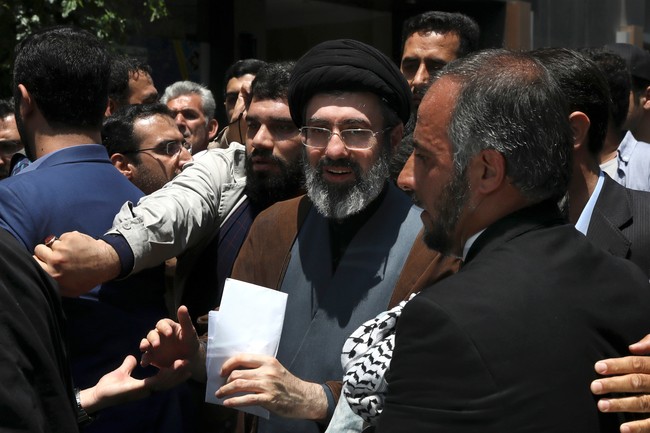
The new, mysterious Supreme Leader of Iran, Mojtaba Khamenei, has been named amid chaotic reports and social-media mockery, but his whereabouts and whether he is even alive remain unanswered questions that have left Western intelligence and Tehran watchers scrambling for answers.
He rose to the top after the U.S.-Israel strikes that reportedly wiped out Ayatollah Ali Khamenei and much of Iran’s command structure, yet Mojtaba has not appeared in public and the regime’s communications around him look strange and staged. The few statements attributed to him have been read by others, and images circulating online are widely suspected to be altered or generated. That mismatch between claim and evidence has set off a stampede of skepticism across intelligence circles and social feeds.
The CIA thinks they know why.
Observers note that if he were the genuine, functioning head of state he would be front and center, delivering messages himself and being seen by the people who still matter to the clerical regime. Instead, the Iranian state has relied on voice-overs, proxies, and state TV anchors to convey the words attributed to their new leader. That kind of distance breeds suspicion: either Mojtaba is incapacitated, being hidden away, or he exists mostly as a puppet for the ruling apparatus.
Social media has turned Mojtaba into a running joke, with mockery centered on his rumored personal life and his ineffective public profile. Memes aside, the bigger issue is strategic: a leadership vacuum or a leader who cannot credibly lead leaves Iran in disarray at a moment of intense pressure. From a Republican viewpoint, this is the kind of weakness that should be exploited to reduce threats to the region and American interests without ceding initiative to our adversaries.
State television’s treatment of Mojtaba’s first major message underlines the oddity. The March 12 address that vowed to “avenge the blood of our martyrs” and to keep the Strait of Hormuz closed was not delivered by him but was read on air by a female anchor, a glaring sign that the regime is managing optics rather than delivering authentic leadership. That fuels the theory that the visible face is a placeholder while the true centers of power — the Revolutionary Guard and the clerical elite — continue to call the shots behind closed doors.
In his first, fiery address to the Iranian nation on March 12, new Supreme Leader Mojtaba Khamenei vowed to “avenge the blood of our martyrs” and to keep the Strait of Hormuz closed. That message of defiance wasn’t delivered by Khamenei himself: It was read out on state television by a female news anchor.
Since then, the mystery surrounding Khamenei’s whereabouts and well-being has only deepened. Khamenei hasn’t appeared in public, nor has the Iranian government issued new images of him or even recordings of his voice.
The pictures that have been released often show Khamenei in clearly fictional scenes for propaganda purposes. Many photos of him appear to have been generated or modified by artificial intelligence, according to analysis by The Wall Street Journal and scholars of Iran’s visual imagery.
Plainly put, if Mojtaba were an active, breathing leader, Tehran would put him on screen—just as insurgent leaders and terror bosses have occasionally released recorded statements when hiding. The absence of live footage or unedited recordings suggests either they are protecting someone who is unwell or they are manufacturing a persona to hide the real power holders. Neither scenario is good for regional stability.
Western officials have openly admitted the uncertainty. One senior Israeli official said bluntly, “We have no evidence that [Mojtaba] is really the one giving orders.” A U.S. official put it this way: “It’s beyond weird. We don’t think the Iranians would have gone through all this trouble to choose a dead guy as the supreme leader, but at the same time, we have no proof that he is taking the helm.” Those candid assessments should sharpen policy rather than paralyze it.
“We have no evidence that [Mojtaba] is really the one giving orders,” a senior Israeli official told Axios.
“It’s beyond weird. We don’t think the Iranians would have gone through all this trouble to choose a dead guy as the supreme leader, but at the same time, we have no proof that he is taking the helm,” a U.S. official said.
The clerical regime has always been opaque, but this episode exposes a deeper rot: a top-down theocracy that can name leaders for ritual purposes while real authority hides behind a curtain. That is an exploitable weakness for any external actor committed to rolling back Iran’s malign regional ambitions, and Republicans arguing for decisive action can point to this fracturing as evidence that pressure works.
Whatever the truth about Mojtaba’s status, the consequences matter now. A regime that cannot present a credible leader invites internal maneuvering, power grabs by security forces, and miscalculation abroad. Those dynamics increase the risk of accidental escalation, misdirected retaliation, or fractured command-and-control at a time when the United States and allies must keep a cool head and exploit openings created by Tehran’s disarray.


Add comment