
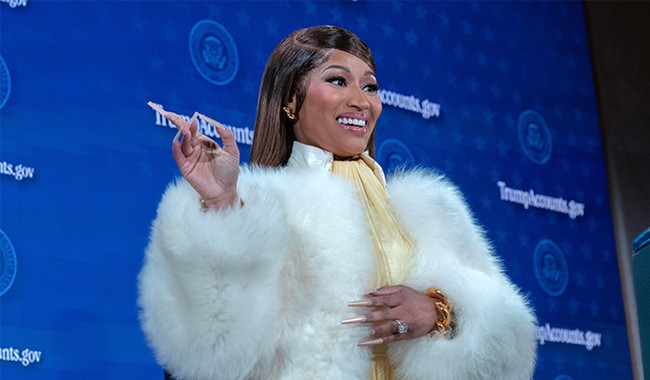
Nicki Minaj’s offhand joke about “bribing” her fans to call senators shoved a simple policy debate into a media tantrum, and it revealed how election integrity has become a culture war flashpoint. The exchange centers on the SAVE America Act, a proposal to require proof of citizenship and photo identification for voter registration, and the furious reaction shows how polarized even basic verification rules have become. Her message landed with millions of young fans and forced mainstream outlets to choose whether to treat the issue as a legitimate policy question or a scandal. What followed was less about the bill itself and more about who gets to frame the conversation.
Minaj told her followers on X, “Barbz, get your pretty little fingers out and call your senators. I will bribe you if I have to,” pairing the comment with a video and promises of fan perks for those who acted. That line, playful in tone, was seized by critics who recast it as proof of something nefarious and used it to obscure the underlying policy. The uproar ignored the actual text of the SAVE America Act, which focuses on requiring proof of citizenship and photo ID to register and tightening some mail voting safeguards already in place in many states. Thirty-six states already require some form of ID at the polls in one way or another, so the proposal is hardly radical in practice.
Reporters turned a joke into a headline and treated the notion of verification like a partisan poison pill, even though asking for ID is routine in everyday life. You show identification to fly, to open a bank account, and to pick up prescriptions, but suggesting the same standard at the ballot box became framed as an existential threat to democracy. Supporters of the bill argue that reasonable verification builds public confidence in election outcomes, especially after years of contested results and legal turmoil. Opponents counter that it will make voting harder for certain groups, a claim that has become a core political line rather than a neutral assessment of administrative changes.
The way media outlets described Minaj’s comment — phrases like “willing to bribe” and claims that she wanted to “pass [a] law making voting harder” — transformed ordinary online banter into moral panic. Treating a celebrity’s playful language as evidence of corruption distracts from the substance of the debate: whether elections should be administered with consistent verification measures. Conservative voices saw the flap as shorthand for a broader double standard, where celebrities who echo progressive positions get sanctified while anyone who supports voter ID is demonized. That imbalance shaped coverage more than any examination of the bill’s text.
The SAVE America Act aims to standardize safeguards already present across much of the country, not to invent new barriers out of thin air. Proponents say uniform requirements would reduce confusion and strengthen trust in electoral outcomes, a legitimate policy goal even if reasonable minds disagree about the best approach. Critics paint it as a roadmap to suppression, often without engaging with specifics like photo ID options, provisional ballots, or targeted outreach programs to ensure eligible voters can comply. This is politics using fear of exclusion as its primary tactic rather than engaging voters about practical solutions.
Minaj’s comparison drew attention for a reason: many Americans notice the inconsistency between broad public health verification and the sanctity of showing ID to vote. Mandates for vaccine proof or photo IDs in other contexts were accepted by large swaths of the public, yet the idea of showing identification at the ballot box is now framed as uniquely oppressive. You do not need to subscribe to any particular party line to see the contrast; you only have to look at how verification is treated in everyday transactions versus political coverage of election reform. That contrast helped explain why her post landed where it did.
Her history of praising President Donald Trump and publicly supporting voter ID complicated how different audiences read the message. For some, it signaled that a cultural icon was crossing expected partisan lines; for others, it meant an opportunistic headline and a chance to rally outrage. Either way, the episode underscored a shifting dynamic: influential figures can break from established media scripts and prompt fresh conversations. The backlash looks less like a reasoned critique and more like a defensive reflex to preserve familiar narratives about voting rights.
The broader question the uproar avoided is straightforward: should American elections be administered with basic, verifiable identity checks so that only eligible citizens cast ballots? Framing that inquiry as an attack rather than a policy debate shuts down the possibility of practical compromise. A growing number of voters, tired of theatrical coverage and partisan bluster, want clear rules that are fairly enforced at every level. That desire for clarity is at the heart of the SAVE America Act discussion, even if you disagree with every provision it contains.
The media meltdown over a tweeted joke served as a reminder that culture and policy are deeply entwined, and that framing often matters more than facts. Republicans argue that requiring proper identification to vote is a commonsense measure to protect elections and public trust, not a partisan trick. As the debate continues, the focus should be on whether proposed changes improve election administration and access, not on weaponizing celebrity banter into moral hysteria. The conversation about verification deserves less theater and more substance.
Editor’s Note: Republicans are fighting for election integrity by requiring proper identification to vote.

Add comment