
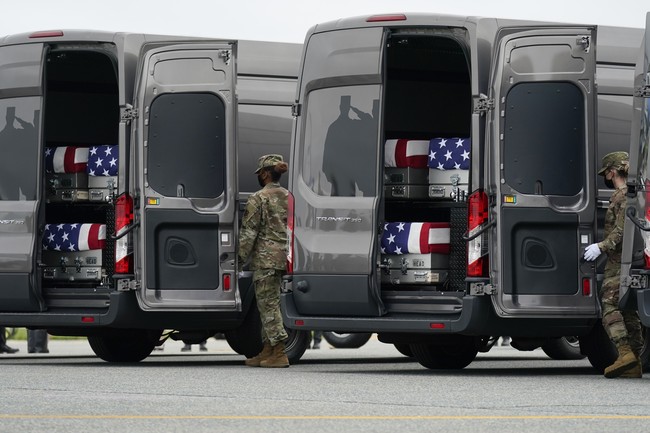
The Department of War has formally recognized the Marines who defended Abbey Gate during the chaotic 2021 Afghanistan withdrawal, upgrading valor awards to reflect their actions under direct enemy fire, while a review panel chaired by Pentagon officials seeks answers about failures that led to the deadly attack.
The Abbey Gate bombing was a defining tragedy of the August 2021 withdrawal from Afghanistan, where an ISIS-K suicide bomber struck a crowded entry point to Kabul’s airport. Thirteen U.S. service members were killed and roughly 170 Afghan civilians lost their lives in a single, preventable act of violence that exposed catastrophic planning and leadership failures. For many, those moments are forever tied to a broader critique of how the evacuation was handled and who was in charge when things collapsed.
Gold Star families turned “Remember Abbey Gate” into a call for accountability and for honoring the courage of the service members who stood in harm’s way. The Department of War has answered part of that call by reviewing awards given to the Marines who faced the blast zone and then deciding some recognitions had been inappropriately downgraded. That official correction matters to veterans, families, and anyone who believes sacrifice should be recorded truthfully.
Pentagon spokesman Sean Parnell summarized the decision and the broader review in a public statement that explained why the upgrades were necessary. The message made clear the review panel’s purpose: to examine the record, identify failures, and make sure service members receive the recognition they earned. Restoring proper honors is a necessary, but limited, step toward justice for the fallen and their families.
Following the Afghanistan Withdrawal Special Review Panel’s recommendation and at the direction of Secretary of War Pete Hegseth, the United States Marine Corps has upgraded the valor awards for the Marines of Company G, 2d Battalion, 1st Marines, who stood at Abbey Gate on 26 August 2021. After reviewing the original awards and determining that several had been inappropriately downgraded, these awards have now been upgraded to levels that more accurately reflect the extreme risk these Marines knowingly accepted and the lives they saved under direct enemy fire.
The Marines at Abbey Gate chose to hold the line in the direct blast zone with minimal cover while evacuation efforts continued, fully aware of a likely suicide attack. Their resolve under fire saved lives and demonstrated the warrior spirit that many feel has been eroded by years of mismanagement and political calculation. That reality was at odds with the original award decisions, which the review panel found did not reflect the true level of peril those Marines faced.
Parnell’s statement continued, emphasizing the panel’s responsibility to probe what went wrong and to prevent a repeat of such a catastrophe. The Afghanistan Withdrawal Special Review Panel will continue investigating operational, administrative, and leadership lapses that contributed to the disastrous withdrawal. The goal, as framed by the Department of War leadership, is to learn lessons and demand accountability wherever it is due.
The Marines at Abbey Gate were positioned in the direct blast zone with minimal cover, fully aware of an imminent suicide attack, yet they held their ground to keep evacuation operations running. Their actions that day were heroic. The original awards did not reflect that reality. Today’s upgrades correct that injustice.
Beyond upgrading medals, the panel’s work is meant to uncover systemic failures so commanders and policymakers can fix them and avoid repeating the same mistakes. Properly honoring valor is important, but it must be accompanied by real changes in policy, planning, and leadership oversight. That combination—recognition plus reform—is what will actually protect future service members.
None of the administrative fixes will bring back those who died at Abbey Gate, yet correcting the record restores dignity and signals that courage will not be diminished by bureaucracy. Meanwhile, critics rightly point fingers at the Biden administration’s handling of the withdrawal, arguing that leadership failures created a preventable environment for tragedy. From a Republican perspective, this episode underlines the need for strong, accountable leadership and a military culture that values readiness and responsibility.
The panel’s findings and the upgraded awards provide a partial measure of justice for the Marines and the families of those lost. The Department of War, now under leaders who emphasize the warrior ethos, has taken a step to correct past wrongs and to ensure future recognition matches battlefield realities. That is a necessary move for honoring service and restoring trust in how the nation treats its defenders.

Add comment