
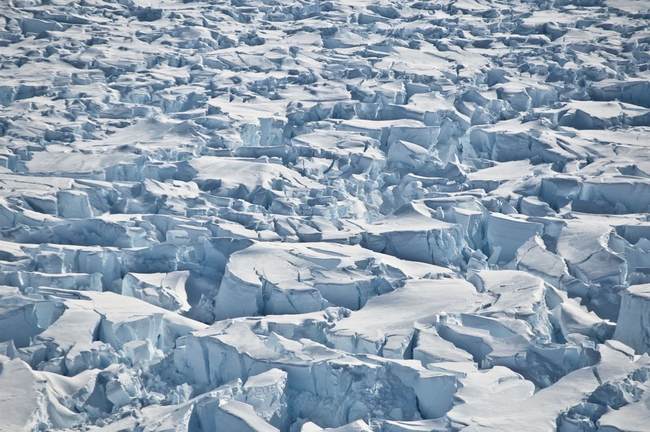
The media hype around Antarctica’s Thwaites Glacier — nicknamed the “doomsday glacier” — overstates both the immediacy and inevitability of catastrophe. This piece explains what scientists actually observe, why ocean currents matter more than tabloid headlines admit, how models differ from measurements, and why prudent monitoring and adaptation beat panic as a policy response.
Reports have treated retreating ice as if it equals imminent collapse, but retreat is not the same as collapse and collapse is not the same as near-term global calamity. The dramatic claim that Thwaites is about to flood the world’s coasts ignores the long history of cautious scientific language and replaces it with sensational certainty. “…entire nations could be wiped off the face of the Earth by rising sea levels if the global warming trend is not reversed by the year 2000.” That quote, often resurrected in scare stories, shows how alarmist framing has long outpaced measured evidence.
Thwaites contains roughly 600,000 gigatons of ice, a vast reservoir by any measure. News items frequently spotlight projected losses measured in the hundreds of gigatons and imply those numbers equal imminent collapse. Even a loss on the order of 200 gigatons spread across decades is a small fraction of the glacier’s total mass and not an automatic signal of structural failure.
Researchers studying Thwaites have found warm Circumpolar Deep Water intruding beneath the floating ice shelf, melting the ice from below at temperatures roughly 1 degree Celsius above freezing. That is a crucial point: the primary mechanism driving observed thinning is ocean-driven basal melt rather than direct atmospheric heating in that region. Framing the issue solely as an air-temperature problem leaves out the main physical process at work.
Ocean currents, salinity, wind patterns, and bedrock geometry all influence grounding-line migration and ice-shelf behavior, and these factors vary regionally across Antarctica. Basal melting and grounding-line retreat have been part of Antarctic dynamics for millennia, and they operate on geophysical timescales rather than TV-news deadlines. Simplifying the causes into a single atmospheric narrative misleads the public about what is actually being measured.
Modeling plays a central role in projecting future outcomes, but models are not measurements and they rely on assumptions that can change results dramatically. Scenarios that produce multi-meter sea-level rise depend heavily on processes like marine ice-cliff instability and hydrofracturing, which are parameterized in diverse ways across models. Small tweaks in those assumptions produce a wide spread of projections, so the most dramatic headlines typically reflect the outer tail of uncertainty distributions.
Observed thinning and retreat are real, and they justify continued, focused observation. However, extrapolating present trends into guaranteed near-term collapse lacks empirical support. The practical distinction between continued retreat over decades and irreversible, rapid disintegration is huge, and sloppy reporting regularly blurs that difference for effect.
Antarctica’s behavior is not uniform. While parts of West Antarctica have lost mass in recent decades, other regions have shown stability or even gains depending on the timescale examined. Treating the entire continent as a single melting block ignores this spatial variation and encourages policy driven by fear rather than targeted science-based response.
Measured sea-level rise is gradual and measurable in millimeters per year, not meters per decade, and increases that do occur unfold over decades to centuries. Even under higher-end scenarios, contributions from Antarctic ice would emerge over long timescales, giving communities time to plan and adapt. Engineering and policy options exist; adaptation is neither impossible nor unprecedented.
That said, Thwaites is an important glacier in a vulnerable marine setting and it demands sustained scientific attention. Monitoring campaigns, sub-ice instrumentation, and careful modeling remain essential to resolve uncertainties and to update projections as new data arrive. But vigilance should not be confused with inevitability, and measured rhetoric should guide public expectations.
Political pressure and media cycles push the most alarming projections into the foreground, while follow-up studies that add nuance rarely get equal exposure. The phrase “doomsday glacier” is marketing, not science, and it conveys a false sense of finality. Policy should be rooted in observed trends and realistic risk management rather than worst-case models presented as foregone conclusions.
Practical stewardship means funding observation, refining models with real-world measurements, and investing in adaptation for vulnerable coasts. Those steps provide a sober, constructive path forward without surrendering to sensational narratives that overpromise certainty and underdeliver useful guidance.



Add comment