
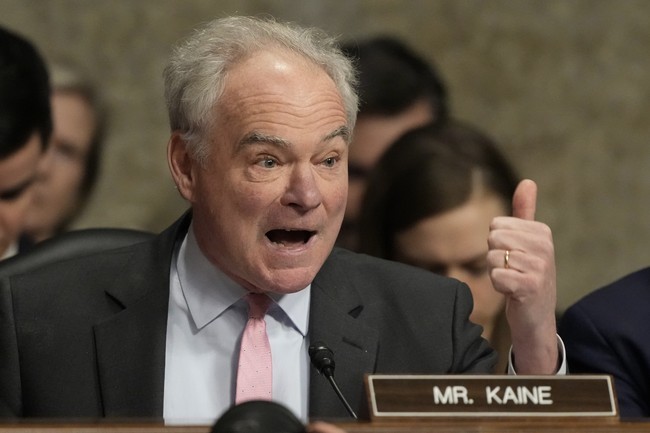
Sen. Tim Kaine has sent a sharply worded letter to President Trump questioning the legality of last year’s U.S. maritime strikes against narco-terrorist vessels and claiming some of the people killed were “murder victims.” This article examines Kaine’s allegations, the administration’s response, and the broader context of U.S. efforts to stop drug trafficking and protect American lives.
Tim Kaine is a well-known Democratic senator from Virginia and a former vice presidential nominee, and he has taken a prominent role questioning the Trump administration’s use of military force. In recent months Kaine has pushed for a War Powers Resolution aimed at limiting presidential authority after strikes the administration carried out beginning in late February. His scrutiny now focuses on maritime strikes in the Caribbean and Pacific, which the administration says targeted narco-terrorist activity.
According to Kaine, he reviewed a document described as an “execute order” that sets targeting criteria for those strikes and concluded some of the people struck were not involved in narcotrafficking. He wrote to the White House on August 3 and raised concerns that the targeting list is classified, limiting public oversight and congressional awareness of who was designated. That secrecy, Kaine argues, creates a real danger that civilians or uninvolved parties could be killed under orders they could not know were issued against them.
https://x.com/TeriChristoph/status/2080420767582327173
In his letter Kaine wrote, “You selected numerous organizations for targeting,” and he emphasized the classified nature of the list. He also warned that “the classification of the list means that those you have asked the Department of Defense to target are entirely unaware that they are marked for execution.” Those exact lines are central to his case and underscore why he insists on further review of the legal and operational basis for these strikes.
Some of those hit by the strikes, said Kaine, “are murder victims.” That blunt phrase has become the headline line for critics who say the government crossed a legal line. To press his point, Kaine referenced classified directives, a Department of Justice legal opinion, and various strike notifications, asserting that the U.S. has conducted “violent and fatal attacks against people far beyond those whom the OLC opinion claimed could be lawfully targeted.”
From the administration’s side, White House officials pushed back forcefully, arguing the strikes were aimed squarely at designated narcoterrorists trafficking deadly drugs into the United States. The White House response framed the operations as necessary actions to stem the flow of illegal narcotics and to protect American communities from poisoning and violence tied to cartel operations. Administration spokespeople made clear the president intends to continue using all available tools to stop drug smuggling into U.S. waters.
The political stakes are high because the debate is not just about individual strikes but about presidential war powers and how the U.S. defines and pursues threats outside conventional battlefields. Kaine’s letter links the maritime strikes to broader concerns about executive authority and seeks to involve Congress more directly in reviewing those decisions. That push aligns with his earlier efforts to pass a War Powers Resolution responding to U.S. actions in the Middle East and elsewhere.
Critics on the right argue Kaine is defending people who were actively engaged in maritime drug trafficking and who threatened American lives by pushing poison into U.S. communities. They say the strikes target members of organizations the U.S. has labeled narco-terrorists, groups that combine criminal activity with violent tactics and often operate in international waters to move massive quantities of drugs. From that perspective, the operations are defensive measures meant to stop a deadly flow of drugs before it reaches American shores.
Supporters of strong enforcement point out that U.S. authorities have long grappled with how to apply legal frameworks to nonstate actors at sea, especially when those actors are linked to transnational criminal networks. They stress that designations, legal opinions, and operational guidance exist to ensure that strikes focus on legitimate targets while minimizing civilian harm. Yet the tension remains between protecting classified operational details and providing Congress with enough information to exercise oversight.
The controversy also highlights the human cost on both sides: Americans harmed by narcotics trafficked across international waters, and individuals abroad who may have been killed in targeted operations. Kaine’s letter forces the country to grapple with how to weigh those costs within the rule of law and the Constitution. It also sets up a predictable clash between those who prioritize aggressive interdiction of drug networks and those who demand stricter congressional review of executive military actions.
As the exchange between Senator Kaine and the White House continues, the legal and political debate over maritime strikes and presidential authority is likely to intensify. Lawmakers on both sides will have to decide whether oversight procedures are adequate or whether new constraints or clearer rules are needed for operations that occur in international waters. The outcome will shape how future administrations handle transnational criminal threats that spill into American communities.
“You selected numerous organizations for targeting,” Kaine wrote, addressing Trump. “That target list is classified so I cannot reveal it.”
“Importantly, the classification of the list means that those you have asked the Department of Defense to target are entirely unaware that they are marked for execution,” he said.
‘MURDER VICTIMS’: Democratic Sen. Tim Kaine accuses the Pentagon of killing people uninvolved in narcotrafficking during the Trump administration’s boat strikes against alleged drug traffickers in international waters.
In a letter to President Donald Trump dated Aug. 3, Kaine wrote that his review of classified directives, a DOJ legal opinion and strike notifications “makes clear that the United States is engaged in violent and fatal attacks against people far beyond those whom the OLC opinion claimed could be lawfully targeted.”
The White House fired back, with spokesperson Anna Kelly saying all strikes “have been against designated narcoterrorists bringing deadly poison to our shores” and that Trump “will continue to use every element of American power to stop drugs from flooding into our country.”


That’s what being a lunatic leftist Globalist shill does when it reaches critical mass your leftist is now a totally bonkers madman detached from any sense of reality; look at that maniac in the photo!!!
No Maniac you are 100% WRONG! Do those evil devil kingpin Drug Cartel Terrorists bat an eyelash for any of the countless Americans they’ve directly had a hand in the deaths of or the countless families they’ve ruined!!! Not in a Million years; so this is the Reality Sponge Bob Boy!!!
“all strikes “have been against designated narcoterrorists bringing deadly poison to our shores” and that Trump “will continue to use every element of American power to stop drugs from flooding into our country.”
That’s the way it’s done and show ZERO mercy to any of that Scum, continue to blow them out of the water in the Caribbean or out of their shoes wherever they stand at any given moment Trump Administration!!!
BTW Kaine you Moron; you’re of the same party and was part of that evil Biden/Harris defunct auto-pen administration that pushed to the wall and beyond abortion on demand for anybody full term and even day after birth of absolutely 100% Innocent Human Babies! Guess what you A-Hole I think you screwed yourself for Eternity because go on and try to explain those ideas and agendas you pushed to God Almighty on your judgment day!
And here you have some psychotic nerve to be sympathizing for Drug Kingpins and Narco-Terrorists that got exactly what they deserved but you have the paradigm flipped completely ass backwards! Go figure its because you’ve been an ass the whole time you’ve been in politics!!!